Archbishop Gänswein Speaks Candidly on 3 Popes — and His Reconciliation With Francis
In an exclusive interview with EWTN News, Archbishop Georg Gänswein reflects on decades of service under Popes Benedict XVI, Francis and Leo XIV.

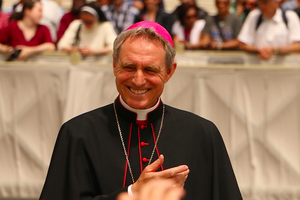
Archbishop Georg Gänswein, longtime personal secretary to Pope Benedict XVI and former Prefect of the Papal Household under Pope Francis, spoke June 13 with Rudolf Gehrig of EWTN News and CNA Deutsch, CNA’s German-language news partner, about his current diplomatic role as apostolic nuncio to Lithuania and his decades of experience in the Vatican.
In this excerpt from a wide-ranging interview, Archbishop Gänswein shared personal impressions and reflected on the path of mutual understanding that led to his reconciliation with Pope Francis. He also described the mood in Rome following the election of Pope Leo XIV and reaffirmed his dedication to preserving the legacy of Benedict XVI, calling it both a responsibility and a continuing pastoral mission.
Rudolf Gehrig (EWTN News): Archbishop Georg Gänswein, welcome to the EWTN Vatican studio here in Rome. … You’ve already had the chance to meet the new Pope a few times. What’s your first impression?
Archbishop Gänswein: My first impression is not from this week, but from the evening he was introduced at the Loggia of Benedictions — or rather, when he introduced himself. The first impression was surprising and very positive. Not only because he wore the stole and the mozetta again, but simply because of the way he presented himself. And the very first surprise was, of course, the Cardinal Protodeacon’s announcement of his name. That was the first sign of things to come and certainly surprised many people, others less so. I have to say, I wasn’t that surprised by his choice of name.
EWTN News: Did you already have any premonition that it would be Cardinal Prevost?
Archbishop Gänswein: Not at all. I must confess, I knew Father Prevost from the time of Pope Benedict’s pontificate. He was there twice — once when Pope Benedict visited the tomb of St. Augustine in Pavia in 2009, and once when a copy of Our Lady of Genazzano, the Madre del Buon Consiglio (Mother of Good Counsel), was dedicated in the gardens. This was done by Pope Benedict, and the General, Father Prevost, was also present. He was here until 2013, and then Pope Francis appointed him bishop in Peru. When he came back and started [at the Dicastery for the Bishops], that was at the beginning of January 2023, when my time was up.
EWTN News: Now today, June 13, it’s exactly 36 days since Pope Leo XIV stepped onto the loggia and introduced himself as the new Pope. You’ve been around for quite some time now and you know the Vatican from the inside. What are the biggest changes you’ve noticed?
Archbishop Gänswein: Already in Vilnius, I must say, I noticed a change in atmosphere. You know, atmosphere is always something that is very subjective, but it has a meaning. I came [to Rome] last Saturday and I noticed it here too. I used to live in Santa Marta, and as I mentioned, I know my way around here a bit. There’s an atmosphere here too, which is relieved. It’s a kind of pacified and open atmosphere. So I had the impression that the encounters were simply happy, cordial and also pacified from within, in a certain way.
EWTN News: So this is an atmosphere that can also be felt in the city of Rome when you come back here now — you can confirm that?
Archbishop Gänswein: Yes. Above all, I can confirm that all the nuncios in the world came … and they reported similar things completely independently of each other. So in this respect, it wasn’t a very subjective feeling, but something that was evident and tangible across different countries and continents.
Pope Francis
EWTN News: As Pope Benedict’s private secretary, you also experienced the papacy at close quarters. After that, you were also Prefect of the Papal Household for seven years under Pope Francis. Pope Francis passed away on April 21. Were you still able to say goodbye to him? After all, you shared a long time together.
Archbishop Gänswein: Yes, it wasn’t always easy. Not everything was as the press reported — that it was a big “falling out.” So that’s not true. There were certain difficulties, certain tensions, but they were already resolved in January 2024.
Why in January? I came to Rome on the first anniversary of Pope Benedict XVI’s death, on Dec. 31, 2023. The Mass was at the Altar of the Chair, and two days later I had a brief audience with Pope Francis together with the memores. And that was the moment of the relaxation process, so to speak.
The fact that I was subsequently appointed nuncio in the Baltic countries is certainly one of the fruits of this. But the important thing for me now is that I myself wanted to visit his [Francis’] tomb — and I was able to do that. I even met with the archpriest of St. Mary Major, who, incidentally, is a Lithuanian priest, Cardinal [Rolandas] Makrickas. He welcomed me, and I was also able to offer my prayers for Pope Francis at his tomb. That completed the reconciliation.
EWTN News: So you could part in peace?
Archbishop Gänswein: Yes. It wasn’t that we broke up in a fight and now he’s no longer [with us] and the reconciliation is too late. No, it wasn’t like that. I also had my first audience as nuncio last November, in 2024, and that was also very cordial. So [the meeting in] January 2024, then the appointment as nuncio in June 2024, and then the first audience as nuncio five months later — that was a three-step process that also brought me inner peace again.
EWTN News: But how surprised were you that this appointment as nuncio came a year ago, in June 2024? Because after all, you are kind of a “career changer.”
Archbishop Gänswein: That’s right. So for me, it was a big surprise. Obviously, the Holy Father spoke with his staff and then wanted to help me out of this situation that he himself had placed me in, so to speak. And with the help of the Holy Spirit, and with much human skill, this solution or this task came to me. Someone once told me: Never grasp after an office or drag it by the hair, but if an office presents itself, take it by the scruff of the neck. In other words, I didn’t apply for a position myself — it came to me from the Vatican.
EWTN News: But is there also pastoral care involved in your ministry? You are still an archbishop, a priest. So do you still have contact with the “normal” faithful?
Archbishop Gänswein: I seek out contact. An ambassador, a nuncio, is a pastor in what he does, even in dealings with other colleagues. He remains a priest, a bishop, as he must. I also notice that in many people. We [ambassadors] are not only Catholic; there are also non-Christians. It is important that in each encounter with the person, something really comes across of goodness or of what characterizes Christianity.
Pope Benedict XVI
EWTN News: But how are you perceived by people? I mean as the “face of Pope Benedict’s companion” and someone who also served for a long time in the Vatican under Pope Francis, you must be relatively well known.
Archbishop Gänswein: It’s an advantage — especially my time as Pope Benedict’s secretary. I was [his secretary] not only during the time he was active, but also until the very last breath of his life. That was 20 years, which certainly leaves a mark.
EWTN News: Then my last question. Now we’ve talked a lot about your new work, only to come back to Benedict at the end. Does it actually annoy you that you will probably always be reduced to the private secretary of this great pope for the rest of your life?
Archbishop Gänswein: No, it’s a reality — one that shaped my life for a long time and gave it a different direction. You can’t plan that. And if God has given me this task, then I have gladly accepted it.
Benedict is no longer among us as he was among us physically. He is among us in a different way, but we must not let this great gift, his legacy, go to waste. That is one of my goals in life — that I help, as much as I can and wherever I can, to lift up this treasure. It doesn’t annoy me in any way.
People I don’t know talk to me as if we’re still in Benedict’s time, so to speak. It’s endearing. Of course, it’s also a bit challenging at times. It requires patience. But it’s a form of pastoral care — and this must be accepted. I’ve accepted it, and I’m happy to continue along this path.