US Ambassador to the Vatican on the Failed Maduro Off-Ramp, the First American Pope, and This ‘Catholic Moment’
Full text of an exclusive interview with the ambassador to the Holy See
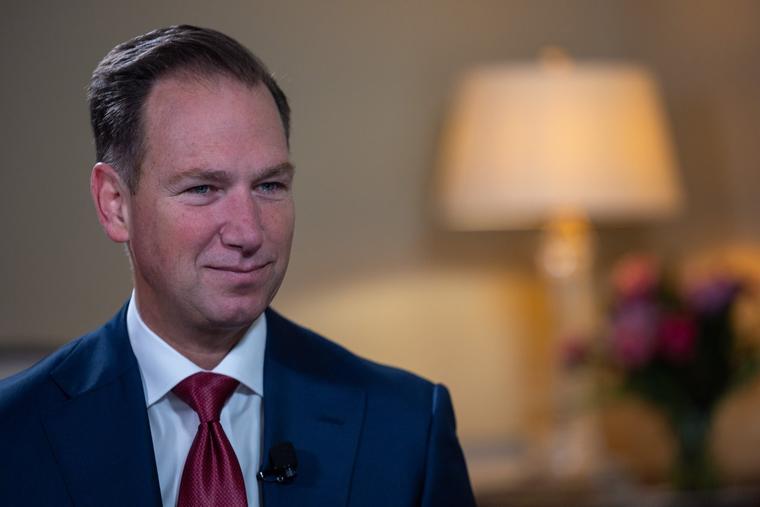
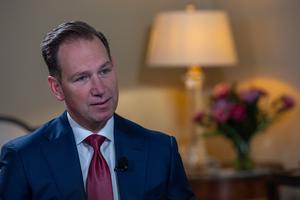
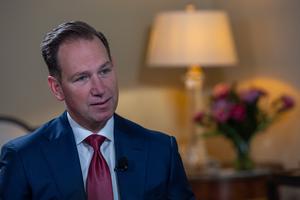
Editor’s Note: EWTN News In Depth correspondent Colm Flynn sat down with U.S. Ambassador to the Holy See Brian Burch to discuss the shifting landscape of U.S.-Vatican diplomacy. In this exclusive interview, Ambassador Burch, who is co-founder of CatholicVote, confirms his role in the high-stakes Christmas Eve negotiations at the Vatican intended to provide a diplomatic off-ramp for Nicolás Maduro prior to U.S. military action in Venezuela. Burch also reflects on the “Catholic moment” in Washington and his personal journey as a cradle Catholic.
The following transcript has been edited for length and clarity. The full interview airs on EWTN News In Depth this Friday at 8 p.m. ET.
Ambassador Brian Burch, it’s a pleasure to meet you, and thank you so much for doing this interview.
Great to be with you here in Rome.
When you were first appointed to the position, I remember the talk of the town here in Rome. And normally when there’s an ambassadorial appointee, people don’t pay too much attention. But when Brian Burch was coming, on one hand, there were people who were saying, “This is fantastic. He’s a great Catholic. He’s already done so much for the cause.” And then on the other hand, they were saying, “Oh, no, Brian Birch is coming. He’s a far-right activist in a highly politicized and polarized world in the U.S. and in America, the Catholic Church.” Were you aware of that reaction? And what was it like coming into that?
Yes, of course. You look at Twitter a little bit and [I] saw some of the comments. I think the most important thing was I was the choice of the president. I was honored and privileged to accept the nomination, and then I had to get ready to get confirmed. I know some of the noise here in Rome, you paid a little bit of attention to, but I also understood that I was walking into a position that was bigger than me. There was a relationship between the Holy See and the Vatican that had gone back since 1984, and people from both political parties from different sides of the political spectrum had served in this role. As I got more comfortable recognizing that the Holy See, to the extent it can, typically rises above some of that noise ... it turned out that’s exactly what happened. I’ve been very welcomed here.
Why do you think you were picked?
Political appointees, they’re different than career ambassadors. Most countries use ambassadors who serve a lifetime as a diplomat. In the United States, we are chosen by the president. We serve at the pleasure of the president. I think one of the things the president said to me when he called me was that he was very proud of what we had done during the campaign; representing him, helping to synthesize his policy agenda, what he campaigned on, and to make it relevant and important for Catholics. I think that job we did, he won the largest margin among the Catholic vote in over 40 years. I think he saw that we had the ability to relate what he intended to do as president to Catholics, both in the United States and around the world.
I mentioned some of the atmosphere around Rome when people were talking about your appointment. But from within the Vatican, when you did arrive, how were you received by the various cardinals, by the other diplomats around the Vatican, by the Pope himself?
It was unbelievably gracious. [I was] a little bit nervous walking into the Apostolic Palace for the first time. You walk down the hallway, you’re going to meet this Pope who is just the first Pope from America — and the pageantry, the Swiss Guard, the unbelievable history, the tradition. And then I got to sit down with him, and he says “Hello” in a Chicago accent, and we start talking about common things that we remember from home. From the Pope to the leadership in the Vatican, it’s been nothing but warm and gracious.
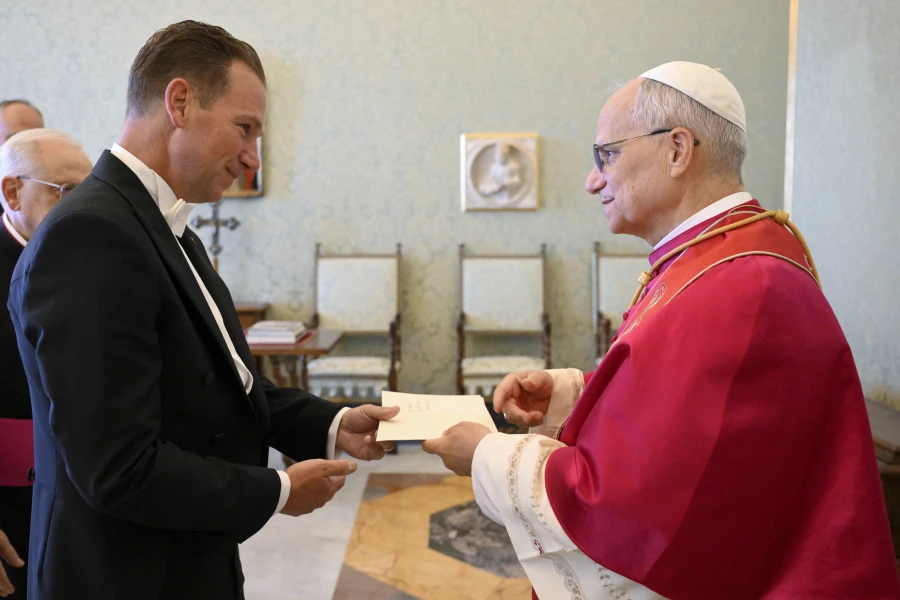
This papacy, of course, is still being defined in many different ways. I think so is my relationship as the ambassador with those that I work with. I think, again, you step into this role as a steward of a great tradition and relationship. It’s not something that you just make up from scratch.
You mentioned, Ambassador, that, of course, this papacy is still being defined. We’re not even a year in. But what are the characteristics you think, so far, that are defining Pope Leo and his papacy?
I think back to when he first came out on the balcony: “Peace be with you.” This is a Pope deeply committed to, I think, healing a lot of the divisions in the Church, and that speaks to me certainly as a diplomat. Part of my job here is to build consensus, to help the Holy See to understand the policies and aims of the administration, and to build bridges between the two sovereign states. I think this papacy is also very much marked by a deep, reflective Pope who wants to understand the challenge of our modern age, whether it be AI, whether it be the polarization that’s occurring, or some of the social disintegration that’s occurred as a result of a loss of faith or a loneliness and people searching again for real answers to what it means to be human, what it means to live a fulfilled life. This is what the Church brings to the world. And this is a Pope, I think, who really wants to heal some of the things that I think our modern world is struggling with.
I was talking to someone the other day, and they were American, and they said to me, “Colm, I think the Vatican is anti-America.” And they went through a few different elements to back that up. They said, “Look at the fact that we have our first American Pope, but President Trump and the Pope have not met yet.” I don’t think, to the best of my knowledge, they’ve even spoken on the phone. The Vatican, before it confirmed what countries the Pope would be visiting, it confirmed a country it would not be visiting this year, the United States. In his first interview, when he was asked about his brother’s political views, his brother has said that he’s a MAGA supporter, went to the White House. The Pope said, “Well, we would have differing political views there.” Also, the Vatican said they didn’t want to join President Trump’s Peace Board. When you look at all of that together, is it a fair assessment that the Vatican might be anti-America?
No, it’s not at all. I think, again, the common things that the Vatican and the Holy See in the United States share go much beyond the political framing that I think a lot of people want to interpret. I will say from the first days that I began working, I remember a comment one of the highest-ranking cardinals said to me. He said, “When we deal with a lot of these difficult issues, often we don’t always know what the answers are. One of the things we often come back to is we need to talk to the United States.” It’s not because we have the perfect answer to every question, but it’s because we share this Western civilizational idea that we inherited, again, as the secretary recently said, from Europe, but also that the Holy See, United States share this common bond about truth and justice and human dignity and fundamental understanding of freedom. These are perennial things that transcend the politics. I know it’s easy to politicize, “Well, they didn’t join the Board of Peace,” and there are reasons for that, or he may have made a comment about the United States. I think this Pope in particular is going to be very careful to not come across as an American who’s meddling in politics. And, in fact, he said that directly to me when I met him.
Is that going to be one of the great challenges for Pope Leo, in that no matter what he says on any issue, it will always be seen through the prism of what the U.S. administration is doing at that current time in that area?
This Pope, he said to me when I first met him, “I don’t want to be seen as an American who’s trying to meddle in the domestic political fights in the United States.” He said, “I’m not an American Pope. I’m a Pope from America for the world.”
What else did you talk about when you sat down with him in the Apostolic Palace?
We talked about the chocolate cake that I gave him for his 70th birthday. We talked about Chicago. We talked about people that I knew that knew him as Father Bob, the substitute physics teacher at a high school. We talked about the South Side of Chicago, where he came from. Then we talked about a lot of the issues. We talked about this new administration that had come in, some of my hopes and some of my belief that the administration really does represent a way of synthesizing Catholic social teaching and the idea of the need to prioritize the working class in the United States, to prioritize the need to be proud of our country once again, to recover some of those Western civilizational ideas that made our country great. Again, he was exceptionally gracious. I think he has a deep love for the country that he was born in, but he also recognizes that God has called him to be something greater in his life; and that he is now, as I said, a Pope for more than just the United States, but for the world.
Is there a reason, Ambassador, that he and President Trump have not met yet or spoken on the phone?
No, I think he’s going to meet the president at some point. He was considering, I think, coming this year; the United Nations has invited him to speak. He had considered a visit and then decided to push it off — probably till next year, is what we anticipate.
Was there a reason that the trip didn’t go ahead this year?
No. I know he has considered visits to a lot of places. Just this week, I know he formally announced a trip to Africa, to Spain, and a couple of other places.
Monaco as well.
Exactly.
I think there are lots of considerations. There’s the logistics. There’s the fact of going back to the U.S. It will undoubtedly be one of the biggest trips he makes as the Pope. I think there’s also the consideration of whether or not it would look like he was attempting to influence the midterm elections and some of the politics around that. The Vatican makes its own decisions, and I think we know he wants to come. We’ve talked a bit about that, and I think, at the right time, he will.
So far, I think, is it once you’ve met him, or how many occasions?
I spent about 45 minutes with him when I presented my credentials. That was the longest meeting.
Did any controversial issues come up? For example, the U.S. and immigration?
A bit. We weren’t shy about saying we knew some of these issues would be potential sources of conflict. And it was mostly us getting to know each other and how we would try to talk through some of this. The first meeting is one of courtesy and cordiality and graciousness. It wasn’t hostile in any way.
That’s something that many Catholics have been looking at as well: how to understand in their mind, of course, the United States and the administration and the right to protect the borders in their country and deport people who are there illegally in a humane way, as Pope Leo has called for, with humanity and dignity. But then on the other hand, when they see what had happened in Minnesota with that terrible tragedy, and they wonder, is the administration going too far? They’re listening to the Pope, who seems to share the same concern. As a Catholic yourself, how do you marry the two? Or when you see what is happening with ICE, how does it make you feel?
Well, certainly seeing the events in Minnesota from afar over here, it was terrible. The larger question of immigration is something that will constantly be a source of debate and conversation between the U.S. and the Holy See. I think the thing that frustrated me is there were a lot of accusations that somehow this was borne out of some xenophobia or hate, when I know this administration, this president, is deeply committed to protecting the safety and security of our country. This was what he was elected on. I think this is what people expected him to do. We lived four years of chaos, where our border was overrun, where migrants were exploited, where people were coming into our country unaccounted for, where children were lost throughout our country. And the president said, “Enough.” He had the courage to do something very difficult. I think people, I think, sometimes, underestimate the difficulty of unwinding the chaos that had occurred. Now, as Catholics, of course, we believe that all humans have dignity. They deserve respect, and certainly in the administration of the law, including in the deportation process, that we have to do so in a way that respects that dignity.
I think that’s where the debate is occurring. I’ve worked here on that process, on making sure that deportees have access to spiritual leadership. We have made sure that they have access to the sacraments. We’ve talked about the process. I’ve to explain to the Vatican how our deportation process is working. These are never easy questions because you’re trying to unwind a terrible situation. The fact that there were terrible things that happened, we should all have regret and remorse and recognize this is not how it’s supposed to work. Law enforcement should be able to do its job without being impeded, without there being violence, and that the way that we went about this should be done in a way that would respect the dignity of those that have broken our law that need to return home.
Let me ask you about another huge story, which now we know the Vatican was involved, talking about Venezuela and the removal of Nicolás Maduro. The Washington Post reported that the Vatican, working with the United States and other countries, possibly, was trying to organize some escape passage from Maduro into another country.
Well, right. The Washington Post did report a story that, on Christmas Eve, I was here with my family and got a call and ended up in the Vatican in a meeting where we were discussing this.
Who calls you on Christmas Eve from the Vatican?
My staff, who gets a call from the staff at the Vatican, who says Cardinal Parolin would like to see you.
And we did discuss this, and I was at the Apostolic Palace talking about this question. Certainly, our country at the time was looking at trying to resolve the problem of a narco-terrorist who had cheated in his election, who had basically, was illegally controlling his country. Secretary [Marco] Rubio and the State Department was working to try to find a peaceful way for Maduro to leave. The Vatican conversations that I had were just one piece of a much larger effort on the part of the United States government to try to find a way to not have to use the military to solve this.
What was it, Ambassador? What was Plan B? I know it was reported, possibly go to Russia.
Yeah, I’m not going to get into a lot of the details.
I think the Vatican wanted to try to find a peaceful resolution to this. There were lots of options, as I understand it, that were presented to Maduro. Secretary Rubio and others were negotiating with different countries to try to find a way to peacefully resolve this. Regrettably, Maduro did not accept any of the offers. He was resistant and thus forced the hand of the U.S. government to go in and enforce the law to remove this narco-terrorist and put him into the justice system, where he will soon have his day in court.
It’s fascinating when you see the soft power that the Vatican has all across the world. And I was struck when I read his first interview, he was talking about Ukraine. And before that, under Pope Francis, they had always said, “Look, we will be a meeting place, a mediator between Russia and Ukraine. They can even have talks here at the Vatican.” Whereas Pope Leo this time said, “I think it’s probably unrealistic that we will be a mediator between the two, but we can use our voice to advocate for peace.” How much power does the Vatican have, geopolitically around the world, to influence situations and conflicts?
It’s a great question because it can often be assumed that the Vatican is just the Church. It’s just St. Peter’s. It’s just the Pope who does these Angeluses and Masses. And, of course, the Vatican is also the sovereign state of the Holy See, which is who I interact with, the sovereign entity. I don’t deal in the ecclesial affairs of the Church. I think it’s fair to say that the Vatican, the Holy See, has significant influence in the world. Let’s remember, the Holy Father speaks every Wednesday in an audience and every Sunday during his Angelus to 1.6 billion people. What other entity has that power? What was it? Thirty million or so pilgrims came last year during the Jubilee. What other place attracts that size and scope of people? Then, of course, you have the Church. You have cardinals, bishops, priests, parishes. You have people everywhere in every corner of the globe that are involved, that are engaged in the work of the faith. That reach of the Church has enormous power.
The voice of the Vatican and the Holy Father may be heard. Is it respected? I think of when he condemns Russia for attacks; even when he says he’s concerned about the treatment of migrants in the United States; or around the time of the capture of Maduro in Venezuela, he said, “Look, we have to respect the sovereignty of countries.” When he says things like that, do world leaders sit up, and does it make them listen and think twice?
Oh, I think so. I think the moral authority of the Church is unmatched: the deep tradition of the Church, the social teaching of the Church, the tradition of the Church, the history of the Church, the papacy. There’s a reason why, when we elect a pope, the entire world tunes in to figure out what’s happening, right? The other piece that I think you point to that’s important is, behind all of these foreign-policy conflicts are always really important moral questions, that it’s not just a transactional power game that’s occurring that involves economics or involves military might. There’s a moral question of justice. I think this is where the Holy See really helps to shape these debates, that is, what is the right thing to do? What responsibilities do nations have? Where are there injustices and mistakes that need to be resolved through diplomacy or, ultimately, at times, through military force? The Holy See is that voice in the world. There’s nothing that even comes close to the role of the Church, and that’s why the United States has a diplomatic relationship. That’s why my days are filled with meetings at the Vatican and working with other ambassadors to try to elevate that conversation in a way that helps to address these problems.
You mentioned Secretary Marco Rubio there, Catholic; Vice President JD Vance, strong Catholic. You’ve said before that you felt this was something like a Catholic moment, I think was the phrase. What did you mean by that?
Well, you look at the world; and we know as Catholics, we have the question, to whom shall we go? We know that answer is Christ as people of faith. But we also have practical questions that we have to resolve, certainly in my role as the ambassador. I look at what’s happening in the United States, and I see our American political system undergoing a change, people trying to find answers to deeper questions about human life, what makes you happy. I think the Church, of course, has proposals for those answers. But in the context of the practical reality of foreign policy and domestic policy, I think there is real synthesis occurring between where our politics is headed and where the answers the Church proposes for the world, whether it be the foundational role of the family, whether it be the fundamental dignity of the human person, fundamental human rights, whether it be speech, whether it be freedom of religion, whether it be the desire for people to live out their faith in every aspect [are]. People, I think, see the Church not only as a spiritual leader, but someone who has a rich tradition of answers. Now we have an administration that I think really understands how to synthesize a difficult political situation that corresponds to some of the answers the Church has proposed.
You mentioned all those places where they’re on the same page. Are there points you’ve seen so far where they differ?
Oh, of course. There are areas of prudential judgment where we may agree on the end but disagree on the means. That’s certainly the case. That’s the case in a lot of different political questions. But I think on the fundamental questions, certainly the protection of life, the importance of the family, the right of parents to direct the education of their children, the need to advance peace and justice around the world, there’s no disagreement between the Vatican and the United States.
You yourself, ambassador, you are from Phoenix, Arizona. I was telling you before we went on air that I’m from Ennis, County Clare. My little hometown is twinned with Phoenix. When we were growing up in school, from primary school, elementary, first place in the U.S. we knew existed was a great Phoenix, Arizona. I’ll never forget that. Was Catholic faith always important to you growing up?
Absolutely. I was raised cradle Catholic. My grandmother was a wonderful Catholic model for me. A daily Massgoer, said her Rosary every day. I was blessed with the faith from the beginning. Phoenix is one of the fastest-growing dioceses, as you know. I think projections are, over the next several decades, it may be larger than some of the biggest dioceses, New York or Chicago. Obviously, a large Hispanic population, many Catholics there. It’s a place that’s vibrant, full of young families, wonderful faith, and I still have many family members that live there.
What were your ambitions then as a young person? What did you want to be when you grew up? What did you want to do?
I always liked politics. It’s probably no secret I ended up doing what I did. I remember I worked for the governor. I worked for the United States Sen. John Kyl at the time. I always liked political debates. I was probably more of a troublemaker sometimes, getting involved in debates and things and clubs at schools. I remember I went to Boys State, for example, in high school.
Being a provocateur.
Yes. Now I’m a provocateur of a different sense, hopefully in a better way. But I always enjoy the public debate around politics and issues, and certainly —
But has that been difficult for you, to go from someone who was a bit of a provocateur, and even your work at CatholicVote, you’ve got to have these sharp articles, sharp headlines that grab attention, that get people watching to make your points in a sharp, clever way; whereas now, I guess you have to rein that in a bit. You’re a diplomat.
You do, but it doesn’t mean you check your beliefs or your principles at the door. I think what you have to do is to build relationships. I think diplomacy is really built on deep friendships and relationships so that you can communicate both to the bilateral country that you serve or to your fellow diplomats in a way that they respect you, they take you seriously, and that you can speak honestly to each other in a way that can hopefully drive towards solutions. The Church talks about this, the need for dialogue. Well, it’s not dialogue for the sake of dialogue. It’s dialogue for the sake of getting to the substantive answers and resolutions that we all want. And you can’t do that if you don’t have a relationship.
Has it forced you to have relationships and dialogue with people maybe in the past you would probably have no reason to interact with?
No. People that really know me, you have the public persona of the MAGA Catholic or the provocateur. The people that really know me understand I enjoy being —
When you hear that, MAGA Catholic, you’re smiling now. What do you think when you hear that?
Well, I’m proud of it. I’m proud to have worked to elect this president. I’m proud to have represented what I think was a very important point, inflection point in our country. I think sometimes the noise in the media can color that a bit. But I think to be a Catholic and to be an American, there’s no shame or there’s no apology. There’s no, well, I was this, and now I’m this. No, I’ll always be who I am. But the thing that I guess I was pointing to is you can talk to partisans left and right in the Church. They will tell you, I’ve always made an effort to have a relationship with them, even when we disagree. And you’d be surprised, actually, of some of the relationships I maintain, including people who are entirely on the opposite side of our politics that I still talk to regularly.
Nine children?
Yes, nine children. I married above my pay grade.
Last count, nine children. And how many of them are over here in Rome with you?
We have four children living over here in Rome; and my daughter, who is working here in Rome, who’s helping with the kids when she can. And then we have four back home, both at the University of Dallas, as well as living in Phoenix and working.
You mentioned that when you were growing up, you wanted to get involved in politics. And now when we fast-forward and see where you are today, this appointment is incredible politically. But for you personally as a Catholic, as someone who has always held the faith so dear, you’re here now working with the Pope, with the Vatican. What does it mean for you personally?
Well, there’s a joke that this is the only U.S. government position that pays you to go to Mass. There’s something really rich and beautiful about being in a job that mixes rich spiritual experience as well as diplomatic role that you serve as the ambassador. I think for me, I never thought I would end up in this position. Even shortly after the election, I never really thought seriously about this until a set of circumstances emerged, and I recognized I had the opportunity to do this. The question is, for all of us, why has God put you here? What gifts has he given you that you’re now supposed to act on and to live out, and then what this will mean for me in the years ahead. My life changed dramatically in the last year, and now here I am in this role. I look at it as I’m along for the ride. God is the driver, and I’m just trying to keep up.
Ambassador Brian Birch, it’s a pleasure talking to you, and thank you.
Thank you very much, Colm.
- Keywords:
- brian burch
- 'pope leo xiv'
- maduro's regime

Colm Flynn Colm Flynn serves as Vatican correspondent for EWTN News.