Activist Fighting for the Ones We'll Never Know
Deirdre McQuade became a pro-life activist in her teens.
That's when she first missed some days of high school to attend the March for Life in Washington, D.C., and later started the first Students for Life group at Bryn Mawr College in Pennsylvania. Now, after serving as national program director for Feminists for Life, she has been named the new director of planning and information at the U.S. Bishops’ Secretariat for Pro-Life Activities, succeeding Cathy Cleaver Ruse.
She spoke to Register staff writer Tim Drake from her office in Washington.
Tell me about yourself.
I was born in New York City, but grew up in northern New Jersey. My parents met at the New York World's Fair and have been married for 38 years. I have one younger sister who is married with two daughters. In the past year, they all moved to Virginia, so we will be able to see more of each other now. I'm really looking forward to that.
My father is retired and has a new part-time career in real estate, but most of my life he was a route salesman for Entenmann's cakes. My mother spent many years working hard raising us. Her educational background is in design. During our high school and college years she worked for a textbook publishing company. Their daily commitment to Christ shows in everything they do — from leading prayer meetings and selling houses to caring for their grandchildren.
Did you grow up Catholic?
Yes, I'm a cradle Catholic. I received my first Communion, made my first confession, and was confirmed at St. Virgil's Church in Morris Plains, N.J. Church was a real hub of activity for my family. I attended public elementary school and a private high school. After graduating from Bryn Mawr, I went to Notre Dame for graduate studies in philosophy and theology.
From junior high onward, I've been involved in weekly Christian fellowship — Bible studies, prayer groups and service projects. Being able to pray and have fellowship with other Christians is a tremendous gift.
Last year, I worked for The Vine, an amazing ecumenical non-profit that builds relationships among diverse believers for greater unity in the body of Christ and for cultural renewal. There, my distinct Catholic perspective was welcomed and valued, and through prayer, conversation and recreation with fellow Christians, my own love of God was enriched. It will be a joy to see how the Holy Spirit blesses the world through many friendships started there.
Did you have any early experiences that attracted you to the pro-life movement?
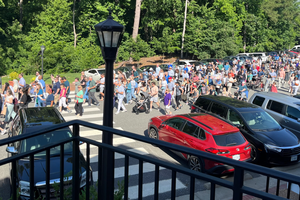
During high school, our youth group traveled by bus to the March for Life. I remember some classmates asking, “Why go? You'll get frostbite.” I was going because the group was going. I didn't have a very developed philosophical sense of why it seemed important to be pro-life, but rather thought it was important to stand up for women and the unborn. At the marches, I got outside my local context. It put a face on the pro-life movement for me. I was struck by the size and diversity of the crowd and the many different ways that people stood up for life.
At Bryn Mawr College, my sister and I helped start a pro-life group that continues today. We felt it was important to say that the National Organization of Women does not represent every woman on this issue. We developed ways to address the issue at a traditionally feminist women's campus.
Do you have any immediate plans?
I've dedicated the office to Our Lady of Guadalupe. Her picture hangs on the wall overlooking the television set where I watch the news. I entrust my work to her care and intercession.
I have also been so bold as to entrust all the abortionists and abortion advocates to her as well, knowing that nothing is impossible with God. I pray that they would have the courage to face what they are doing and change their ways that they might be powerful witnesses in defense of life rather than its destruction.
What are the secretariat's current projects?
Our main focus is on educating people about the Roe v. Wade decision and its implications. There is a deep misunderstanding that the Roe decision legalized abortion only through the first three months. It has to be understood that, paired with its companion case, Doe v. Bolton, Roe opened the floodgates so that abortion on demand is legal at any time throughout pregnancy. Many people aren't aware of that.
Our “Roe Reality Checks” examine basic myths and misconceptions about Roe and answer them with basic facts about the decision. Many legal experts have said it employed a faulty mode of legal interpretation, simply asserting a new right not found anywhere in the Constitution.
If Roe were overturned, it would place the decision-making capacity back to the states, into the hands of the state legislators and their voting constituents rather than in the hands of nine people on the Supreme Court. So, even if Roe were overturned, our pro-life work would not be over.
In addition to our focus on Roe, embryonic stem-cell research and cloning are very much on our radar screen.
Recent studies seem to suggest that especially among the young, more and more are embracing a pro-life stance. Do you think we are turning a corner on the issue in this country?
This generation has not lived a day without abortion. They aren't protesting a change they've seen in their lifetime. They are standing up for life, I believe, because in their lived experience, they see how impoverished their world is. They're sitting in classrooms that should have more classmates in them. Some are aware of siblings or cousins who have been aborted.
This is a deep wound.
A pro-life speaker I know reports that students often come up to her weeping, saying that they know their mother had one or more abortions in college.
They are grieving the loss of someone they never got to know. They may even feel insecure about their own status: Was I wanted or was I a “mistake,” too? These wounds are present in our culture, but not recognized. The young see that Roe is the law of the land, but many are challenging this status quo, saying we can do so much better than abortion. I believe that if we equip them well, they will help build a world where every life is valued.
Tim Drake is based in St. Joseph, Minnesota.
- Keywords:
- October 16-22, 2005