US Sacred Heart Consecration Carries Echoes of French History
Despite the failure by France’s monarchy to fulfill Jesus’ request to consecrate the country, dedication to his Sacred Heart remains alive in the hearts of its people.
More than a century before the French Revolution, Visitation Sister Margaret Mary Alacoque wrote to the then-reigning “Sun King” Louis XIV, telling him Jesus had requested that he consecrate France to his Sacred Heart.
Centuries later, on June 11, the United States will be consecrated to the Sacred Heart of Jesus, fulfilling what France’s monarchs had failed to achieve at the behest of the French saint. The consecration will take place just weeks ahead of the 250th anniversary of American independence, hard won by a revolution which, in turn, inspired France to follow suit over a decade later. Ironically, this Reign of Terror claimed the life of Louis XVI who, prior to his execution, had planned to consecrate France to the Sacred Heart, fulfilling the request first made to his predecessor.
A Divine Request
Upon receiving the directive from Jesus for the king to consecrate France to the Sacred Heart, St. Margaret Mary explained the mission to her superior, writing:
“He (the Sacred Heart) desires, it seems to me, to enter with pomp and magnificence into the palaces of kings and princes, therein to be honored as much as He has been despised, humiliated, and outraged in His Passion.”
With this consecration, she continued: “Make known to the eldest son of my heart that as his temporal birth was obtained through devotion to the merits of my holy childhood, in the same manner he will obtain his birth of grace and eternal glory by the consecration that he will make of himself to my adorable heart, which wishes to triumph over those of the great ones of the world. It wishes to reign in his palace, to be painted on his standards and engraved on his arms, in order to render him victorious over all his enemies,” namely (according to another translation), “all the enemies of the Holy Church.”
Although several attempts were made to get St. Margaret Mary’s message to Louis XIV through channels close to him and the court, history remains unclear whether or not he did receive it, ignored it or dismissed it. Even though he was known to favor consecrations — his birth was considered miraculous because his mother Anne of Austria conceived late in life — the consecration of France to the Sacred Heart didn’t take place under his rule.
A Vow Foiled by Revolution
Louis XIV’s descendent, King Louis XVI, is said to have made a private consecration to the Sacred Heart, but with his beloved country in the hands of revolutionaries, he would be executed before he could publically consecrate the nation.
Deeply repentant over his failure to consecrate France to the Sacred Heart, Louis XVI, while awaiting his execution, wrote about the consecration he planned in a letter discovered in his residence years later. His anguish comes through in the opening:
“You see, O my God! all the wounds which tear my heart, and the depth of the abyss into which I have fallen. Evils without number surround me on all sides. My personal misfortunes and those of my family, which are dreadful, overwhelm my heart, as well as those which cover the face of the kingdom…”
In Histoire du Sacré Coeur (History of the Sacred Heart), Alain Denizot describes how Louis XVI dedicated not only himself but his family and entire kingdom to the Sacred Heart of Jesus. He acknowledged his weaknesses and “appealed to the ‘Divine Redeemer,’ the ‘Heart of Mary,’ and the ‘assistance of St. Louis.’”
Louis’ vow was contingent on regaining his freedom, Denizot writes. Once back on the throne, he would revoke the Civil Constitution of the Clergy and establish “a solemn feast in honor of the Sacred Heart of Jesus, which will be celebrated in perpetuity throughout France, on the first Friday after the octave of Corpus Christi, in reparation for the outrages and profanations committed during the time of unrest.”
He also promised to build a church, chapel, or altar “dedicated to the Sacred Heart of Jesus,” and “consecrate himself, his family, and kingdom, promising to give all his subjects ‘the example of the worship and devotion due to this adorable Heart,’ and to renew this vow every year on the feast day of the Sacred Heart.”
Louis XVI promised a great revival of devotions to honor the Sacred Heart of Jesus. He then privately consecrated France to the Sacred Heart:
“O Heart of Jesus, we offer you our entire country and the hearts of all your children.”
All this was contingent on his regaining his freedom, which, of course, he never did. He was guillotined in January 1793. When his wife, Marie Antoinette, underwent the same fate later that year, it marked the end of the royal dynasty of France.
Hope for France
Looking back, Louis XVI’s act concerning the consecration did not go totally unacknowledged and unanswered, as devotion to the Sacred Heart remained alive in France after his execution.
For example, the Catholics in the Vendée War wore Sacred Heart badges on their clothing. Various military officers performed consecrations to the Sacred Heart during the 1870-71 Franco-Prussian War.
During this time, there came promises to build churches to the Sacred Heart. In his history, Alain Denizot recounted that in 1871, Bishop Félix Fournier of Nantes promised to build a church to the Sacred Heart if the city and the diocese escaped the invasion during the Franco-Prussian war. Before that, on Dec. 8, 1870, “two Parisians exiled in Poitiers, Alexandre Legentil and his brother-in-law Hubert Rohault de Fleury, made a vow to have a church dedicated to the Sacred Heart erected in Paris.” Legentil was “put in contact with Father Ramière, director of the Messenger of the Sacred Heart of Jesus, and in January 1871 he launched the idea that would become the National Wish.”
Archbishop Joseph Hippolyte Guibert of Paris approved, then in 1873, asked the government “that a temple, erected to recall divine protection over France and particularly over the Capital, be placed in a place overlooking Paris and that can be seen from all points of the city.”
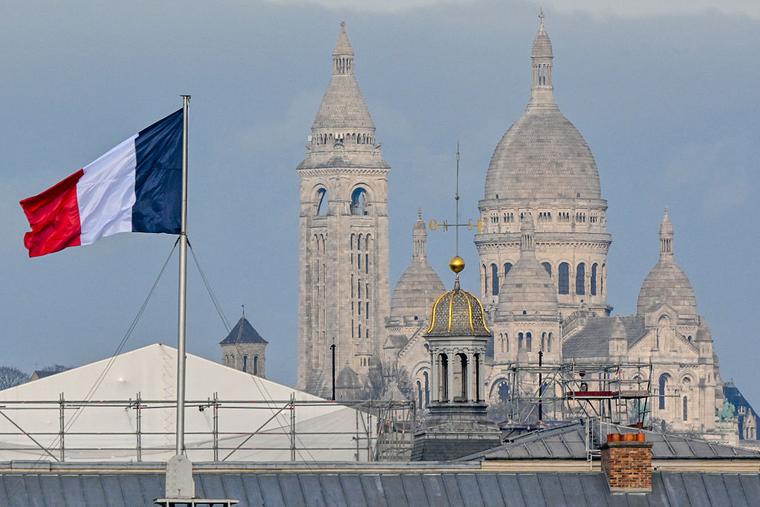
Despite the prevailing anti-religious sentiment in France, the magnificent Basilica of the Sacred Heart on Montmartre — the place where St. Denis, patron saint of Paris, was martyred — began in 1875. It was completed in 1914 and consecrated five years later.
“I will reign in spite of all who oppose Me,” St. Margaret Mary reported Our Lord telling her. This promise echoed in the magnificent Sacred Heart Basilica high on Montmartre, visible from many parts of the city, in a location with a sweeping view of Paris. Most especially, Christ reigns in the Holy Eucharist, where people come 24 hours a day to worship in the basilica, where there has been perpetual adoration since 1885. The Sacred Heart reigns there triumphant, as if to bring Louis XVI’s vow to completion.
- Keywords:
- sacred heart of jesus