Unequally Yoked But Abounding In Hope
In time for the Nov. 17 feast of St. Elizabeth of Hungary — patron of those antagonized for their devotion to Christ and the Church — suggestions on what to do when your spouse doesn’t share your zeal for the Catholic faith. By Joseph Pronechen.

Do not be yoked with those who are different, with unbelievers.”
When St. Paul issued that warning to members of the Church at Corinth, he wasn’t speaking specifically about marriage. His primary concern was a clique of Christians who mistakenly saw their faith as compatible with paganism. (The “yoke” metaphor recalled the crosspiece that binds a team of oxen together at the head so they can work side by side as they pull their plow.)
But that Scripture, 2 Corinthians 6:14, is often used as advice for dating and engaged couples anyway — and for good reason.
When offered charitably and in proper context, it’s usually wise advice. It can apply not only when a Catholic is thinking about marrying a non-Catholic, but also when a deeply devoted Catholic seems headed for the altar with a lukewarm or fallen-away one. Not to mention an agnostic, an atheist or anyone else who expresses open disdain or hostility toward the Catholic faith.
“Differences about faith and the very notion of marriage, but also different religious mentalities, can become sources of tension in marriage, especially as regards the education of children,” the Catechism reminds us in No. 1634. “The temptation to religious indifference can then arise.”
“Differences about faith and the very notion of marriage, but also different religious mentalities, can become sources of tension in marriage, especially as regards the education of children,” the Catechism reminds us in No. 1634. “The temptation to religious indifference can then arise.”
Of course, this imbalance can also arise in unpredictable ways — as when a spouse who was once filled with zeal for Christ and his Church gradually, for whatever reason, turns against the faith.
St. Elizabeth of Hungary could have related, albeit in a roundabout way.
Niece of St. Hedwig and great-aunt of St. Elizabeth of Portugal, whose own monarch husband harassed her about her spiritual practices before his “reversion” to the faith, Elizabeth of Hungary (1207-1231) was devoted to prayer and charity even before her marriage at 14 years old to Prince Louis of Thuringia. Theirs was a happy home, as he approved of her prayer life, generous almsgiving and work for the poor.
But after he died on the way to the Crusades, his relatives — who had from the start disapproved of Elizabeth’s devotion and her use of royal wealth and resources to help the poor — banished Elizabeth. She and her three small children became destitute.
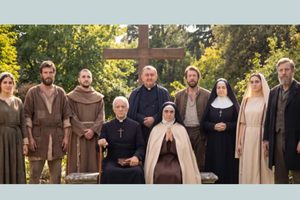
The 17th of November would be a perfect day to invoke Elizabeth of Hungary’s intercession for husbands and wives who find themselves struggling in an “unequal-yoke” situation. Her numerous patronages include people antagonized for their devotion to Christ and the Church.
Prayer and Perseverance
Paulist Father James Lloyd, a priest-psychologist with long experience in New York City, knew this kind of situation with his own parents. He recalls his mother as “a simple Irish woman” who loved the Rosary. His father was Jewish but non-observant. Both were Vaudevillian entertainers.
“She was adamant their kids were going to be Catholic,” says Father Lloyd. “She quietly kept her faith.”
The priest’s very vocation testifies to his mother’s perseverance. “My mother would compromise not at all,” he says. “My father gave in, being a secular Jew (to whom) religion wasn’t important.”
Through it all, they managed to maintain a strong, loving relationship. His father even came to church occasionally with his wife. Then, too, their marriage matured in the days before no-fault divorce laws combined with a consumerist culture to change the way Westerners think about matrimony.
In Mobile, Ala., before Phil and Shelly Proctor married 15 years ago, she made it clear she wanted their children raised in the Church — even though he was not Catholic. “There was no negotiation,” Shelly recalls. “And Phil agreed.” Today they have twin 11-year-old boys and a 5-year-old daughter.
“I encouraged the practice of her faith,” says Phil, who was raised Protestant but would attend Sunday Mass with Shelly even before they married. “I wasn’t faithless but didn’t subscribe to any specific denomination.”
Even when such benevolent (if noncommittal) support reigns, there are usually hurdles to overcome. So say Tom and Caroline McDonald, who serve as family-life coordinators for the Archdiocese of Mobile, Ala., and write a monthly “Family Matters” column on the married life for the Register.
“When children come into the picture, things get more complicated” in mixed marriages, Caroline points out. “That’s where it becomes more challenging, especially when the kids get older and they start asking questions.”
When the Proctors’ children received first Communion and first Penance, Phil wished he could have joined them. Because Shelly grew up with a family practice of the faith, she too felt the lack of true togetherness.
Working in marital counseling many years, Father Lloyd found it’s “easier” when the wife is the Catholic. Why? Because women tend to do better at getting themselves, and their children, off to church to worship God.
Too many times, he says, he’s seen Catholic husbands in mixed marriages claim “tolerance” as a way out of committing to, and teaching, the Catholic faith to the children.
“The kids grow up lukewarm,” says the priest. “Or the couple makes a stupid agreement: ‘Let’s not give them any religion and let them choose for themselves when they grow up.’”
That, he notes, is a recipe for spiritual calamity.
Couples must address religious differences before they magnify, stresses Father Lloyd. “The big mistake is not to talk about this whole area before marriage,” he says. “After marriage, it’s almost too late.”
Conversion Happens
To be sure, the goal every devoted Catholic spouse hopes for is a conversion by their non-Catholic (or nominally Catholic) “better half.” But the experts agree that preaching, punishing or otherwise pushing often tends to backfire. The pushed party sometimes turns against the Church rather than toward it.
Caroline McDonald suggests letting actions speak louder than words ever could — first by being a kind, loving and forgiving spouse, second by involving the family in fun but meaningful works of charity, and third by knowing the faith well so that questions can be answered authoritatively but not emotionally or argumentatively.
Shelly Proctor’s experience bears this out. At the same time Shelly and her family were praying for Phil, she realized the importance of living the faith daily.
Saying prayers with the kids at night, reading the Bible with them, taking them to confession regularly and going herself: “He’s got to have an example and not a half-hearted one,” says Shelly. The added bonus was a primer in Catholic apologetics. “I had to find answers for Phil and for myself,” she says, “so I could say what it is I believe to him and other people.”
In doing all this, Shelly was putting No. 1637 of the Catechism into practice. “Sincere married love, the humble and patient practice of the family virtues, and perseverance in prayer,” we read, “can prepare the non-believing spouse to accept the grace of conversion.”
Just so. Recently Phil told Shelly he has decided to join the Catholic Church. He’s enrolled in RCIA and has started working in their parish.
So it is that sometimes — not always, but sometimes — an unequal yoking unfolds into a beautiful bond of unity. “Others should know,” says Shelly, “that there’s always hope.”
Staff writer Joseph Pronechen
writes from Trumbull, Connecticut.