The Catholic Vision of ‘Coliving’
With both private and shared living space, trend offers affordable, community-building alternative to traditional apartments, developers say.

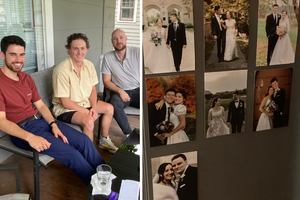
First cousins and business partners, Jake and Alex Zikmund, who grew up in the Dakotas, remember that as their families got ready for Mass on Sunday mornings, their parents’ homes sometimes ran out of hot water before everyone had a chance to shower.
The co-founders of the St. Paul, Minnesota, firm Gro Development have kept this and other challenges of communal living in mind while designing and developing housing for coliving, a new type of rental housing that is more affordable because groups of adults who have their own bedrooms and often their own bathrooms share a kitchen and living spaces.
As they prepare for tenants to move into “Little Mod,” the business partners’ first coliving housing project in St. Paul, cold showers shouldn’t be a problem because the building’s two separate dwelling suites, each designed to house six tenants, have their own water heaters. An additional water storage tank and hot water recirculation pump will provide backup for the dwellings, said Alex, 32, who is an engineer and developer. Jake, 36, an architect, designed the housing.
Alex grew up in Aberdeen, South Dakota, while Jake was raised in rural northeast North Dakota, where their large extended family has its roots.
Together with another partner, the Zikmund cousins founded in 2019 the Minnesota commercial and residential architecture firm BLOK Studio (formerly Double Jack Design).
In 2022 the cousins founded Gro Development with the goal of creating affordable housing developments that they hope to own and operate long term after completion, Alex said.
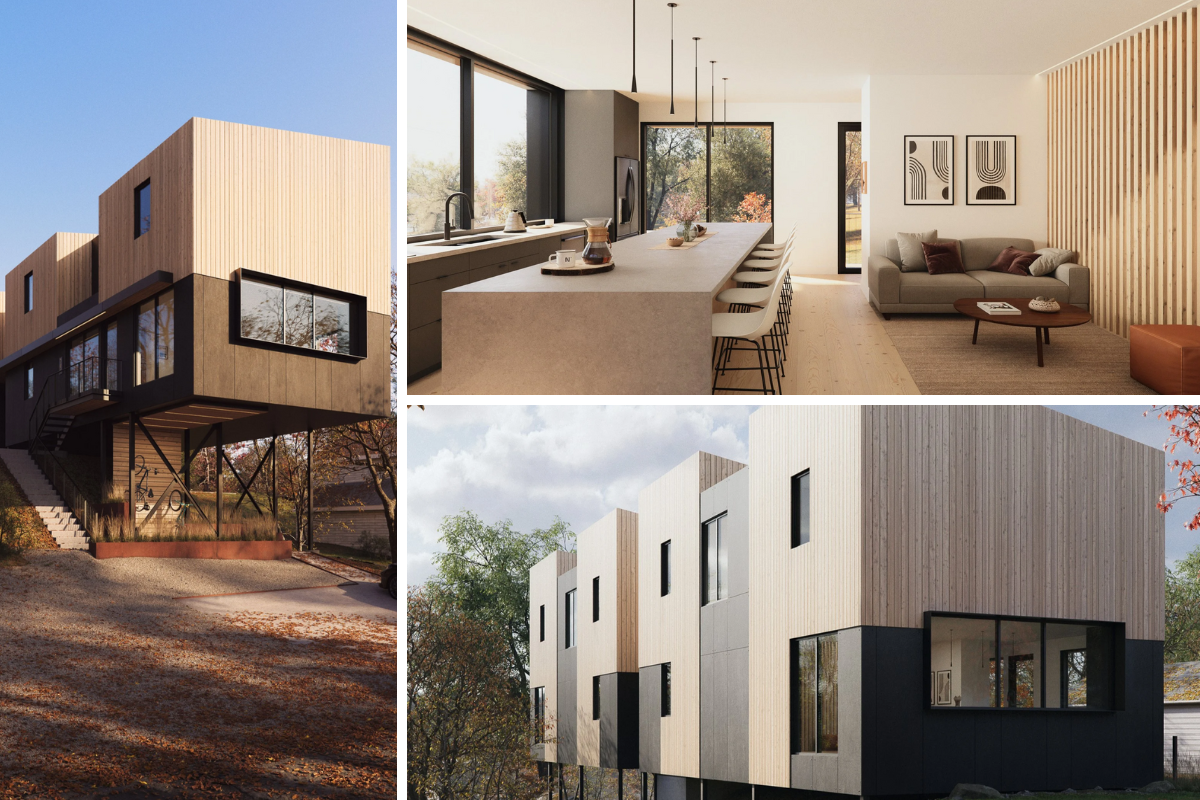
The business partners named their first Gro project “Little Mod” because of its relatively small size and Nordic-inspired, modern and modular style, Jake said. The housing is also innovative because the all-electric building produces all its power through roof-top solar panels, he said.
Growing Trend
Potential tenants responding to ads for partially furnished Little Mod have mostly been in the 22-32 age group, but several older applicants have also responded, Alex said. They are part of a growing U.S. housing trend, now mostly of young adults, seeking affordable housing, as costs of renting and purchasing continue to rise, according to Coliving.com, an online platform offering 38,000 rooms in 1,900 coliving spaces around the world. Coliving offers benefits of a private apartment, along with the sense of community, cost sharing, and, in some cases, more amenities than other renters might have access to, according to the website.
“People seem to be trying to find coliving and living in a coliving way, and they’re just making things work for them,” said Alex, who with his wife lived with another person in a Miami coliving unit for 10 months.
Gro Development seeks to locate its housing in urban areas similar to the St. Paul neighborhoods where the business partners live with their own families — close to transit and walking distance to shops and restaurants to help build community inside and outside the housing, Alex said.
With coliving, it’s possible to place on a lot more leases than an average housing development, which helps keep costs down while also making it possible to build higher-quality housing, Jake said.
While a one-bedroom apartment in St. Paul rents on average for more than $1,250 per month, a Little Mod coliving unit that includes a furnished bedroom (minus mattress and bedding), a private bathroom with access to a furnished, shared living space is available for $850 per month.
Few developers are building coliving housing, Jake said. “I don’t think a typical developer would look at building something with 12 toilets and be comfortable with that,” he said. “So the reason it doesn’t exist is because you’re doing something that’s so abnormal in comparison to what is normal.”
Not many lenders, investors or even potential tenants are yet familiar with coliving, but when they see it, they don’t find it very unusual, Alex said.
Some coliving housing consists of adapted single-family homes, but may not have the same features as housing developed specifically for coliving such as Little Mod, Alex said.
“The kitchen, living space, being able to have two fridges, we’re able to intentionally from the beginning design for its end function, as opposed to a lot of the older homes today that are being used as coliving that were single-family homes,” he said. Related initiatives include “Live Near Friends,” a movement of “cohousing” by which people intentionally seek to live near each other.
Coliving can accommodate those who don’t want a full-term lease, such as traveling nurses. Some coliving housing, including in Europe and other parts of the world, also provides for the needs of those who want to work onsite. According to one self-described “digital nomad” commenting on an online forum, coliving provides opportunities to meet like-minded housemates, combat social isolation from remote work, and enjoy a work-hard, play-hard lifestyle and lower travel costs.
But others commenting on the same forum described risks associated with not always being able to choose housemates, costs that were higher than expected, theft, lack of privacy and having to pay for a group grocery plan.
The cousins said they recognize the need for thorough vetting, including full background and credit checks, as well as income verification. As he continued interviewing potential tenants this summer, Alex said the intention is that all tenants in each Little Mod dwelling suite will be of the same sex — as rooms and bathrooms are leased to individuals — an expectation shared so far by all the applicants.
Local Living — in Community
Who is looking to reside there?
“It’s people that it seems have one-bedroom [apartments], or they’re coming from a situation with roommates looking for their own bathroom, or they’re coming from a one bedroom and they’re paying $1,200 to $1,300 for 400-to-500 square feet, looking to have a little bit more space by living with other people for a lower rate,” Alex said.
Little Mod is small to keep costs down and to accommodate the challenges of the lot, which the cousins purchased first, Jake said. “It’s a very tight, unique site, and so whatever we put on that it, it was going to be small,” he said.
The business partners did not level the lot’s slope because excavating it would have been expensive and would have reshaped other lots on the block, Alex said. Instead, they secured the building by anchoring three-foot-diameter, concrete-filled piers 10 to 20 feet into the site’s bedrock, the method by which many skyscrapers are secured, he said.
The building envelope is “modular” because it consists of structured-foam cored panels that reduce waste because they are pre-ordered and factory-made, Jake said. “They came almost like a Lego set, and so they plugged in, and we were able to construct the building envelope quicker; because of that and because of our unique site, it was a little easier to do that,” he said.
Little Mod tenants will have parking space but could live without a car because of the neighborhood’s access to transit, shops and restaurants, Jake said.
An urban location can also help build community, Alex said. “Why we like localism and urbanism is that sense of community on a bigger scale, but like we also like coliving because of community on a more intimate scale,” he said. “You can have a community within your building, you can have your community within your neighborhood, and then there’s this broader West Seventh community.”
Building coliving housing in “walkable” urban areas “helps [build] a sense of community and local atmosphere” and orients it to local areas and neighborhoods, said Dale Ahlquist, co-editor of the book Localism: Coming Home to Catholic Social Teaching, a collection of essays inspired by the ideas of 20th-century Catholic authors G.K. Chesterton and Hilaire Belloc on property ownership and independence.
Chesterton would call coliving “going against the stream,” Ahlquist said, as it offers a solution to the societal problem of isolation, addresses single young adults’ needs and could help them save to purchase homes.
Coliving also encourages subsidiarity and solidarity, aspects of localism or “distributism,” as Chesterton and Belloc referred to it, he said.
“Subsidiarity gives people control of what’s happening to them,” Ahlquist said. Solidarity between residents is more possible with coliving because they live together.
Looking Ahead
Gro Development has received approval and a funding commitment from the local county for its second St. Paul all-coliving project, scheduled for completion in 2027, Alex said.
The new development will provide 36 more coliving units in six separate dwelling suites, along with other amenities like community gardens, Alex said.
The business partners have two other coliving projects that are currently on hold, Alex said, adding they’d like to look at designing coliving housing for other demographic groups, including seniors.
“I think the thing that’s unique, maybe to Gro, is that we are developing, designing, building and managing all of this,” Alex said. “So this is vertically integrated, but we’re also looking to own these long term. We’re not looking to sell the building.” These developers are not handing their project off to a large corporate manager. They plan to stay involved and manage it themselves, which they say is unusual. So conceivably, this could increase subsidiarity.
The business partners’ approach may be new, but they emphasized that coliving isn’t new.
“It’s something that’s been there; we’re just maybe doing it just a little bit differently, and it’s newer again,” Alex said. “We’re just refreshing it.”
- Keywords:
- fellowship
- authentic human development
- community