St. Jerome Academy Illustrates What Sets a Catholic School Apart
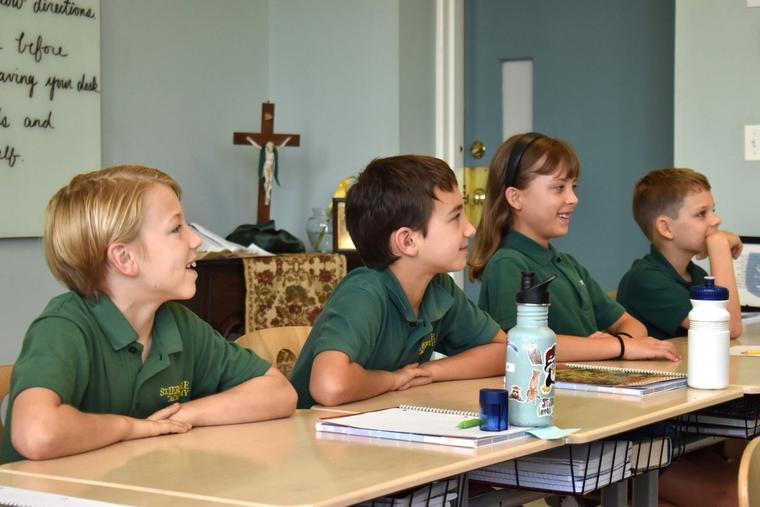
Rich discussions and a Christ-centered schedule — complete with prayer, Mass and adoration, along with classic Catholic hymns are hallmarks of a St. Jerome education. And computers are rarely used.
What sets great Catholic schools apart and allows them to soar?
A new EWTN program aims to find out.
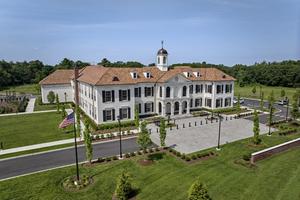
The Catholic School Playbook episode — based on the book of the same name by Michael Ortner, who founded the Ortner Family Foundation dedicated to Catholic education — focuses on St. Jerome Academy in Hyattsville, Maryland, which boasts a student enrollment above 500.
Basketball star Victor Oladipo went to St. Jerome. Oladipo was a first-team All-American at Indiana University and was the second overall pick in the 2013 NBA draft. He has played for the Orlando Magic, Oklahoma City Thunder, the Indiana Pacers and the Miami Heat — but his prowess started at school.
“This is where I first sat and fell in love with the game. I’ll never forget it; it was right here,” he says in the episode, also singing about his true inspiration: “Jesus has saved my whole life.”

Ortner, a husband and father of six, knows the importance of an authentic Catholic education, as “one that is intellectually, spiritually, and culturally Catholic elevates each child to reach their full potential and inspires a sense of wonder in their minds and hearts,” he relates in the program. This at a time when, over the past 60 years, there has been a 70% decline in Catholic school enrollment, and more than half of U.S. Catholic schools have closed.
Catholic education certainly helped Oladipo on his path — including the hour-and-a-half trip to school daily.
“I don’t think you can accomplish anything in life without discipline, focus, and a strong work ethic,” he says. “It’s made me who I am. My sisters [and I] had to wake up at 4:30 every morning, and my dad had to drop us off before the janitor so I could work out at 6 a.m. to better my skills, and then go to school, and then practice, and then work out again after practice. And then, as I grew up, I understood balance, because there is such a thing as overwork; there is such a thing as doing too much. And you just have to have the discernment and ask God for the discernment to know when to rest and when to continue to keep working.”
The academy graduate credits the school community with helping him in his mission to pursue excellence. “They gave us the proper balance of being great, being academically great, being Godly great, and then being a kid and having fun, as well.”
His faith continues to inspire him.
“There’s only one God. What got me here and what keeps me going is my belief, my knowing Who I serve, what I serve,” Oladipo says. “So, for me, I’m going to give everything I have to my craft and to God and use my stage as a platform to do exactly what he needs me to do.”
Mary Pat Donoghue, executive director of the Secretariat of Catholic Education for the U.S. Conference of Catholic Bishops, once served as principal of St. Jerome Academy. (She also attended the school as a child.)
Implementing a truly Catholic liberal arts curriculum in 2010 made all the difference, with Donoghue emphasizing “the integration of school curriculum, pedagogy, culture, faith formation, all integrated and oriented to Christ, the Logos.”
Michael Hanby is a theology and philosophy professor at the John Paul II Institute at The Catholic University of America, and he helped develop the St. Jerome Academy Educational Plan.
“What must education be if Catholicism is true? Because if Catholicism is true, if we and the entire world are known and loved into being by God, it affects absolutely everything,” Hanby says. “It affects the meaning of nature, it affects the meaning of human nature, it affects the meaning of history.”
He further explains, “Education, above all, is humanization. It should make us more profoundly human. The capacity for observation, memory, attention, thought, to be able to hold those together, to love — someone who has those dispositions can do anything.”
Donoghue emphasizes the importance of good literature to cultivate a depth of knowledge. “The faculty of thought is innate in every human person and is aroused when material is given to them that inspires it, or they demonstrate the elasticity and beauty of language, like poetry, or they expand the imagination, as mythology does.”
Heather Campos teaches kindergarten at St. Jerome and enjoys seeing student interest. “They’re learning about the ancients,” she says. “They’re learning about the biblical history that goes along with it. So they’re starting to get some of those internalized values within themselves, as well, that we try to help impart within them. So we started from a very early age to help plant those seeds, to help them grow with them.”
Rich discussions, with history as a framework, and a Christ-centered schedule — complete with prayer, Mass and adoration, along with classic Catholic hymns like O God Beyond All Praising — are hallmarks of a St. Jerome education.
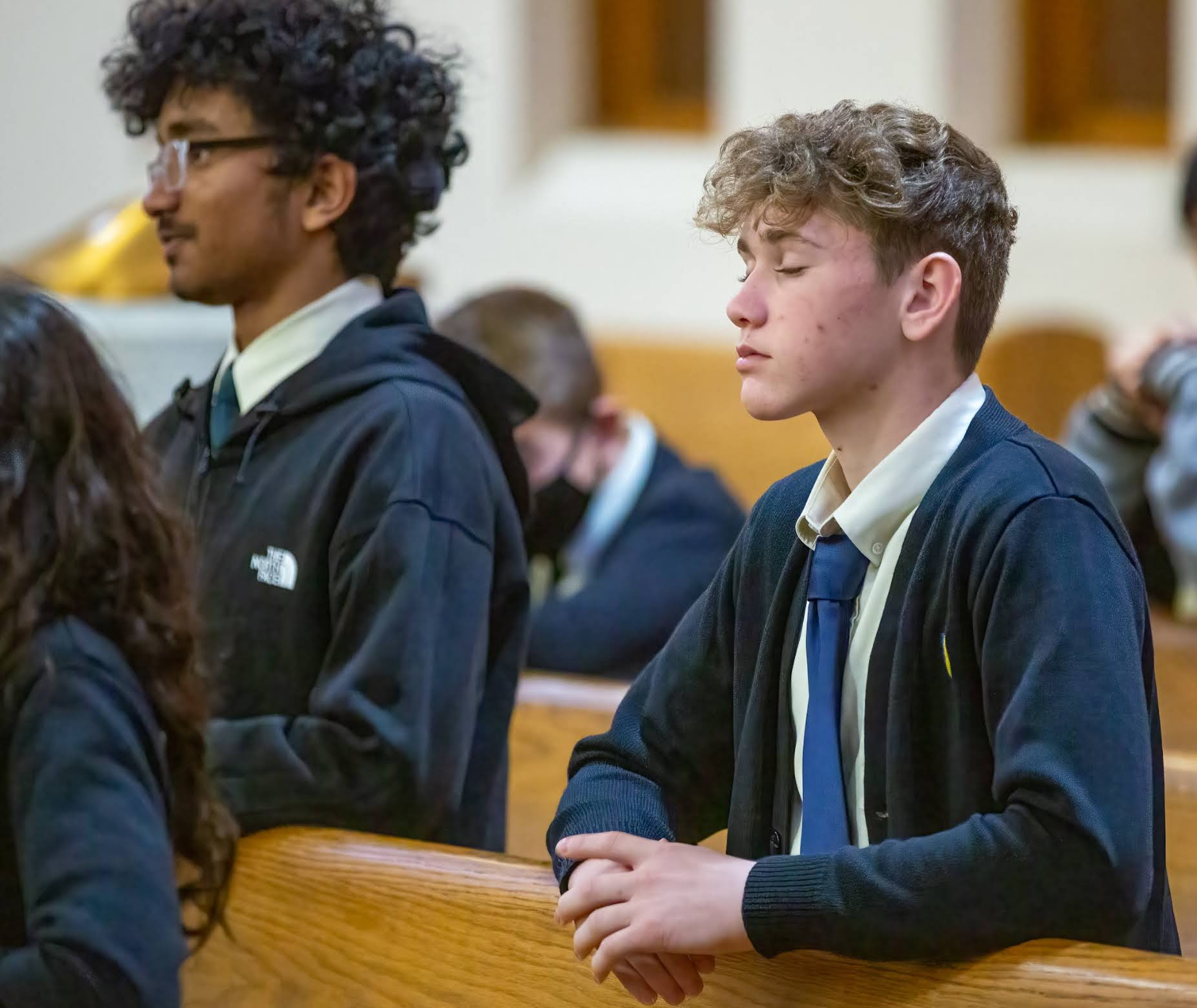
And computers are rarely used.
Principal Kevin Somok explains why.
“We’ve got a cart of laptops, and we use those to test twice a year, and, the rest of the time, they’re in a closet,” he says. “We want students to really be present to each other. We want them to focus on their teacher, not on the screen. We want them to talk to each other. We want them to engage in Socratic seminars. And we think there’s a time and place for technology; we don’t think that’s K-8 education.”
Former pastor Father James Stack points to the source of the success: “The Eucharist, which is Christ. … I could say it was probably one of the most significant things I’d done in my priesthood, was to save this school.”
Parents of the pupils are also pleased.
“I can’t express enough how much my wife and I love the school. It’s just one incredible community,” says Brian Hicks.
Adds Lindsay Myers: “Parents are so welcome. It’s really not like your kids are at the school; it’s like your family is a part of the school.”
Alison Contreras, chair of the Parent Volunteer Corps, also relates: “My kids truly enjoy learning here. They don’t even know they’re learning half the time.”
Students are quick to share why they like school:
“Everything that we learn sticks with us.”
“I just really enjoy it.”
“Science, math, even history and English, they aren’t merely companions to our faith; our faith is a part of all of those subjects. The main theme for all of these courses is that they’re gifts from God, and God has given us an incredible world to explore.”
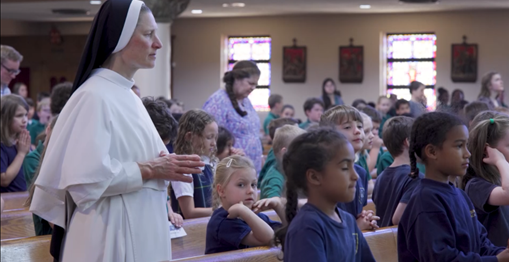
Angela Ambruoso, immediate past president of the Parent Volunteer Corps, sums it up: “The ultimate goal here is to become the person that God wants you to be; it’s to become that saint. And that’s what I think they fully understand, that they have a role in helping that child along the path to becoming the person that God needs them to be.”
WATCH ON EWTN This program will air Jan. 28 (9:30 p.m. ET) and Jan. 29 (5:30 p.m. ET). Learn more about St. Jerome Academy at StJeromeAcademy.org.

Amy Smith Amy Smith is a Register senior editor who edits devotions and features for print and online. Fueled by prayer and coffee, she enjoys writing about everything from Jane Austen to saints for the Register. She is the author of The Plans God Has for You: Hopeful Lessons for Young Women (Emmaus Road Publishing). Her writing has also appeared in various other Catholic publications. She has a master’s degree in journalism and a B.A. in English.