Joy Multiplies
All parents are called to be the primary caregivers and educators of the children God entrusts to their care. But not all married couples become parents in exactly the same way.
In the United States alone, more than 100,000 couples become adoptive parents each year. Another 500,000 open their homes to offer temporary foster care to children in need.
Many of these adoptive and foster parents are Catholic couples who hear God’s call to the vocation of parenthood and, despite the challenges ahead, answer it. Their stories of sorrow, sacrifice and ultimately joy bear witness to the fact that, when it comes to parenting, biological relationships might be nice — but sacrificial love and unconditional commitment form stronger bonds still.
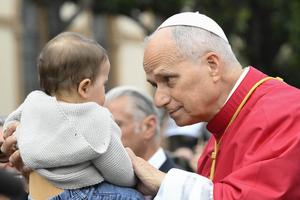
“To adopt a child is a great work of love. When it is done, much is given, but much is also received. It is a true exchange of gifts,” said Pope John Paul II in 2000. He was addressing participants in a meeting of adoptive families organized by the Missionaries of Charity on the third anniversary of the death of their foundress, Mother Teresa of Calcutta.
“Adopting children, regarding and treating them as one’s own children, means recognizing that the relationship between parents and children is not measured only by genetic standards,” he added. “Procreative love is first and foremost a gift of self. There is a form of ‘procreation’ that occurs through acceptance, concern and devotion. The resulting relationship is so intimate and enduring that it is in no way inferior to one based on a biological connection.”
A Family Tradition
When Jay and Margie Dunlap of South Bend, Ind., first were married, they were no strangers to the concept of adoption.
“I’m a third-generation adopter,” Jay explains. “My maternal grandparents adopted a Japanese war orphan after World War II. And my parents, after giving birth to nine biological children, adopted three more who are biological sisters to one another and had spent years getting bounced from one foster home to another before they came to us.”
During their engagement, Jay and Margie agreed that they, too, would like to adopt children one day. Little did they know what God had planned for them.
“Everyone enters marriage expecting to be able to conceive children,” says Dunlap. “So when that wasn’t happening, we were very sad. But my family’s history with adoption and our agreement to pursue that path some day made it easier for us. We had been married less than four years when we first met with the adoption agency.”
Today, the Dunlaps are proud parents of four adopted children: Patrick (11), Elena (8), Leo (6) and Susannah (3).
Their experience with adoption has not been without heartache, however. Two separate times the Dunlaps brought home babies only to be forced to return the children to biological family members.
Additionally, because some of their adopted children are of mixed race, the Dunlaps have been saddened to see their circumstances reveal the ugliness of racism in some of their friends.
Despite the trials, however, Jay is clear that choosing to adopt has been an enormous blessing for his marriage and his family.
“It’s about love. Very simply, these kids are an immense blessing,” he says. “Playing a vital role in who they become before God and the world is an amazing, sacred trust.”
Called to Foster Care
Even before they were married, Ariel and Brittany Doucette of Indianapolis felt God was calling them to a different kind of parenthood: Foster parenting.
“We feel foster care is a pro-life ministry,” says Brittany. “These moms chose life when their circumstances were not ideal. They can’t always care for their children to an acceptable standard and need help.”
As a result, early in their marriage, while they were expecting their first biological child, they went through the foster-care training and licensing process. Then, when their daughter was just 6 months old, they accepted their first placement — a 3-year-old girl who needed their temporary care.
In the beginning, the couple had some reservations about the foster-care system. They worried that perhaps most foster children have suffered severe abuse or neglect to a point where they might become dangerous. Their experiences, however, have proved otherwise.
“Yes, most foster kids have had rough experiences,” explains Brittany. “But a consistent, loving and stimulating home environment can really turn things around.”
“Our foster daughter was quiet, tentative and confused at first,” she recalls. “After a few months in our home, though, she is a happy and delightful little girl. It’s amazing how quickly children can blossom when given what they need to thrive.”
A unique and particularly sacrificial aspect of foster parenting is that, from the beginning, the situation is understood to be temporary. It is hoped and expected that children placed in foster care will eventually return to their biological families.
The Doucettes recognize the sorrow of this inevitable future parting with their foster daughter, and their acceptance of it is an example of the kind of generous and self-sacrificial love all parents are called to give their children.
“I guess the way Ariel and I find peace with this reality is by remembering that all parents are stewards of their children,” says Brittany. “They belong to God and he entrusts us to care for their needs, raise them up in a faithful home and prepare them for the next step. Foster children just move on to that next step a little sooner. We know that it is best for a mother to be with her child when possible.”
Surprised by Adoption
Catholic author and Register columnist Carl Olson and his wife Heather were not actively seeking to adopt a child when the opportunity presented itself to them a few years ago.
“One night in December 2000, we received a phone call,” says Carl. “Were we interested in adopting a newborn baby girl? We had only a few hours to decide. The next day, less than 24 hours later, we were holding Felicity in our arms.”
The Olsons, too, have had to deal with the problem of subtle racism.
Carl remembers: “One person said to us, ‘It’s so wonderful that you have her. Do you also plan to have children of your own?’ The pain caused by this ignorant comment was probably heightened by the fact that Felicity is Hispanic and we are Caucasian. It made us wonder what other people might think or say and what effect that could have on her.”
Also frustrating, according to the Olsons, is the painful scrutiny and extreme vulnerability required of adoptive parents during the adoption process.
“The level of scrutiny, the lack of control, the emotional and financial demands — these are all things that can cause a lot of frustration and doubt,” says Carl.
And yet today, as an adoptive father to not only 5-year-old Felicity but also 1-year-old Gavin, Carl Olson recognizes that the rewards of adopting his children have been well worth any cost.
“A unique reward of adoption is the understanding that family is ultimately about much more than biology and flesh and blood, as wonderful as those things are,” he says. “This has helped us to appreciate even more the great grace of being sons and daughters of God, by adoption through Jesus Christ and the power of the Holy Spirit.”
Danielle Bean writes from
Belknap, New Hampshire.