Holy Fathers and Their Fathers
Learn about the fathers of the four most recent popes.

Pope Leo XIV
Pope Leo XIV’s father, Louis Marius Prevost, was a Navy veteran, who led the local Altar and Rose Society and served as a teacher and school principal.
The U.S. Department of Defense (DOD) released a statement about Pope Leo’s late father and his role in the revered “greatest generation” that won World War II.
Louis Prevost was born on July 28, 1920, in Chicago. After he graduated from college, he joined the Navy in November 1943, when he was 23 years old.
According to the Department of Defense, Prevost became the executive officer of a tank landing ship and “participated in the D-Day landings in Normandy, France, on June 6, 1944, as part of Operation Overlord.” He was in charge of a landing craft that “the Allies used to land infantry soldiers and Marines onto beaches during the war.”
After the war, Prevost returned home and became the head of an elementary school district in Glenwood, Illinois. He later took a job as a principal at Mount Carmel Elementary School in Chicago and also did work teaching “the principles of the Christian religion” as a catechist.
In 1949 Prevost married Mildred Martinez, who was a librarian at the time, and they had their three sons, with the now-Pope as the youngest.
The Prevost patriarch died in Chicago on Nov. 8, 1997.
A touching recollection gives insight into his fatherly advice:
“Maybe it would be better I leave this life and get married; I want to have children, a normal life,” the future Pope, in a 2024 interview on Italian television, told his father, as reported by The New York Times. His father responded, by telling him that “the intimacy between him and my mom” was important, but so was the intimacy between a priest and the love of God.
“There’s something,” then-Cardinal Prevost recalled thinking, “to listen to here.”
St. John Paul II
Karol Wojtyła Sr., who was born in 1879 and served in the military, was a witness of holiness for his son.
Pope St. John Paul II owed his vocation to his father, he explained:
“My preparation for the priesthood in the seminary was in a certain sense preceded by the preparation I received in my family, thanks to the life and example of my parents. Above all I am grateful to my father, who became a widower at an early age. I had not yet made my First Holy Communion when I lost my mother: I was barely nine years old. … After her death and, later, the death of my older brother, I was left alone with my father, a deeply religious man. Day after day I was able to observe the austere way in which he lived. By profession he was a soldier and, after my mother’s death, his life became one of constant prayer. Sometimes I would wake up during the night and find my father on his knees, just as I would always see him kneeling in the parish church. We never spoke about a vocation to the priesthood, but his example was in a way my first seminary, a kind of domestic seminary” (Gift and Mystery, emphasis in original).
Tragically, the younger Karol came home from work in 1941 to discover that his ill father had died. But his life’s witness lived on.
“Lolek also learned from his father that manliness and prayerfulness were not antimonies,” papal biographer George Weigel explains in Witness to Hope. “Perhaps, above all, the captain transmitted to his son an instinct for paternity. He would, later, come to understand this in theological terms: The instinct for paternity and the responsibilities of fatherhood were a kind of icon of God and of God’s relationship to the world. Fatherhood meant rejecting the prison of selfishness; fatherhood meant being ‘conquered by love.’”
Benedict XVI
Joseph Ratzinger Sr. was a policeman who belonged to an old family of farmers from Lower Bavaria of modest economic resources.
As Register writer Shaun McAfee chronicled, Joseph Sr. “resorted to placing an ad in the Liebfrauenbote, the local Catholic newspaper, with a simple description of himself: ‘State employee, single, Catholic, forty-three years old. Seeks matrimony, as soon as possible, a capable Catholic girl.’”
The same article, based on the biography Benedict XVI: His Life and Thought, outlines how “the Ratzinger household made sure their lives were rooted in the Church, the liturgy, and prayer. ‘Every day we prayed together, and in fact before and after each meal (we ate our breakfast, dinner, and supper together). The main prayer time was after the midday dinner, when the particular concerns of the family where laid out.’”
Benedict’s father also brought him on the day of his birth to be baptized, McAfee details: “In those times, his biographer writes, the baptismal font was drained and a fresh supply of water was poured and blessed on Holy Saturday as a fitting part of the Paschal liturgy. Joseph was born several hours before, and his father wanted to seize the opportunity while his mother rested from a difficult delivery. His father bundled him up and took him to be baptized. Cardinal Ratzinger later commented in his memoirs: ‘I have always been filled with thanksgiving for having had my life immersed in this way in the Easter mystery, since this could only be a sign of blessing.’”

Pope Francis
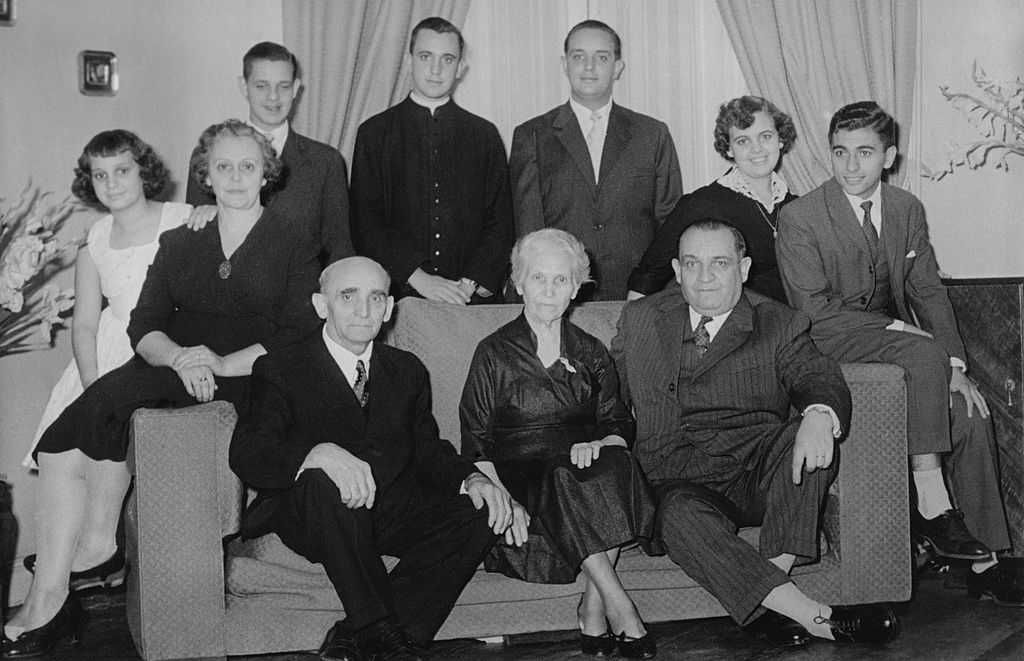
According to the Vatican website, Jorge Bergoglio’s “father Mario was an accountant employed by the railways.”
Mario, a soccer fan like his son, suffered a heart attack while cheering a goal. He died 20 days later, at age 53. The future Pope helped his mother care for his younger siblings, as his autobiography Hope recounts. The autobiography also recounts how the Pope’s father and parents missed an ill-fated ship.
SS Principessa Mafalda, a passenger ship that set sail from Genoa, Italy, to Buenos Aires, Argentina, on Oct. 11, 1927, sank, a Register column by Father Raymond J. de Souza explains. “That story was told in my family,” Francis recalls. “It was told in my barrio, my neighborhood. My grandparents and their only son, Mario, the young man who would become my father, had bought their ticket for that long crossing, for that ship. … But they didn’t take it.”
- Keywords:
- fatherhood
- spiritual fatherhood
- papacy