‘Come to the Stable’ Any Day of the Year
Heartwarming film reminds viewers of what kindness paired with unwavering trust and faith can accomplish.
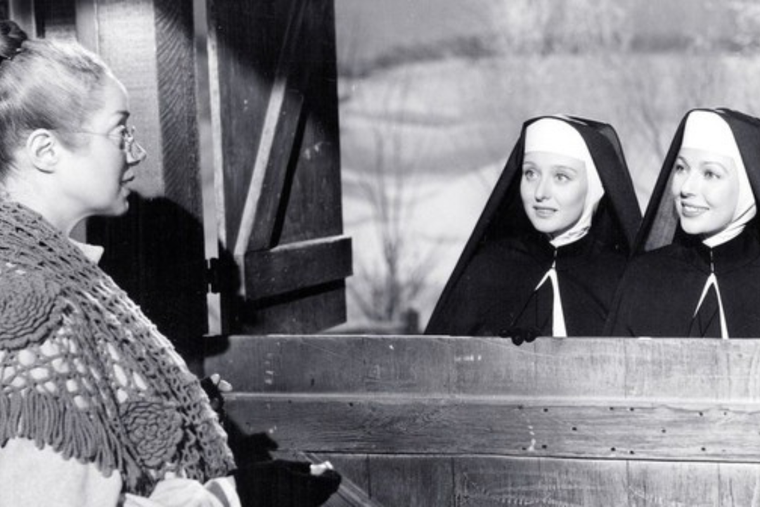
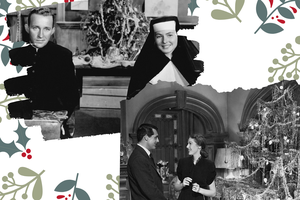
With the 12 days of Christmas still fresh in mind, a moving and very entertaining classic film to watch that has hints of Christmas and remains a present all year long is Come to the Stable.
In a very appealing and gentle way, it not only brightens hearts, but it contains powerful reminders of keeping the message of the Christ Child alive and well in our goals and relations all year through.
It begins with two nuns walking in the evening along a snow-covered road surrounded by snow-covered fields. They stop at a directional sign that points the way to Bethlehem, their destination. This one happens to be in Connecticut. The sisters have come from France.
“Oh, sister, I think we reached our journey’s end. God is good,” says Sister Scholastica (Celeste Holm) to Sister Margaret, played by Loretta Young in one of filmdom’s perfect casting choices.
The story of this 1949 film takes its idea from the real-life story of the Benedictine Sisters in France who came in 1947 to establish the Abbey of Regina Laudis that exists to this day in this rural town and that inspired writer and Catholic convert Clare Boothe Luce to bring it to film. Naturally, the story had to be adapted in many different, fictionalized ways.
Unlike the real-life goal of founding a monastery, these sisters have come to begin a children’s hospital in the rural New England countryside, unaware of roadblocks they will face, and that will seem impossible to hurdle. But to these nuns who had survived World War II, insurmountable barriers will look more like mere pebbles as they put all in God’s hands.
Indeed, they hear sounds from a barn near them; and, reaching it, they hear Venite Adoremus being sung by a family and children practicing a Nativity scene. They’ve arrived at the living quarters of Miss Potts (Elsa Lanchester), an artist whom they immediately befriend. Her painting of a lovely snow-covered hillside drew them to this Bethlehem to build the hospital.
During the war, the enemy had used the sisters’ children’s hospital as an observation post — a target for the advancing American armored division. More than 100 critically ill children could not be taken from their beds. Sister Margaret promised God that if he helped her reach the American general and the hospital be spared, she would someday come back to her own country and build a hospital for sick children. Obviously, her prayer was answered. The hospital was unharmed in the battle, and as “God kept his end of the bargain, now I’m going to try to keep mine,” she said, explaining to Miss Potts that they selected this town because it “was the hand of Providence. We had a postcard with a reproduction of your painting” with identification of the town and the artist who painted religious pictures. “It was to us like the star of Bethlehem leading the way.”
The painting pictures the hill across the way from Miss Potts’ modest barn-turned-residence. Here is another wonderful tie-in to the inspired story because this artist is based on Catholic convert and major religious artist Lauren Ford, who studied in France, had a farm by this Bethlehem (her The Nativity is frequently pictured in her own barn that is repurposed and is among the buildings Ford donated to the abbey), and helped the Benedictines found Regis Laudis Abbey. (Regis Laudis’ Benedictines survived World War II, and, later, one of the sisters was the granddaughter of Gen. George Patton.)
Sisters Margaret and Scholastica know immediately this is the place; and the next day, they are on the hillside “planting” a medal of St. Jude, patron saint of the impossible, on the property, adding a fervent prayer to him for his help. “Dear St. Jude, patron of the impossible and of our holy endeavor here on this lovely hilltop, with the help of Our Lord and his dear servants, we will build your hospital,” prays Sister Margaret (so sincerely done by Young, who herself was a devout Catholic).
This scene — and indeed several others throughout the film — is a prime example not just of the sisters’ unshakable faith, but of the shining days of Hollywood films that treated religion with all reverence, and respect, and even awe.
There are other references to St. Jude, as the sisters rely heavily on the saint’s help in their endeavors. Sister Scholastica readily hands out medals of St. Jude, all graciously received. One time turns into a very humorous scene when the recipient is a petty gangster who thinks it’s a — well, the incident must be seen.
Naturally, the sisters face opposition.
But help is ever at the ready, including from a popular songwriter who lives next door. At times, he is a bit annoyed and then displeased by them, yet he is always respectful and polite (again, a hint at the way Hollywood once treated religion and religious people). He even helps the sisters as they prevail upon him for all kinds of favors, including borrowing his Jeep. The Jeep becomes a humorous prop in the way the sisters zip around in it.
Natural, low-key good humor like this pops up at the right moments, especially in people’s reactions to the sisters, in full habit, nonchalantly driving. They also boldly go where required — even to see the head man in an illegal bookie joint to prevail upon him to donate land for their planned hospital.
Time after time, the simple, strong, unquestioning faith of the sisters awakens admiration in others, from Luigi Rossi, the gambling head, to Anthony, the all-around helper of the neighbor songwriter played with fine, understated humor by Dooley Wilson (remember him as Sam in Casablanca).
The film is filled with memorable characters, memorable lines and memorable lessons.
“I like peace, seclusion, quiet. My educated friends tell me it has something to do with man’s feeling of insecurity,” songwriter Mason tells the sisters when they meet. “Mr. Mason, God is the only answer to man’s insecurity,” responds Sister Margaret. “Yes. Yes, I suppose so,” he hesitantly agrees.
Even Miss Potts, who extends kindness to the sisters to stay, is told God will bless her for her generosity. A humble Miss Potts says, “For the first time in my life, I know how it feels to be poor.” Sister Margaret responds, “Poor? Oh, my dear Miss Potts, you’re a rich woman. You’re rich in kindness and greatness of heart ... and faith.”
But amid the warm humanity, blunt human nature emerges.
When confronted with the goings-on across the road, upset Mason, who just wants quiet, says something many people would say: “I’m all for it. I’m for a lot of worthy things — orphan asylums, insane asylums, old people’s homes, sanitariums — but I’m just like everybody else. I don’t want them right under my nose, and I’m honest enough to say.”
Then there is the practical Bishop who wonders how the practically penniless sisters can get the necessary funds, and his assistant, Monsignor Talbot, who nevertheless looks at the sisters’ determination and unwavering trust and faith and says, “Excellency, it is that irresistible force against which, quite obviously, there is no defense.” The Bishop answers, “There hasn’t been for nearly 2,000 years.”
The lesson continues when the Bishop learns of their plans to buy a building with only a few dollars down, and he says, “Something tells me that an irresistible force has been let loose in New England.”
If any viewer thinks that such a story and events can be only mere fantasy, they only need to remember the story of Mother Angelica and EWTN. As she said, “Unless you are willing to do the ridiculous, God will not do the miraculous.”
These sisters, in their childlike faith — “unless you become as little children” (Matthew 18:3) and their reliance on the intercession of St. Jude — certainly live that out in the most inspiring and enjoyable way in Come to the Stable.
- Keywords:
- religious life
- catholic movies