What Have We Learned in the 80 Years Since V-J Day?
COMMENTARY: On the 80th anniversary of the Allies’ victory over Japan in World War II, it is essential that we look at our moral failures and vices as well as our victories and virtues.
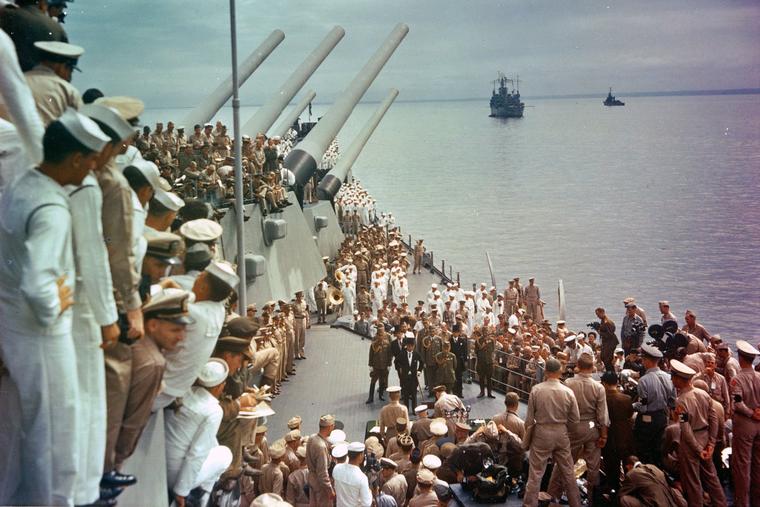
This year marks the 80th anniversary of the Allies’ victory in the Pacific, bringing World War II to a close. Japan formally accepted the terms of surrender on Aug. 14, 1945, and signed the formal documents aboard the USS Missouri anchored in Tokyo Bay on Sept. 2, 1945. Both days are commemorated as dates ending the brutal warfare instigated by Japan’s imperial ambitions.
Writing in honor of the Allies’ victory over fascism in Europe earlier this year (see “When America Was Great”), I spoke of the virtues that were needed to achieve these victories: Dedication and commitment, social love and charity, enterprise and industriousness, magnanimity and compassion were all essential to a successful war effort. There is no doubt these virtues (and more) were necessary to both major theaters of action. And the post-war magnanimity was on display in both Europe and Japan as we helped these nations build back up their economies and their civilizations.
As I have been taught in both the military and the Church, after every major endeavor it is important to do an “after-action report,” analyzing what was done well and what worked, but also assessing very honestly what went wrong and why. In addition, it is essential that we look at our moral failures and vices as well as our victories and virtues.
The Allies’ Bombing Practice
One glaring area that must be evaluated is the Allies’ choice to directly attack whole cities and their populations via the practice of obliteration bombing. By now it should be clear to everyone, especially every believing Catholic, that the practice of targeting and destroying whole cities with their entire populations is always and everywhere wrong. This was clearly stated by the fathers of the Second Vatican Council in Gaudium et Spes:
“Any act of war aimed indiscriminately at the destruction of entire cities or extensive areas along with their population is a crime against God and man himself. It merits unequivocal and unhesitating condemnation” (80).
This moral judgment of the Council fathers is based on the jus in bello criteria of the just-war tradition. Such actions are almost always disproportionate to any legitimate war aim and most certainly indiscriminate in the fact that they do not properly honor or protect innocent noncombatants. (Innocent here means “not harming” — it comes from the Latin in- [not] and -nocere [to harm]). The many young, old, wounded, sick and imprisoned present in any population are all noncombatants and should never be directly attacked. They should also never be subject to reckless or disproportionate harm, even in an otherwise justifiable military action.
This is not a new or even controversial teaching of the just-war tradition. The great moral theologian Jesuit Father John C. Ford clearly stated these truths during the war when he wrote in 1944 in Theological Studies the courageous article, “The Morality of Obliteration Bombing.”
As Father Ford painstakingly argues, the vast majority of people in any city — he was analyzing German cities at the time — are innocent noncombatants. And he clearly shows that the Allies, by intent and action in their attacks against cities such as Dresden, Hamburg and Cologne, intended their bombing to break the morale and terrorize the civilian populations.
Father Ford analyzes official American and British publications at the time, concluding, “This same authoritative publication [Target Germany] (presented with a foreword by General [Henry] Arnold himself) makes it clear that the terrorization of civilians is part of our bombing strategy.”
The evidence in the Japanese theater is even clearer. Lt. Col. Robert McNamara, a key figure on the staff of Gen. Curtis LeMay, later served as secretary of defense under both Presidents Kennedy and Johnson. He would later state that he and LeMay committed war crimes in their choice to firebomb Tokyo and destroy whole population centers in Japan: “LeMay said, if we’d lost the war, we’d all have been prosecuted as war criminals. And I think he’s right. He, and I’d say I, were behaving as war criminals” (The Fog of War).
McNamara said this in the context of describing the bombing campaign against Japan in general — but particularly the firebombing of Tokyo on the night of March 9-10, 1945, which deliberately targeted the civilian population and killed more than 100,000 people in a single night.
What About the Atomic Bombs?
The dropping of atomic weapons on Hiroshima and Nagasaki was both immoral and unnecessary. They were immoral because they were both disproportionate and indiscriminate. They were unnecessary because Japan would have surrendered before the end of 1945 without the use of atomic weapons or any invasion of the Japanese mainland.
This is not merely my opinion but the official opinion of the U.S. government. Little known to the public, there was an official “after-action” report authorized by President Harry Truman to examine the effectiveness of the bombing campaign against Japan. I have read this document housed in the Truman Library in Missouri. A blue-ribbon committee of experts (including many well-known civilians but with a staff of more than 800 officers and enlisted personnel operating from Tokyo) drew this conclusion about Japan’s surrender:
“Based on a detailed investigation of all the facts, and supported by the testimony of the surviving Japanese leaders involved, it is the Survey's opinion that certainly prior to 31 December 1945, and in all probability prior to 1 November 1945, Japan would have surrendered even if the atomic bombs had not been dropped, even if Russia had not entered the war, and even if no invasion had been planned or contemplated (‘US Strategic Bombing Survey’).”
We also now know, and Truman knew it at the time due to our code-breaking efforts, that Japan had approached Josef Stalin and the Soviet Union with an offer of a peace deal, with the only Japanese condition being to preserve the position of the emperor of Japan. Of course, Gen. Douglas MacArthur ultimately preserved the emperor’s role as part of his effort to rebuild postwar Japan.
Consequentialism Then and Now
As Elizabeth Anscombe pointed out in her famous essay, “Mr. Truman’s Degree” (1957), the morality behind the Allies’ bombing decisions was based on the idea that one can do evil that good may come of it. This principle was clearly shown to be immoral by the philosophy of Plato and Aristotle. Plato in the Gorgias goes even further to teach that it is better to suffer evil than to do it. Of course, St. Paul also teaches that you cannot do evil that good would come of it (Romans 3:8).
However, the false idea that you can justify evildoing by some good outcome(s) is at the heart of the modern ideas of utilitarianism, consequentialism and proportionalism. Unfortunately, these philosophies dominate much of what passes today for ethical thinking. And the results are devastating.
It is consequentialism that leads people to embrace such immoralities as contraception, abortion and euthanasia. As Venerable Archbishop Fulton Sheen taught in War and Guilt:
“An act must be good not only in its end but in its means. That is what the modern pagan forgets: He thinks because the end is good, he can use any means he pleases. No! The end never justifies the means.”
Archbishop Sheen also recognized clearly that the dropping of the bombs changed humanity for the worse, for the atomic age destroyed many important moral boundaries. Speaking to schoolchildren in 1974, he made this point plainly:
“See how much the world has changed? Now, what made it change? I think maybe we can pinpoint a date: 8:15 in the morning, the sixth of August, 1945. Can any of you recall what happened on that day? … It was the dropping of the bomb on Hiroshima in Japan. When we flew an American plane over this Japanese city and dropped the atomic bomb on it we blotted out boundaries. There was no longer a boundary between the civilian and the military, between the helper and the helped, between the wounded and the nurse and the doctor, between the living and the dead — for even the living who escaped the bomb were already half-dead. So we broke down boundaries and limits and from that time on the world has said, ‘We want no one limiting me.’ So that, you people have heard the song, you’ve sung it yourselves: ‘I gotta be me; I gotta be free.’ We want no restraint, no boundaries, no limits. Have to do what I want to do. Now let’s analyze that for a moment. Is that happiness: I gotta be me; I’ve got to have my own identity?”
Freedom without moral limits is not real freedom at all.
A Great Victory but at a Moral Cost
Fascism in Germany, Italy and Japan had to be opposed. Acts of aggression left unchecked can lead to worldwide disaster. Anti-human ideologies that target the destruction of those deemed “undesirable” must be overcome. The Allies heroically and with great virtue opposed and defeated these false ideologies. Other falsities, most notably communism, were left for another day.
But an honest appraisal of our war efforts must also include an acceptance that some immoral means were chosen and used in World War II.
Never again should we embrace a policy of obliteration bombing. Never should we intend or accept the destruction of whole cities with their populations, either by conventional or unconventional weapons or weapons of mass destruction.
Some things are always morally wrong — even in war.