Abraham Foxman Never Forgot the Catholic Woman Who Saved His Life
The national director of the Anti-Defamation League, who died May 10, credited his Polish Catholic nanny Bronisława Kurpi with saving his life during the Holocaust.
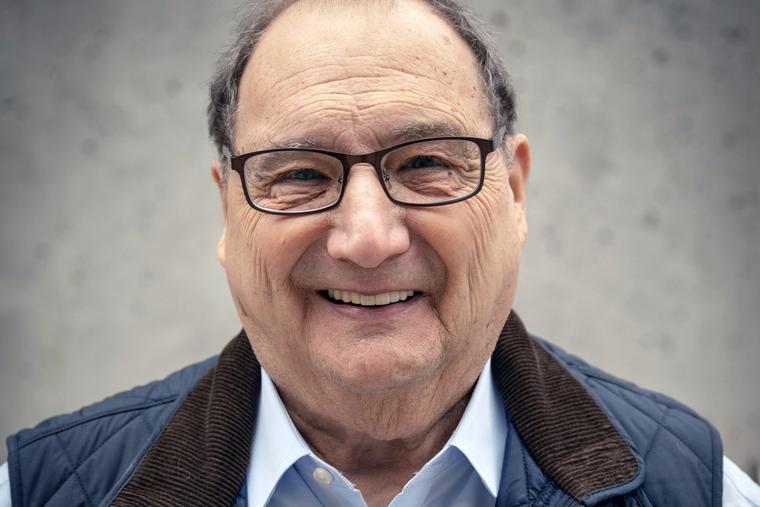
Abraham Foxman, the longtime national director of the Anti-Defamation League and one of the most respected leaders of American Jewry, survived the Holocaust as a young child. He credited his Catholic nanny with saving his life and for being the role model he believed humanity should emulate.
Foxman, 86, who died on May 10, was born in Poland on May 1, 1940. His parents fled to Vilnius in Lithuania, where they lived freely for a time, until the Nazis invaded the city in June 1941. Desperate to save their 15-month-old son before being forced into the Vilnius (Vilna) Ghetto, they entrusted him to Bronisława Kurpi, the Polish nanny who had accompanied the Foxman family to Vilnius.
To hide Abraham’s Jewish identity, Kurpi, a devout Catholic, renamed him Henryk, had him baptized at a local church, and raised him as her own son for four years, until his parents, who managed to survive the Holocaust, reclaimed him.
Kurpi’s heroic decision to hide a Jewish child from the Nazis put her in grave danger, Foxman told the USC Shoah Foundation decades later. The Nazis routinely killed people found to be sheltering Jews.
Foxman, whose organization works to prevent and call out antisemitism and hatred in all its forms, noted that Kurpi took an especially big risk by harboring a Jewish boy.
“Between 90% and 95% of Jewish hidden children were [girls],” he said. “It was much safer to hide a girl than a boy, because Jewish boys were circumcised,” and non-Jewish boys at the time were not. For this reason, Kurpi “couldn’t let me out of her sight.” Being discovered “could not only destroy myself, but destroy her.”
The Nazis and their collaborators systematically murdered more than 1 million Jewish children from 1938-1945. Of those who survived, 10,000 were saved via Kindertransport (Children’s Transport) missions to Great Britain from Nazi Germany, Austria and Czechoslovakia and placed in foster care. A few thousand other Jewish children were hidden by Christian individuals, families, priests and nuns, especially in Poland, where only 300,000 of the country’s 3,325,000 Jews survived the Holocaust. Just 28,000 Jewish Polish children remained alive after the war.
“At places where Christians or whoever said ‘No’” to the Nazis’ plan to exterminate every Jewish adult and child, “Jews lived,” Foxman said in his USC Shoah Foundation testimony. He viewed those who rescued Jews as proof that ordinary people can choose to act righteously even during the most terrible times.
Kurpi was a prime example, Foxman said. “She didn’t go to college, she could barely write. She knew she was risking her life. She saw me as a human being.”
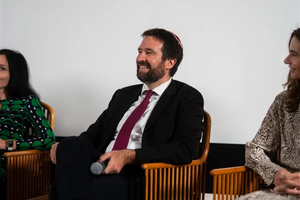
Mark Medin, executive vice president of the UJA-Federation of New York, a philanthropic organization, told the Register that Foxman’s childhood experiences fueled his mission as an adult.
“His lived experience shaped every ounce of his fiber,” Medin said. “He remembered [Kurpi] as his mother, given up as a 1-year-old. He remembered her as a loving, kind woman who protected him and raised him as a young Catholic boy.”
Medin, who worked with Foxman for several years and accompanied him on an emotional trip back to Poland and Lithuania, told the Register Foxman frequently spoke about his rescuer in meetings with government officials in Eastern Europe.
“He talked about it regularly,” Medin said. “About fighting hate and doing good. He believed that people are teachable. All because of the good deeds of a good Catholic woman who showed the best of humanity.”
Laura Kam, a former ADL employee and longtime friend of Foxman, told the Register that being saved by a Catholic profoundly shaped his belief that interfaith dialogue and education are key to fighting antisemitism.
“This Catholic woman, like the people who saved my own parents, was Catholic and unbelievably selfless and brave,” Kam said. “Being a child saved from the Holocaust is a very special space to be in. It’s a small group of people, knowing someone righteous who risked their lives to save them.”
Kam said Foxman believed those acts of righteousness demonstrated that hate is not inevitable.
“It’s why Abe believed that if people were educated and learned that there were people who saved Jews’ lives, that people could change for the better,” she said. “He was always very interested in interreligious relations. He grew up in a Catholic home. He believed that there was a way to improve relations.”
Rabbi David Rosen, a longtime leader in Jewish-Catholic dialogue, said Foxman’s childhood rescue strongly influenced his practical approach to coexistence.
“For him, I think his own experience animated his conviction that there has to be cooperation and collaboration among religions,” Rosen told the Register. “It is an imperative Jewish and human interest.”
Rosen described Foxman as “a very practical man” with “amazing street wisdom.” In his view, Foxman understood that “the best way to advance the welfare of Jews was to have a pluralistic society.”
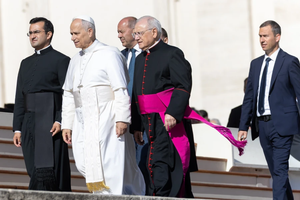
His relationship with the Catholic Church carried personal significance. Rosen cited Foxman’s close bond with Pope St. John Paul II and his visits to the Vatican.
“Here was Abe, the embodiment of the tragedy of ancient antisemitism, which the Church played a significant role in,” Rosen said, referring to anti-Jewish tropes such as the claim that the Jewish people collectively bore responsibility for Jesus’ death. Pope St. Paul VI’s 1965 declaration on the relation of the Church to non-Christian religions, Nostra Aetate, rejected such accusations and helped usher in a new era of Catholic-Jewish relations.
“To be received at the Vatican as a representative of the Jewish people, to be respected and loved, that was for him a sense of the triumph of the Jewish people and history,” Rosen told the Register.
Like all hidden children, Foxman lived with trauma. His grandparents and 13 of his aunts and uncles were murdered during the Holocaust. Learning at the age of 6 that he was born Jewish was confusing.
He told interviewers, “I was raised Catholic,” and related how he would spit on the Jews living in the Jewish ghetto across from the church, as other Christian children did at the time.
When his Jewish mother escaped from the ghetto and assumed a non-Jewish identity, he was told that she was his aunt. When his father returned after the war, Foxman’s parents wanted to leave Vilnius with their son for a better life elsewhere. Kurpi, the only mother that Abraham remembered, refused to let him go.
Foxman’s parents asked her to accompany them abroad, but she declined. A bitter four-year custody battle ensued. When the Foxmans moved away, “she got her family to take me away,” Foxman said of Kurpi. “Jewish partisans kidnapped me back.”
Custody battles over Jewish children who had been baptized were not uncommon after the war, especially when the children’s parents had died and their Jewish relatives or organizations wanted to adopt them.
In one well-known case, Antoinette Brun, a Catholic woman in France, took in two Jewish orphans. In 1945, after she learned that their parents had been murdered and that a Jewish aunt wanted to adopt them, she started adoption proceedings. Three years later, she baptized them. When the court ordered that the boys be given to their aunt, Brun and several Catholic clergy hid the children near France’s border with Spain. They were subsequently arrested.
Foxman’s parents survived, so there was no doubt that they wanted to raise their son as a Jew.
Eventually, the Foxmans moved to a camp for displaced persons, where Abraham, then 6, was surrounded by other Jewish Holocaust survivors, including many children like himself, who had been hidden by Christians and raised in very different worlds.
Foxman’s parents and Kurpi became estranged when they returned to assume custody of their son. His parents sent Kurpi, who moved back to Poland, money and packages. “She signed for them, but she never wrote back,” Foxman said, his voice wistful.
While Foxman said he lived with the “baggage” of his early life, he continued to cherish the love Kurpi gave him during the most horrific years of European history.
“I lived through the worst, but this lady, however one wants to judge her, said no [to those who were murdering Jews], in her own way. I don’t think she thought about whether I’d be a Catholic or a priest, or contemplated my parents surviving or not surviving. If [only] we could clone her goodness…”