Why Me, Lord? A B-17 Gunner’s Lifelong Journey of Faith
COMMENTARY: After witnessing the deaths of his friends over Warsaw in 1944, Vincent Stefanek spent the rest of his life seeking to understand why he survived — and how God wanted him to use the ‘second opportunity’ he had been given.
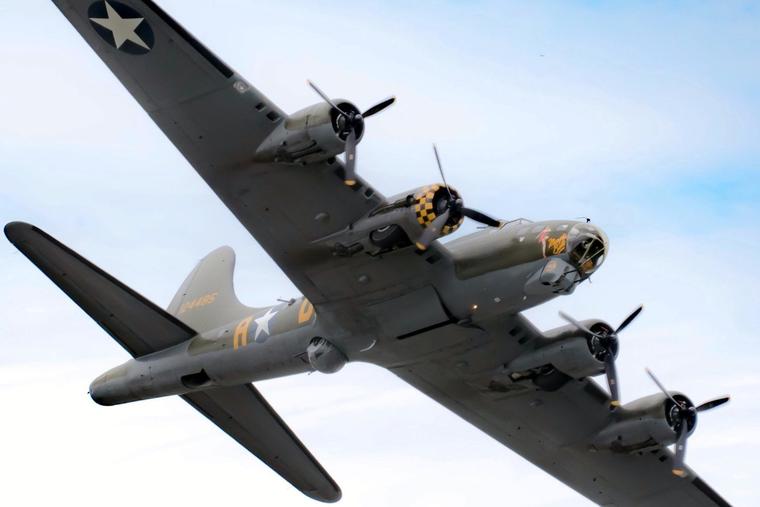
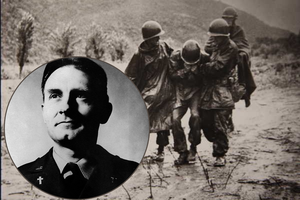
Vincent Stefanek could not have anticipated the life-changing events that occurred when he decided to drop out of the University of Dayton and enlist in the armed forces during World War II.
A shy 19-year-old from a Catholic Slovak family, Stefanek enlisted in the Army Air Forces, which trained him as an aerial gunner in a B-17 Flying Fortress at Drew Field, Florida.
He immediately became aware that his crewmates were a microcosm of American society. They came from various parts of the country. Their family backgrounds and religions were also different. Yet, when the young men met in Florida to train as a heavy bombardment unit, they forged a bond that transcended their differences.
Francis Akins, the pilot of the crew, was the highly respected leader. Only 23, Akins had a quiet authority and seriousness that stemmed from the time he studied to become a Catholic priest. While studying for the priesthood, he realized that he did not have a religious vocation and left the seminary to join the Army Air Forces.
Stefanek had a close friendship with Marcus Shook, affectionately called “Shooky,” who had deep roots in Appalachia and was a consummate Southern gentleman. As shy as Stefanek, Shook had an infectious sense of humor that his crewmates enjoyed.
Stefanek, Shook and Akins were no different from the rest of the 10-man crew who, like other young men of their generation, enjoyed listening to the big bands of Tommy Dorsey, Glenn Miller and Duke Ellington. They jitterbugged, taking the frenetic dance with them to Great Britain, where air crews of the Eighth Air Force were based.
These young men enjoyed radio hosts Kate Smith and Arthur Godfrey and couldn’t hear enough songs sung by Frank Sinatra, Bing Crosby, Dinah Shore and Perry Como.
All of them came from homes where rationing was a way of life, women became a vital part of the workforce to free men for the armed forces, and Victory Gardens dotted the country’s landscape.
Stefanek and his crewmates were children of a patriotic generation with an enviable innocence and a strong conviction that good would triumph over evil. They were part of “America’s Greatest Generation,” a legacy worth remembering.
Akins, a devout Catholic, expressed some of these noble sentiments in a letter he wrote to his wife shortly before the combat mission that took his life:
Someday soon I hope we and our family will settle down for good and there will be no more goodbyes. I know that you think the same as I that if it weren’t for our magnificent dreams of the future, neither of us would be happy. As it is, I am happy because indirectly I am doing things for you and that’s all I want.
After completing training in Florida, Stefanek joined his crew at an air base in Framlingham, England, a town so old it is mentioned in the Domesday Book. Flying as an aerial gunner in the crew’s B-17, named “I’ll Be Seeing You” after the song popularized by Bing Crosby, Stefanek wrote at the time how “content and happy” he was “to fly with my crew that I came with for my initial mission.”
But Stefanek soon suffered a major disappointment. He learned that he would no longer fly with the men he had grown to love and respect. He was ordered into a reserve pool from which he would fill the position of aerial gunner with different crews on other planes.
Despite the transfer, he always considered himself part of the “Akins crew,” a feeling shared by his old crewmates. And the bond he forged with them survived the war in his lifelong friendship with Marcus Shook.
In mid-September 1944, Stefanek learned that he would be a part of a massive air armada of Flying Fortresses sent not to bomb targets in Germany but to drop desperately needed supplies and food to the beleaguered Poles in Warsaw, who had launched a major uprising to retake their capital from the Germans and hold it until the arrival of the Soviets, who were only a short distance away. The Soviets never moved until after the Germans had completely suppressed the Poles.
Stefanek, who was in a plane that closely followed “I’ll Be Seeing You,” was one of hundreds of airmen who not only began an audacious military mission but also became part of an incredible story of bravery, heroism and humanitarianism.
On Sept. 18, 1944, a formation of 107 B-17s, escorted by three squadrons of P-51 Mustangs, approached Warsaw. When the Poles saw the big planes, they knelt and prayed in gratitude that Allied help had finally arrived. To some Poles, the planes with their large wings glistening in the sun looked like flying tanks.
The Germans responded with immediate artillery barrages and fighter attacks. Akins, reaching back to his seminary days, recited in Latin the oldest extant prayer to the Blessed Virgin Mary — “Sub Tuum Praesidium” (“Under Thy Protection”).
What followed was five minutes of incredible horror that made a profound emotional and spiritual impact on Stefanek as he watched “I’ll Be Seeing You” come under devastating attack. Lt. Akins, the pilot, was shot and killed. While the co-pilot tried to pry Akins’ fingers from the yoke in order to steady the plane, one of the engines became engulfed in flames.
“The cockpit is full of blood!” the co-pilot screamed over the radio. These were the last words heard from anyone aboard “I’ll Be Seeing You” before it veered off, lost altitude and exploded in the air.
Only two crew members, Marcus Shook and James Christy, managed to parachute to the ground, where the Germans took them prisoner. A third member of the crew was shot to death as his parachute descended from the sky.
Shook, badly wounded in both legs, received medical care from Polish Catholic physicians who, like him, were prisoners of war. Shook often remarked later that he liked the Poles so much he wished there was some way “to package them and take them home with him.”
Shook returned home after the war and lived until 1995 while Christy, who was seriously ill, lived only a few years into the postwar period.
After the horrific episode he witnessed, Stefanek experienced survivor guilt. He questioned why his friends died while he survived. He plaintively asked, “Why me, Lord? Why was I the one permitted to survive?”
For Shook, too, it raised profound questions about justice and the purpose of life. But unlike Stefanek, who often talked about the events of Sept. 18, 1944, with his wife, Shook refused to discuss his wartime experience for many years, burying himself in his profession.
Eventually, Shook sought out Stefanek, restoring their wartime friendship, a major step in helping him heal the deep emotional wounds he had borne for so long.
Stefanek’s strong Catholic religious background helped him discover that life never ceases to have meaning, even in suffering and death. “It made me realize I’m an instrument,” he said. “I’m supposed to try and be an instrument of Faith.”
After returning home, Stefanek became an exemplary Catholic. Commenting on his devotion to the Catholic faith, he said: “I have been blessed with my Catholic faith because it taught me how to live and how to die.”
Before he died in 2010, Vincent Stefanek reflected on the meaning he had drawn from surviving the war and losing so many of his friends. “I felt I had been given a second opportunity to do something good,” he said. “There was a reason for me to continue to exist beyond my personal goals.”
Through his words and deeds, Vincent Stefanek demonstrated that he had devoted his life to the teachings of Jesus Christ — offering a lesson for all of us who too often forget the true meaning of life.
- Keywords:
- memorial day
- world war ii