Senator Flunks Civics 101: Governments Secure Rights, God Grants Them
COMMENTARY: Sen. Tim Kaine’s declaration of dependence on our political leaders misses the point of America’s founding: Governments are instituted to secure our rights, not grant them.
At a recent Senate Foreign Relations Committee nominations hearing, Sen. Tim Kaine, D-Va. — who claims to be a practicing Catholic — asserted that the statement that our rights don’t come from our laws or our governments but instead come from our Creator is “extremely troubling.”
His comments caught attention when Sen. Ted Cruz, R-Texas, responded, correctly noting that our rights come not from government, but from God. The exchange may have seemed like typical partisan sparring, but what was at stake was far more serious.
For Catholics — and for Americans of every background who care about the meaning of liberty — Kaine’s statement reflects a profound misunderstanding of both our country’s founding principles and the Church’s teaching on human dignity. Laws may recognize and protect rights, but they do not create them. To claim otherwise is to confuse the role of government with the Origin of justice himself.
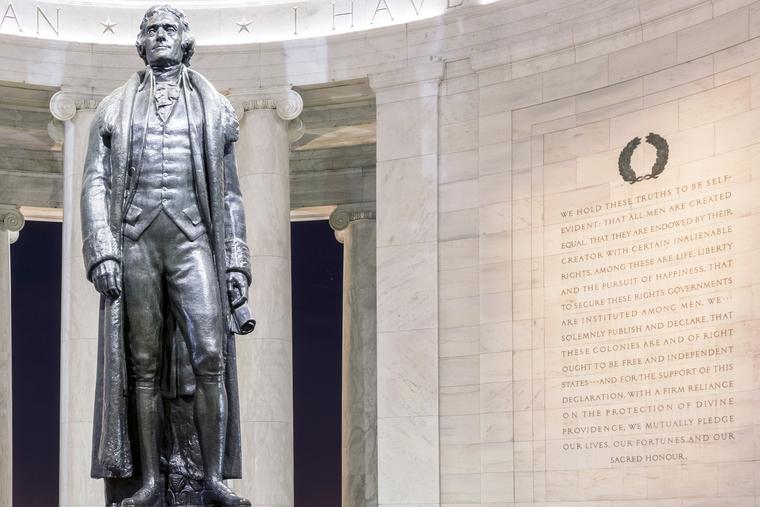
The American Founders were explicit on this point. In words that still inspire freedom movements across the globe, Thomas Jefferson wrote in the Declaration of Independence:
We hold these truths to be self-evident, that all men are created equal, that they are endowed by their Creator with certain unalienable Rights, that among these are Life, Liberty and the pursuit of Happiness.
Government exists not to manufacture rights but to safeguard what God has already granted. Laws may change, but the rights that flow from our human dignity endure, because they are written into our very nature.
Notre Dame political scientist Daniel Philpott warns that when rights are detached from this natural-law grounding, they become fragile — mere products of political will that can be discarded when inconvenient. As he writes, “Human rights are headed for extinction if they are not recognized as natural law.” Philpott will be giving the annual Catholic Political Thought lecture at The Catholic University of America the evening of Oct. 9, where he will share his current work on the Christian meaning of justice. Senator Kaine should consider attending.
Constitutional law scholar Hadley Arkes is also worth Kaine’s attention. Arkes has long emphasized that constitutions and statutes are intelligible only when read in light of moral truths that precede them. In his recent book, Mere Natural Law, Arkes explains that to reduce law to whatever a legislature enacts is to reduce justice to raw power.
And let’s not forget Mary Ann Glendon, Harvard Law professor and former chair of the U.S. Commission on Unalienable Rights. Glendon has warned of the dangers of modern rights rhetoric. In her influential book Rights Talk, she criticized America’s tendency to treat rights as absolute, individualized claims detached from duties and the common good. This distorted view leads to a culture of competing entitlements rather than a shared understanding of human dignity.
In her work on the commission, Glendon emphasized that the modern human rights project — at its best — reflects the natural-law insight that rights are grounded in human dignity and ordered toward human flourishing, not merely asserted as expressions of individual will.
Bishop Robert Barron recently offered a compelling analysis of this very issue, noting that when rights are divorced from their transcendent source in God, they inevitably become vulnerable to manipulation by the state or majority opinion. As the Minnesota bishop put it, grounding rights in anything less than God undermines their permanence and universality. His reflection is a timely reminder that what Kaine dismissed as “troubling” is, in fact, the bedrock of both Catholic teaching and the American experiment in ordered liberty.
The Catholic Church has long proclaimed that human rights are not government-issued favors but reflections of God-given dignity.
The Second Vatican Council’s Dignitatis Humanae insists that the right to religious freedom “has its foundation not in the subjective disposition of the person, but in his very nature.” Civil law must recognize this right, but it does not originate there. It flows from the Creator’s design for human beings to seek truth freely. When states presume to grant rights, they also presume the authority to take them away. When they recognize rights as rooted in God’s design, they respect their own limits.
Pope Leo XIV has counseled leaders of our own day on this very point. In his June address to governing officials, he emphasized that natural law is not an optional philosophical framework but “the enduring moral compass inscribed in the human heart by the Creator, without which justice collapses into willfulness and power.” His words echo the wisdom of the Founders and challenge contemporary leaders to ground law and policy in an objective moral order, not in shifting ideologies.
Even the world’s secular institutions echo this truth. The United Nations’ Universal Declaration of Human Rights, drafted in the aftermath of World War II, affirms “the inherent dignity” and “the equal and inalienable rights of all members of the human family.” Rights exist regardless of whether governments acknowledge them.
Increasingly, we see the proliferation of so-called “rights” that have no basis in natural law — claims manufactured to advance progressive ideology rather than to uphold human dignity. These efforts distort the very language of human rights. They erode the coherence of the natural-rights tradition and, ironically, leave authentic rights — like the right to life and the right to religious freedom — more vulnerable.
Some may wonder why Kaine’s comment deserves such scrutiny. Isn’t it enough that our laws protect certain rights, whatever their origin? The answer is No. If rights are nothing more than legislative constructs, they can be taken away just as easily as they are bestowed. The unborn child can be denied the right to life. The elderly and disabled can be stripped of protections when their care is deemed too costly. Religious believers can be told their convictions must yield to the state’s preferred vision of equality.
But if rights come from God — if they are inscribed in our very nature as beings created in his image — then no government has the authority to erase them. The task of the state is clear: to respect, recognize and protect those rights.
The challenge of our time is to recover this understanding in both law and culture. Philpott, Arkes and Glendon remind us that rights untethered from natural law will erode under relativism and power politics. Bishop Barron underscores the theological and philosophical necessity of acknowledging God as the source of human dignity.
Pope Leo XIV calls today’s leaders to anchor governance in natural law as the Creator’s design for justice. Dignitatis Humanae calls us back to the truth that religious freedom — and indeed every fundamental right — flows from the dignity of the person as created by God. The Universal Declaration of Human Rights shows that this insight, far from sectarian, is the foundation for global peace and justice.
Kaine’s assertion may have been made in passing, but it reflects a worldview with dangerous consequences. If rights are merely what governments say they are, the most vulnerable — those without political power or social standing — will be the first to lose their protections. If, however, rights are rooted in the Creator, then no government, no court, and no majority can take them away. That was the vision of Jefferson and the Founders. It is the teaching of the Catholic Church. And it remains the surest safeguard of human dignity today.