The Little Way of Saint Thérèse of Lisieux Is a Path of Hope
COMMENTARY: What gives Thérèse strength is above all hope.
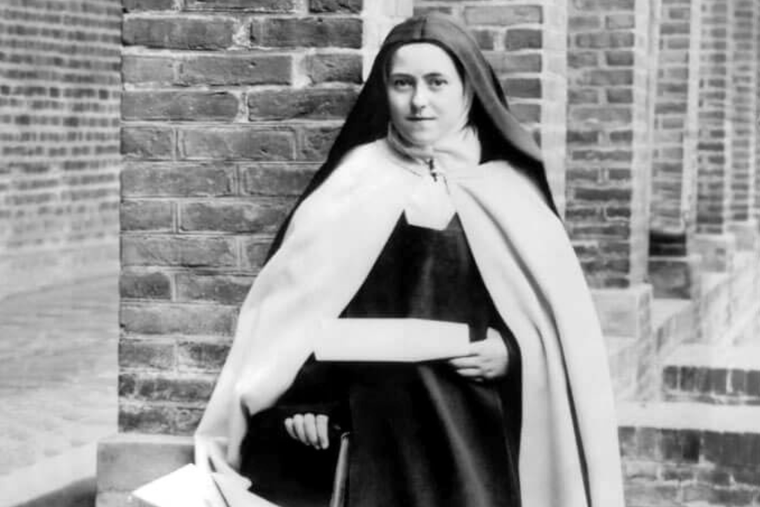
This year, the Catholic Church celebrates the centenary of the canonization of St. Thérèse of Lisieux. On the occasion of the 150th anniversary of her birth in 2023, Pope Francis wrote an apostolic exhortation entitled “It Is Trust,” which is a beautiful synthesis of the spirituality and message of this young nun, who was proclaimed doctor of the Church by Pope St. John Paul II in 1997.
Her feast day is an invitation for us to take an interest again in the message of little Thérèse, a message of inexhaustible richness and topicality.
We are in the Jubilee Year of Hope. Thérèse’s “Little Way” is based on the certainty that “hope does not disappoint,” according to the words of St. Paul in the Letter to the Romans, given as the title of the bull of indiction of the Jubilee. Let’s focus on two aspects of hope in Thérèse’s life: hope for the salvation of sinners and hope to become a saint.
Hope for the Salvation of Sinners
A beautiful experience of “hope that does not disappoint” is when Thérèse prayed for a great sinner. In August 1887, a year before she entered the Carmel convent, she heard of a great criminal, Pranzini, who had murdered a woman, her daughter and her servant in order to rob them. He was condemned to the guillotine, but remained totally unrepentant and refused to see a priest. Thérèse could not bear that this unfortunate man was headed for hell.
She mobilized all the resources of her prayer for him, including the prayers of her sister Céline, and offered Masses for his conversion. This story is explained in Pope Francis’ letter:
“By having Masses offered for him and praying with complete confidence for his salvation, she was convinced that she was drawing him ever closer to the blood of Jesus, and she told God that she was sure that at the last moment he would pardon him ‘even if he went to his death without any signs of repentance.’ As the reason for her certainty, she stated: ‘I was absolutely confident in the mercy of Jesus.’ How great was her emotion when she learned that Pranzini, after mounting the scaffold, ‘suddenly, seized by an inspiration, turned, took hold of the crucifix the priest was holding out to him and kissed the sacred wounds three times!’ This intense experience of hoping against all hope proved fundamental for her: ‘After this unique grace, my desire to save souls grows each day.’”
A shocking detail: Thérèse would call this man, whom all the newspapers called a monster, “my first child” in her autobiography.
Hope of Holiness
Thérèse was proclaimed a doctor of the Church mainly because of her discovery of the “Little Way,” which she had such a great desire to teach souls: a path of holiness that is accessible to all, whatever their limitations and frailties.
The fundamental dynamic of the “Little Way” is a dynamic of hope.
This is expressed very explicitly in the following observation of hers:
“I still feel the same bold confidence in becoming a great Saint, for I do not count on my own merits, having none, but I hope in Him who is Virtue, Holiness Itself; it is He alone who, content with my feeble efforts, will raise me up to Him and, covering me with His infinite merits, will make me a Saint.”
Thérèse always wanted to be a saint because she was convinced that God was calling her to do so. This is the vocation of every Christian. She also aspires to holiness because it is the summit of love; it is also the surest way to be useful to souls and to the Church.
But, after her entry into Carmel, this desire for holiness was put to the test: She very quickly experienced that it was beyond her possibilities. She speaks of this in an important passage in her autobiography:
“I have always noticed, when I have compared myself to the saints, that there is the same difference between them and me as between a mountain whose summit is lost in the heavens and the dark grain of sand trodden under the feet of passersby.”
Thérèse could have been discouraged, but she was not because she was certain that this desire came from God, who was just and faithful and did not ask for the impossible:
“I can, therefore, despite my littleness, aspire to holiness.”
She wanted to find a “small, very short, brand-new way” to achieve this goal, likening it to an “elevator to ascend to Jesus, for I am too small to climb the rough staircase of perfection.” She found the answer to her quest in Scripture, in a passage in the Book of Proverbs, where God invites the little one to come to him: “If anyone is very little, let him come to me!”
Then, in a text from Isaiah, where God expresses what he will do for the little one who approaches him with confidence: “As a mother caresses her child, so I will console you. I will carry you on my bosom and I will swing you on my knees!” (66:12-13).
She understood from reading this text, which touched her very much, that it was the arms of Jesus himself that would raise her to holiness — in her littleness, where she would “remain small, and even become more and more so.”
What does this smallness consist of? It is not, of course, laziness or infantilism, but an attitude of humility that makes us consent to our poverty and accept to be completely dependent on God and his grace — combined with an attitude of total trust, by which little children never doubt their father’s love.
In one of her letters to her sister and godmother Marie (No. 197), Thérèse briefly expresses what the essential attitudes of the Little Way consist of. Marie envied certain ardent desires which her sister had shared with her; she felt inferior to the latter, and Thérèse replied to encourage her: “Ah, I feel that this is not what pleases God in my little soul. What pleases him is to see me love my littleness and my poverty, and this is the blind hope I have in his mercy. This is my only treasure dear godmother; why should not this treasure also be yours?”
This text shows that what gives Thérèse strength, what allows her to follow the small path, is above all hope — a hope that is expressed beautifully in the rest of the letter: “Ah! let us therefore stay far away from all that glitters. Let us love our littleness. Let us love to feel nothing. Then we will be poor in spirit and Jesus will come to seek us; however far we may be he will transform us into flames of love ... ”
Thérèse was greatly nourished by St. John of the Cross. One excerpt that made a profound impression on her was: “God so accepts the hope of a soul that is constantly turned towards Him, without ever lowering its eyes to another object, that it can well be said of it that it obtains as much as it hopes” (Maxim 46).
We get as much from God as we hope for: This is the foundation of the Little Way.
Despite her desire, Thérèse did not do great penances or extraordinary works for Jesus. Her smallness prevented her from doing so. But she did say: “My folly is to hope ...” Thus, hope is accessible to everyone!
As Thérèse knew, far from being a passive expectation, this hope, based solely on God's mercy, will always give us the courage to commit ourselves fully to a journey of conversion and service to our brothers and sisters.
One of the most important concrete expressions of this foolish hope is abandonment. This is expressed at the end of the saint’s “Manuscript B” in words that can encourage each of us, especially those who suffer from our limitations:
“O Jesus! … I feel that if by some impossibility you found a soul weaker, smaller than mine, you would be pleased to shower it with still greater favors, if it abandoned itself with complete confidence to your infinite mercy.”
Father Jacques Philippe of the Community of the Beatitudes is a retreat master whose principal retreat themes have been the subjects of his best-selling books on spirituality. These books have sold more than a million copies in 24 languages. Father Philippe’s books, some of which are available at EWTNRC.com, include The Way of Trust and Love: A Retreat Guided by St. Thérèse of Lisieux.