Providential Feast Days Shine Light on Religious Freedom Week
COMMENTARY: The week’s liturgical calendar features saints who died defying unjust rulers — and feasts that point to the deeper source of true freedom.
The U.S. bishops’ annual Religious Freedom Week has a liturgical setting.
Beginning on June 22, the feast of Sts. John Fisher and Thomas More, the week includes the Nativity of St. John the Baptist (June 24) and concludes with the solemn feast of Sts. Peter and Paul (June 29). All were martyrs at the hands of state power. They are martyrs of religious freedom, and patrons of those persecuted for their religious faith, even if today’s concept of religious liberty was not developed in the ancient or medieval world.
Religious Freedom Week 2025 is unusually rich liturgically and devotionally, as it also includes the moveable feasts of Corpus Christi (June 22) and the Sacred Heart of Jesus (June 27). There are also historical resonances, with important anniversaries heightening the piety of these days. Indeed, it is unusual for so many feasts and anniversaries to fall so close together — all the context of the Jubilee Year 2025.
Fisher and More
St. John Fisher was martyred by King Henry VIII June 22, 1535; St. Thomas More a few weeks later on July 6. They both refused to swear Henry’s oath that he, not the pope, was head of the Church in England.
For resisting that tyrannical usurpation, their joint feast marks the beginning of Religious Freedom Week. This year, their feast will not be observed on Sunday itself, giving way instead to Corpus Christi, but an attentive pastor will offer their votive Mass on the following Monday, as that day is open.
During the Great Jubilee 2000, Pope St. John Paul II declared St. Thomas More the patron saint of statesmen and politicians. For that reason, the Jubilee of Governments has been scheduled for this Saturday in Rome, close to their patronal feast day.
There are too many bishop saints — beginning with the apostles — for anyone to be the patron saint of bishops, but St. John Fisher, the scholar-bishop who alone remained faithful to Rome during the English Reformation, would be a good candidate.
While known principally as chancellor of the University of Cambridge and for his presence in the royal court, Fisher was bishop of Rochester in England. When he was canonized in 1935, Bishop James Kearney of Salt Lake City was in Rome for the occasion. Two years later, Kearney was named bishop of Rochester, New York, and thus declared St. John Fisher the patron saint of his new diocese, linking the “new” Rochester with Fisher’s Rochester, eventually suppressed in England.
The Jubilee of Bishops will be this Wednesday in Rome, and would be a fitting day to invoke St. John Fisher as a model and intercessor for today’s bishops. It would be suitable to meditate upon Fisher’s prayer, written in the Tower of London, or his better-known Prayer for Holy Bishops, taken from a sermon he preached in 1508.
This year marks the beginning of a countdown — a great novena, more or less — towards the fifth centenary of the martyrdom of Fisher and More, and the centennial of their canonization, in 2035.
Corpus Christi
Corpus Christi, the solemn feast of the Most Holy Body and Blood of Christ, falls on the Thursday after Trinity Sunday, but is observed in most places this coming Sunday. Parishes are encouraged to hold a Eucharistic procession after Mass, and many leave the church itself to carry the Blessed Sacrament outdoors.
Pope Leo XIV will mark his first Corpus Christi as pope observing the Roman tradition revived by John Paul II of processing from St. John Lateran to St. Mary Major. John Paul kept that custom to the last year of his life despite his frailty.
Corpus Christi is not a feast of religious liberty — it is greater than any particular issue — but processions can become occasions to assert that freedom under totalitarian regimes. That was the case for John Paul when he was in Kraków where the annual Corpus Christi procession was the principal occasion when Catholic Cracovians took back their public spaces from communist domination. It was at those Corpus Christi processions that John Paul learned how to be a powerful public witness for religious freedom. This year’s theme for Religious Freedom Week carries echoes of that: “Witnesses to Hope.”
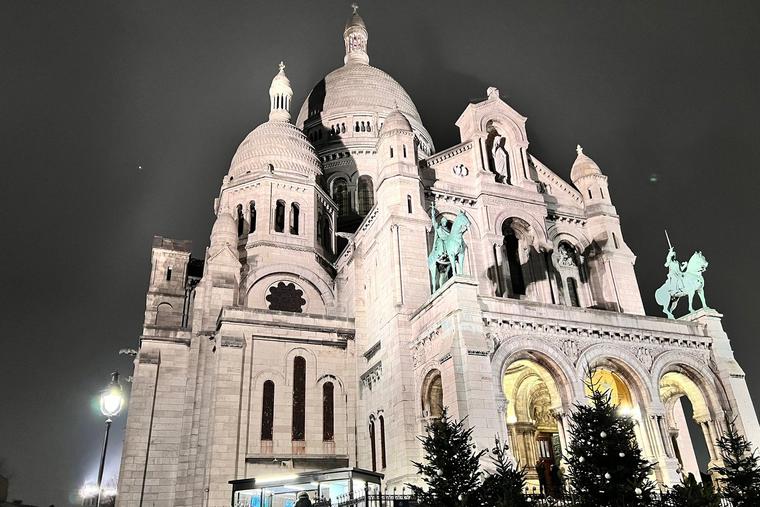
Basilica Sacré-Coeur de Montmartre
The world’s most famous shrine of the Sacred Heart of Jesus is the basilica of that name in Paris. Built on the traditional site of the martyrdom of St. Denis, bishop of Paris, it overlooks the entire city — a symbol that France remains Catholic, even in periods of deep infidelity.
This year marks the 150th anniversary of the laying of the cornerstone in 1875; the basilica was finally completed in 1914. Pope Leo XIV sent a message for the anniversary just this week.
Sacré-Coeur began perpetual adoration of the Blessed Sacrament in 1885, before the basilica was finished. It has continued 24/7 for 140 years, for more than 1.2 million consecutive hours and more than 51,297 nights. This summer, to mark the 140 years of continual adoration, the basilica will have 140 overnight adorers for several weeks.
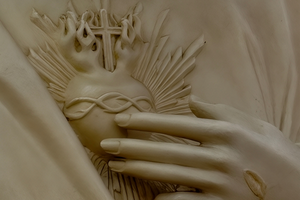
Sacred Heart of Jesus — 350 Years
It is entirely Providential that the world’s Corpus Christi church par excellence should be French and named in honor of the Sacred Heart.
This June marks 350 years since Jesus appeared to St. Margaret Mary Alacoque at the monastery of the Visitation nuns in Paray-le-Monial, France. It was then that Jesus requested a “special feast” of the Sacred Heart be established “on the Friday after the octave of Corpus Christi.” The proper date of Corpus Christi is the Thursday after Trinity Sunday, so its octave falls the following Thursday, and thus the Friday afterward is the solemn feast of Sacred Heart.
Thus the Sacred Heart of Jesus is directly linked to the Eucharist, the former feast depending upon the latter. Hence the construction of Sacré-Coeur, which unites the two devotions, began precisely on the 200th anniversary of the apparitions of 1675.
Priests and the Pope
In 2002, John Paul II established the feast of the Sacred Heart as the World Day of Prayer for the Sanctification of Priests, inviting priests and the faithful to gather in prayer for that intention. It has since become something of a day to celebrate the priesthood itself, and thus was chosen this year for the Jubilee of Priests. They will gather at St. Peter’s Basilica with Pope Leo and the Mass of the Sacred Heart will include priestly ordinations. Indeed, the Knights of Columbus, noting that Pope Leo’s own ordination anniversary is June 19, has proposed a novena linking his priestly ordination to the day of prayer for priests, all under the Sacred Heart of Jesus.
With the Sacred Heart falling just two days before the patronal feast of the Diocese of Rome, Peter and Paul, the Jubilee Year calendar links the priesthood to the Petrine office in a particular way.
With such a range of liturgical and historical occasions over the next week, Religious Freedom Week may be overtaken somewhat by the deeper foundations of the faith — the Eucharist, the Sacred Heart, the Princes of the Apostles. It is for the sake of those deeper foundations that religious freedom exists.
- Keywords:
- religious freedom week
- religious freedom
- sacred heart of jesus
- corpus christi
- st. john fisher
- st. thomas more
- st. john the baptist