A Flickering Lamp, a Living Presence
COMMENTARY: The sanctuary lamp signifies something real — Christ truly present in the Holy Eucharist — and everything must change, because the wounds we carry need not be final.
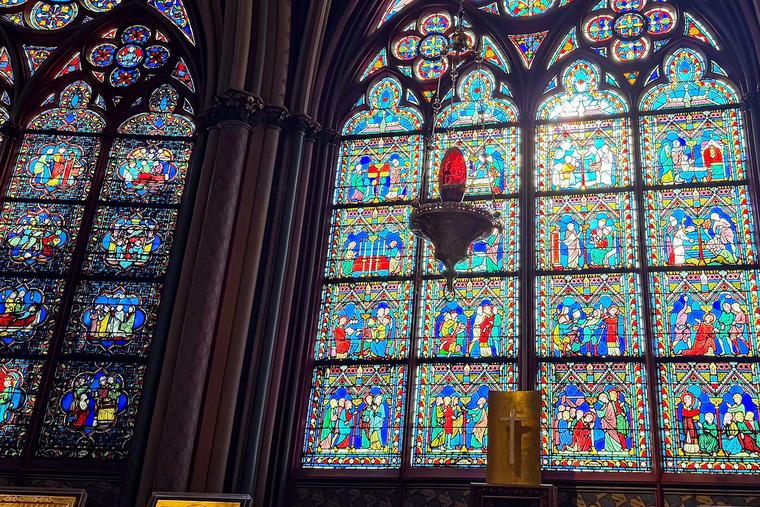
A young man, alone and forlorn following a late-night revel that has left him empty and unfulfilled, wanders into a darkened church that appears to be no less empty than the party he just left. Seeing that he is the only one there, he sits down and, amid the surrounding silence, stares into the darkness.
He sees a light flickering in the distance. It is the light coming from the sanctuary lamp, upon which he fixes his gaze. It occurs to him in a single lightning stroke that if that light is true, if it actually signifies something real, then that makes everything different. Both he and the world will have to change, will need to reorient themselves to this new and unforeseen reality.
The scene I’ve just described, without any artifice to adorn the telling, is taken from a novel by Sigrid Undset, which, unlike her more famous epics set in the medieval world, takes place near the end of the 19th century, and tells the story of this young man’s conversion. I know this, by the way, only because Bishop Erik Varden, who presides over a small diocese in Norway where the novel is set, recounted the story in a recent interview. Having been much affected by it, indeed, haunted by it, he draws the following conclusion, lifting a line from Flannery O’Connor in order to make it: “If it doesn’t speak the truth, then the hell with it!”
Channeling Miss O’Connor, who spoke that line in the company of people too sophisticated to believe a word of what she was saying, was a telling choice. Because it identifies in the most concrete and precise way what defines us, what distinguishes us from an unbelieving world, which is that Christ is at the center of the cosmos and that he remains wholly present to us in the Eucharist. “If it were just a symbol,” as Miss O’Connor was the first to point out, “then the hell with it!”
This is what our faith tells us; this is what Holy Church has never tired of telling us: that here is a truth as plain as it is profound. By the mere lighting of that tiny flame, by keeping it lit, we are assured that God is here, that he has really made himself present to us in the tabernacle and upon the altar where every day he offers himself in sacrifice for the world’s salvation. “He is offering himself to you,” Bishop Varden insists. “Really. Come and eat. Come and be healed. Do you want to be healed?”
Who doesn’t want to be healed? To be made whole? But by a mere wafer? A piece of what appears to be ordinary bread, broken in two in order to be eaten? And what are we to be healed from? For what purpose? Why is it necessary that we be healed?
When asked why he became a Catholic, G.K. Chesterton would simply say, “To get rid of my sins.” If the Eucharist is the medicine of mercy, why wouldn’t we want to take and eat it? Unless, of course, we actually prefer keeping our sins, leaving our souls untouched by the transfiguring action of divine grace. Are there really people who think like that, who cling so desperately to their depraved state that not even the certainty of getting well carries any attraction? Letting go and letting God will never be an option so long as the sovereign self sits high in the saddle.
“The wonderful thing about the sacraments,” says Bishop Varden, “is their blessed objectivity: the fact that we have the assurance that they do confer the grace for which they are set up, whether we feel anything or not.” In these times especially, when so many are fixated on their feelings, their victim status, “it is important to stress a transcendent aspect that does not depend on feelings.” What finally matters, in other words, is that we “nurture the consciousness of what one has in fact received, whether one feels anything or not.”
So much of this it seems will depend on how we view sin. To which end, says Varden, it may be helpful, essential even, to try and see our sins in terms other than a scene from out of a Dostoevsky drama, in which there is first the crime, followed inexorably by the punishment. “We get the balance sheets out and we do the calculations.” Let us instead see things from the standpoint of Scripture and the Church Fathers, where the perspective on sin points to “a primordial wound, a loss, a bereavement, as a kind of amputation in the sense of being cut off and yet yearning to become whole again.”
And the good news, of course, is that while the wounds are unmistakably real, and we must take ownership of them, they need not be fatal. Healing is possible, recovery of the self can in fact happen, returning us to the life for which we were made.
“Be assured,” he reminds us, “that there is no wound that cannot be healed … that what you are made for and what you are intended for, if not in this life, then in the next, is integrity, wholeness, and happiness.”
Asked what so many Christians today suffer from, Bishop Varden suggests that it is a sense of hopelessness, of having nothing to look forward to, no horizon beyond immediate sensate need and desire. One cannot subsist indefinitely on such a diet. Ennui has nothing to commend; it cannot compete with Eucharistica. Better to give thanks than give in to torpor. But to awaken that sense of hope, of holy desire, “is an immense task.” It is a huge and continuing challenge, he tells us:
To get people to believe that this world has an intentional finality, because of which it is moving toward a goal and not just towards ruin. We have to live that hopefulness, while being at the same time entirely lucid and open-minded about the extremely disquieting state of the world we inhabit and for which we are held responsible.
How on earth do we get people to start hoping? It is a question, says Varden, that he often asks. What is it that you desire? At the deepest level, that is, what finally drives your desire? The issue is an urgent one, he says, because its absence seems to be “so preoccupying an aspect of the world we live in now.” Particularly when it infects the very people in whom one would naturally expect an overflow of exuberance. “When you run into 17-year-olds who feel that they have already sort of experienced everything, that there is nothing left, when you see their existential fatigue.”
Where does one go after that? What can one say? “It may seem entirely a banal thing to say,” declares Bishop Varden, who ends the interview by saying it, but it’s the one saving truth on which our lives depend:
For God so loved the world that he gave his only Son, that whoever believes in him should not perish but have eternal life” (John 3:16).
- Keywords:
- holy eucharist
- real presence