The Heart of Christ in Stone: A Forgotten Holy Thursday Devotion
In parts of medieval Europe, the consecrated Host was placed within a sculpted wound in Christ’s chest — a striking expression of Eucharistic devotion now largely forgotten.
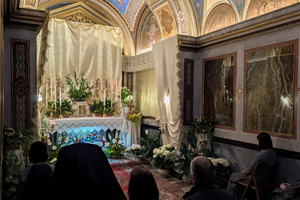
On Holy Thursday, the Church returns to the Upper Room.
We hear again the words that stand at the center of Christian life: “This is my body.”
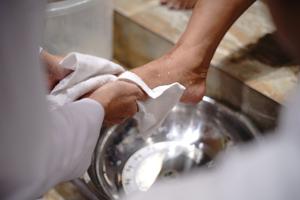
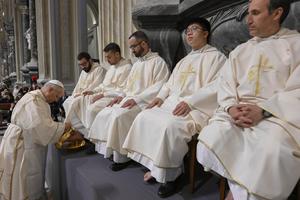
We watch as Christ kneels to wash the feet of his disciples. We follow him into the night, as the Eucharist is carried in solemn procession to a place of repose. The altar is stripped. The Church grows quiet.
It is a night of profound intimacy.
But for many centuries, in parts of medieval Europe, this intimacy took on a form that may seem startling to modern Catholics — yet was, for them, entirely natural.
The Body of Christ was placed within the body of Christ.
A Sculpture That Became a Tabernacle
In the late Middle Ages, particularly in the Rhineland and Alsace, churches began to house what were known as Heilige Gräber — “Holy Sepulchres.”
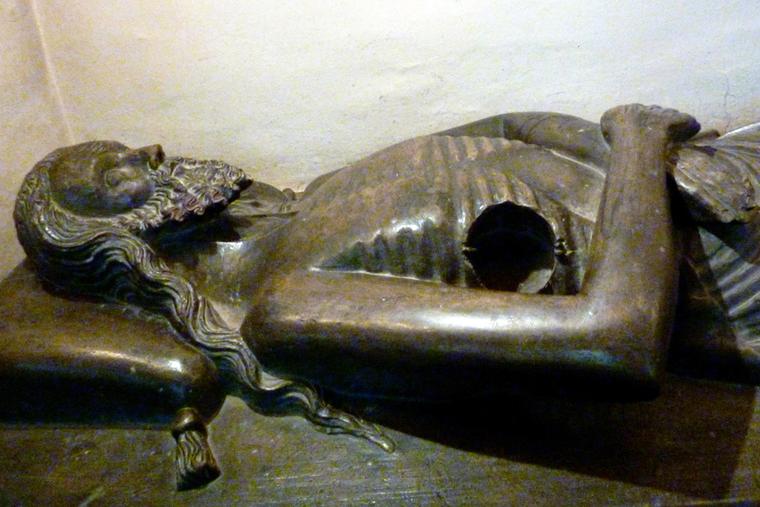
These were not merely symbolic installations or seasonal decorations. They were often permanent, life-sized sculptural representations of the dead Christ laid out in the tomb: recumbent, still, bearing the marks of the Passion.
But some of these figures contained a striking feature. Carved into the chest of Christ — at the very place of the heart — was a small cavity. This opening was not ornamental, but functional.
For it was here, on Holy Thursday, that the consecrated Host was placed.
The Liturgy Written in Stone
Art historians have noted this practice in several surviving examples. As one study observes of the Church of Sts. Peter and Paul at Neuwiller-lès-Saverne (1478), the function of the monument is unmistakable: a cavity in Christ’s chest served as a receptacle for the Eucharist during the liturgy of Maundy Thursday.
This was not an isolated curiosity. Similar structures appear across the Upper Rhine region, in both parish churches and monastic settings, suggesting a widespread devotional practice.
This is how the medieval creative mind intertwined art and liturgy. The sculpture became, in a sense, a tabernacle, with the carved body of Christ the place in which the sacramental Body of Christ was reposed.
The Meaning of the Heart
To modern sensibilities, such a gesture may seem unusual — perhaps even unsettling. But, within its theological and spiritual context, it is remarkably coherent.
It is no accident that the cavity is located at the place where the centurion’s lance pierced Jesus. So for the great preachers of the region at the time — figures like Meister Eckhart and Johannes Tauler — the heart was not merely a physical organ. It was the deepest center of the human person: the “ground” or “spark” of the soul, where God is encountered most intimately.
In this light, the placement of the Eucharist within the “heart” of the figure of Christ takes on a profound resonance. The faithful are not invited merely to look upon Christ; they are invited to enter into him — to participate in the mystery of divine life given and received.
As one theological reading of these monuments suggests, the cavity may be understood as a kind of meeting point: the depth of God calling to the depth of the soul.
Holy Thursday is, above all, the feast of the Eucharist. It is the night on which Christ gives himself — not as image, not as memory, but as presence.
The medieval practice of placing the Host within the sculpted body of Christ does not attempt to explain this mystery; it enacts it.
A Devotion We Have Forgotten
Today, these monuments remain in some churches, but their original liturgical use has largely faded from memory. We are, perhaps, less accustomed to such tactile expressions of faith. We tend to separate art from liturgy, symbol from sacrament, image from reality.
But the medieval Christian imagination did not operate along those lines. It was not concerned with proving the mystery. It was concerned with entering it.
On Holy Thursday, the Church asks us to enter into the mystery of God giving himself completely.
The sculpted Christ of the Heiliges Grab, with its hidden cavity at the heart, stands as a quiet witness to that truth. As an invitation. To begin with the heart.