How This Eucharistic Miracle Helped Spark Corpus Christi
The Eucharistic miracle in Orvieto played a key role in launching the Solemnity of Corpus Christi.

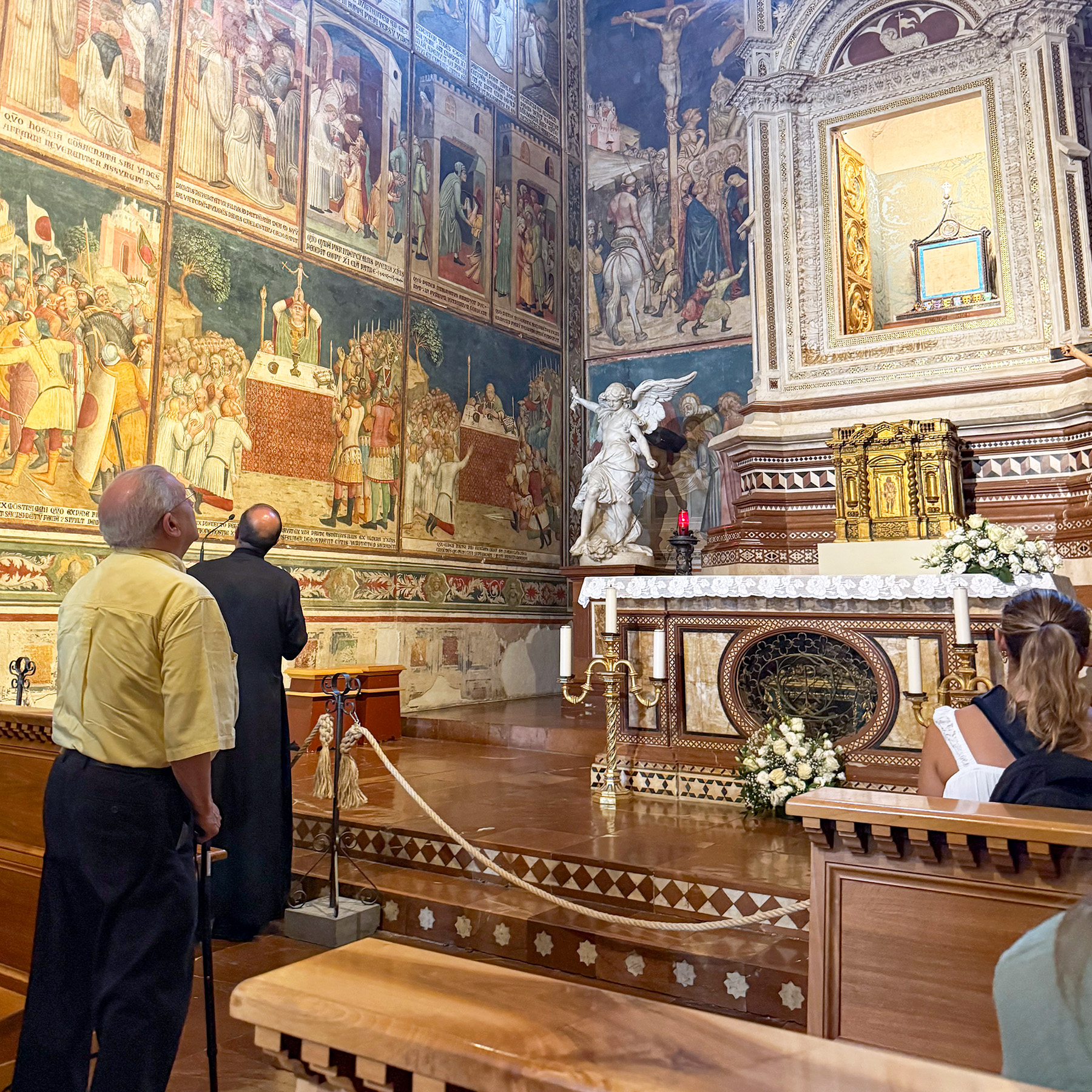
At the end of May, during a pilgrimage through Italy with my family during this Jubilee Year of Hope, I found myself kneeling in silence before a blood-stained corporal in the Cathedral of Orvieto. It is the very linen cloth that gave birth to a feast celebrated by Catholics around the world: the Solemnity of the Most Holy Body and Blood of Christ, also known as Corpus Christi.
I had been to Orvieto before — a beautiful hilltop town rich in history, with medieval streets, Etruscan roots, and one of the most stunning cathedrals in all of Italy.
But this return visit, during the Jubilee Year of Hope, was quite special. The blood-stained corporal from the Eucharistic miracle is displayed only at certain times of the year, and by God’s Providence, I happened to be there when it was visible. Standing before that sacred altar linen, I realized I wasn’t just admiring a historical artifact. I was face to face with a living sign of the hope that still pulses at the heart of the Church
.In 1263, a priest named Father Peter of Prague was struggling with doubt. Though faithful, he found it hard to believe that Christ was truly present — body, blood, soul and divinity — in the consecrated Host. While offering Mass in the town of Bolsena, just outside Orvieto, he begged God to strengthen his faith. At that moment, blood began to drip from the Host onto the corporal and the altar.
Shaken, Father Peter halted the Mass and went directly to Pope Urban IV, who was residing in nearby Orvieto. After an investigation, the miracle was confirmed, and the corporal was enshrined in the cathedral, where it remains to this day.
Just one year later, Pope Urban IV instituted the Solemnity of Corpus Christi for the universal Church, commissioning St. Thomas Aquinas to compose the liturgical texts. The Church responded to doubt with procession, with worship, with reverence. And we are called to do the same.
Today, in a world riddled with skepticism, indifference and confusion, the need for Eucharistic faith is no less urgent. We are told that religion is a private matter, that sacraments are merely symbolic, and that hope is little more than wishful thinking.
Yet throughout history, God has worked Eucharistic miracles — like the one at Orvieto and many others across the centuries — not to dazzle us, but to affirm the truth of his presence and to strengthen our faith. Christ truly dwells among his people, hidden in the Host, carried in the monstrance, and received into our very bodies in Holy Communion.
The Eucharistic Revival in the United States is not just a program. It is a summons to reawaken what has been forgotten. It is a call to see with the eyes of faith, to return to the Upper Room, and to fall to our knees in adoration. The revival is not over. It cannot be over until Christ comes again. Until then, the tabernacle light still burns and the Bread of Life still waits for hungry souls.
Hope is not a vague feeling or a sunny disposition. It is the unshakable conviction that God keeps his promises. In the Eucharist, He fulfills the greatest of them all: “Behold, I am with you always, even to the end of the age” (Matthew 28:20).
I do not know exactly what Father Peter saw that day. But I know what I saw in Orvieto. I saw people from all around the world gathered in that side chapel of the cathedral to pray before this Eucharistic miracle. I saw hope, alive and tangible. I saw the Church, still believing. I saw Christ.
And, more than ever, I believe: the revival is only just beginning.
Tyler Greenwood writes from West Virginia.