The Ostermann Fiasco Is Over. Notre Dame’s Catholic Identity Crisis Is Not
EDITORIAL: Now that abortion-rights advocate Susan Ostermann has stepped away from an academic leadership post, the university needs to undertake meaningful reforms to ensure a comprehensively Catholic identity.
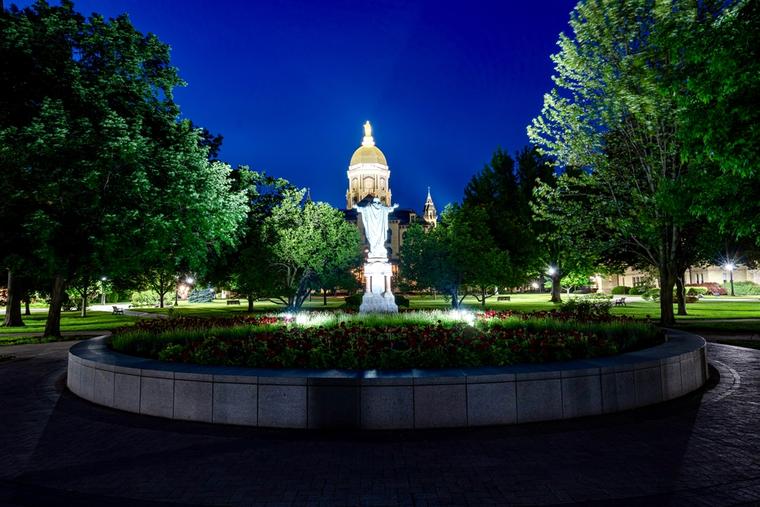
Abortion-rights advocate Susan Ostermann’s decision to withdraw from her appointment as the new head of the University of Notre Dame’s Asian studies institute is welcome news, so far as it goes.
But it’s only the start of initiating a necessary review to identify the factors that allowed her completely indefensible appointment to occur. And more broadly, to do everything that’s necessary to reinstate a comprehensively Catholic identity, throughout all of Notre Dame’s operations.
The decision to appoint Ostermann to head the Liu Institute for Asia and Asian Studies, despite her strident history of abortion-rights advocacy throughout her tenure as a professor at Notre Dame’s Keough School for Global Affairs, ignited a national firestorm of criticism. On campus, it was spearheaded by the university’s student pro-life group and several members of the faculty. Among the wider community, opposition was led (and properly so) by Bishop Kevin Rhoades of Fort Wayne-South Bend, whose denunciation of the appointment as a “scandal” garnered the public support of 18 other U.S. bishops, along with a broad cross-section of concerned lay Catholics. Bishop Rhoades also personally visited the campus this week to lead a prayer vigil in support of Notre Dame’s Catholic identity.
The pro-life community can take heart from what happened after these voices united to make themselves heard. Unlike in the case of Notre Dame’s shameful decision in 2009 to bestow honors on pro-abortion-rights President Barack Obama, this time around the university stepped back from an action that fundamentally contradicted its Catholic mission with respect to upholding the sanctity of life.
When pro-life voices speak together like this — and are backed by powerful prayers — they can attain positive outcomes even when the odds seemed stacked against them.
That said, Notre Dame’s administration hasn’t acknowledged its profound lapse of judgment in appointing Ostermann in the first place. This obstinate refusal to admit mistakes demonstrates how urgently reform is needed. As Holy Cross Father Wilson Miscamble, a retired Notre Dame history professor, commented to the Register, “This sad episode reveals that there is much work to do to uphold the Catholic mission and identity of Notre Dame."
Two priorities are already in view.
First, new procedures must be instituted going forward to ensure key appointments are vetted at the highest level and align with the university’s Catholic values. In this case, sources have told the Register that Holy Cross Father Robert Dowd, Notre Dame’s president, was “blindsided” by Ostermann’s promotion and sought a way out of the public-relations mess that ensued. But it never would’ve occurred if Ostermann’s convictions had been appropriately scrutinized in light of Notre Dame’s Catholic commitments, which go beyond making the university “global.” Notre Dame’s top academic administrators must be on board with this robust vision of Catholic mission; if not, they should be replaced.
Second, the tenor of Ostermann’s own explanation of her decision to back away from the appointment highlights the need to rediscover what academic freedom truly means at a place like Notre Dame. Rather than apologize for her previous inflammatory rhetoric regarding the pro-life movement — which included claims that pro-life laws are rooted in racism and that abortion is consistent with the Catholic principle of integral human development — Ostermann claimed the criticism of her appointment made “clear that there is work to do at Notre Dame to build a community where a variety of voices can flourish.”
No, Professor: The work that needs to be done at your university is to come to a better understanding of how academic inquiry and Catholic mission are united, not opposed.
As Bishop Rhoades said in his statement following the reversal, opposition to Ostermann’s appointment was never about restricting academic freedom, but about ensuring that Notre Dame’s “institutional witness” remains intact.
“Academic freedom protects inquiry. It does not require institutional self-contradiction,” said the bishop, echoing Notre Dame’s own academic principles.
If Notre Dame can’t fully commit itself to the basic principle that human life is sacred — a conviction that flows from both faith and reason, which together guide the university’s unified pursuit of truth — how can it do the clear thinking required to navigate the complexities of artificial intelligence, transhumanism and other rapidly emerging moral challenges?
The Ostermann fiasco is over. Yet while it’s tempting for pro-life students and their supporters to simply take the “W” in the Ostermann case and move on, we hope they’ll continue to press their case, because it’s clear that Notre Dame still must definitively address and definitively answer these deeper questions about its Catholic identity.