Romano Guardini Diagnosed the Pride of Our Age — and Looked to the Cure
COMMENTARY: Long before smartphones and AI, the Catholic thinker warned of the dangers of technological progress unmoored from truth and meaning — and called for a return to contemplation.
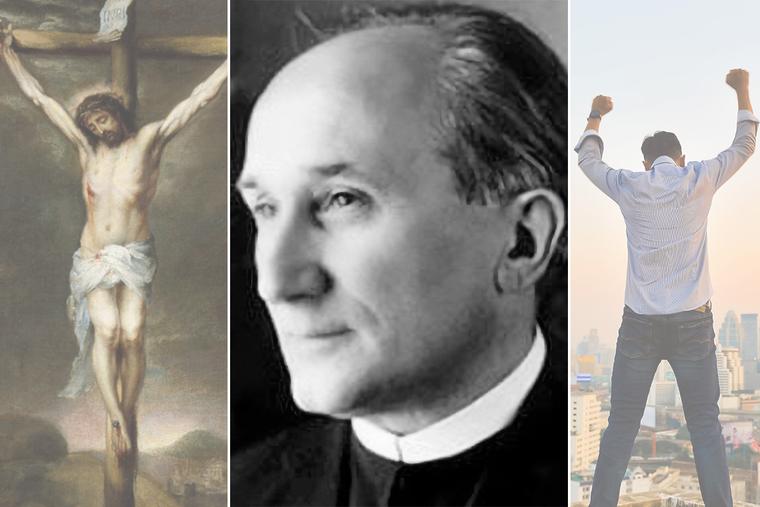
Mid-20th-century theologian Romano Guardini (1885-1968) addressed the social challenges of increased technology in a post-Christian era. Pope Francis’ proposed dissertation was based on Guardini’s work, and Pope Benedict XVI, then Cardinal Joseph Ratzinger, wrote the introduction to the English-language edition of Father Guardini’s book, The Lord.
Given the current fixation with smartphones, social media and artificial intelligence, Guardini’s observations are worth examining.
He challenged a widely-held belief — one that continues to shape our outlook today, often leading to poor decisions, dangerous outcomes, and a feeling that things are no longer “right.”
This belief consists of a fantasy of ever-advancing progress engendered by reason alone. Such an assumption perpetuates the idea that future events are inevitable. Consequently, we become passive and ignore the mistakes, abuses and violence done by individuals.
Some explain this passivity proudly as coming down on the “right” side of history. Guardini warns, however, that the spirit of man is not determined and inevitable but free and able to act on its own. He writes that “history does not run on its own; it is run.”
If, as Guardini suggests, personal decisions determine the direction of history, society can veer off course for long periods. Consider the well-being of a cohort of individuals who believe that nothing they do matters. Or, on the other hand, consider certain individuals who insist that their ability to control future events has been enhanced by science. In both cases, unintended and unfortunate consequences can and do occur.
Guardini, who studied economics for three semesters in Munich and Berlin, valued freedom. He maintained that freedom consists not in rejecting advances in knowledge, but rather in ascertaining the basic facts of existence.
Perverse outcomes result when those in charge operate based on incorrect assumptions concerning the essence of things. Therefore, to avoid such catastrophes, there is a need to change course and “realistically” reorient away from a total disregard of ultimate values.
Guardini sincerely believed that intentions and attitudes are not merely private matters of no historical importance. Therefore, he focused on those tasked with certain responsibilities: the schoolteacher maintaining discipline, the judge deciding a case, the priest championing the things of God, the doctor treating a patient, the bureaucrat dealing with the public, the industrialist directing a firm, the merchant supplying customers, the factory-worker tending a machine, the farmer running a farm. Each interaction yields direct and indirect outcomes.
If history is not decided arbitrarily by natural forces, how do we choose to do what is good and right? A better future is ensured, according to Guardini, by integrating ourselves with the Creator who gave the world into our keeping and who will demand an account.
Personal dignity, freedom and justice were not uniformly practiced in former times, but they were at least acknowledged. How then does Guardini explain how modern society has lost its bearings?
First, he suggests that in a post-Christian world, the cognitive elite consider themselves unbiased realists. They are certain that they are acting in the best interests of society and upholding the course of history. Indeed, technology has bestowed on them great power but, in many cases, the power to control outcomes is beyond their ability.
As for society as a whole, Guardini indicates that any order is destroyed when the essence of things is ignored or abused. He warns that sooner or later reality hits when things are misused. For example, the essence of obedience, freedom, property, friendship, and the union of a man and woman must be acknowledged. Only then can an accurate assignment of weights be given to a range of values.
Guardini admitted to misgivings about the ability of present-day Christians, guided by the impulses of power, prosperity and pleasure, to recapture lost attitudes. He did, however, offer a potential solution. It is the rediscovery of a contemplative attitude, an interiority deep enough to contact the truth lying at life’s center. He strongly recommends moments of stillness opening hearts and minds to piety, wisdom and ethical honor. Emerging from such contemplation will be an awareness of what is right and proper regret.
Guardini suggests a type of asceticism that is neither hostile to ordinary life nor searching for a transcendental experience. Rather it is one grounded in responsibility and the requirements necessary to rule oneself in freedom rather than slavery. To think independently, a person must acquire a certain distance from things, such as “street traffic, newspaper, radio, screen, and television.” Asceticism is the refusal to capitulate to forces of barbarism and hold on to higher things.
There is a reason why Guardini refused to outline a specific contemplative program. It is because no one is capable of constructing such a relationship with God. Rather, the very essence of a person consists of this relationship. Thus, our character is determined by how seriously we view our relationship with God and what we do about it.
Today, we experience perverse outcomes from believing that the future is determined by technology-assisted natural forces rather than personal agency. A return to a more contemplative way of life offers a more realistic perspective.
This might sound like too simple a solution for modern challenges, but Guardini’s suggestion might be worth a try.
- Keywords:
- Romano Guardini