The Great Aunt Who Held My Family Together
COMMENTARY: From a velvet chair, Great Aunt Wladyslawa reminded a crowded room of cousins and kin that family must be ‘nurtured like a plant,’ rooted in Catholic faith and shared tradition.
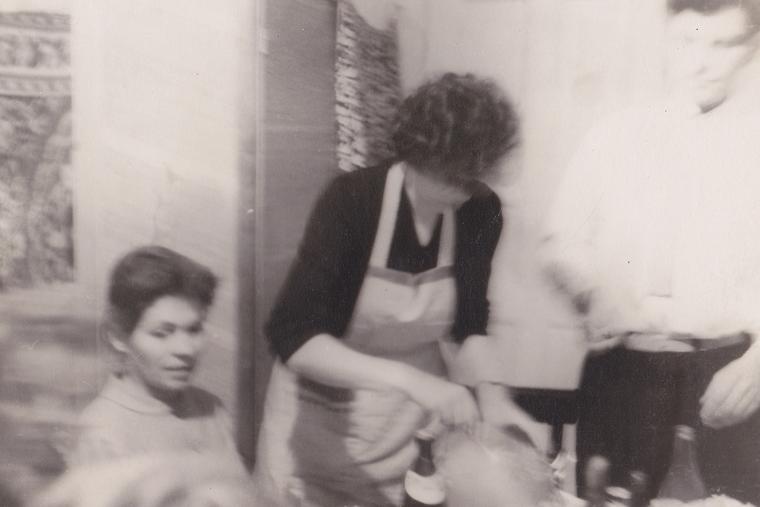
When I reflect on my boyhood, I always think of my Great Aunt Wladyslawa, who was the unquestioned matriarch of our extended family.
The last of four sisters who had emigrated from Poland to the United States in the latter part of the 19th century, Great Aunt Wladyslawa, whose name means “ruling with glory,” married my Great Uncle Michael, whose background was Lithuanian. This was not unusual, because during much of their history, Poles and Lithuanians had been joined in one kingdom.
My great aunt epitomized the meaning of the word “family.” During our annual visits from our home in Lynn to Lawrence, Massachusetts, for the celebration of her birthday, everyone received a tutorial on the meaning and significance of family in our lives.
“It is God’s gift to us,” this tall, ample lady proclaimed from her velvet Victorian winged-back chair. “It is something to treasure and nurture.”
This was the theme of every speech she gave to our extended family of my cousins, aunts and uncles, who were packed into the parlor and adjoining dining room of her home at all of her birthday celebrations.
Always elegantly dressed in a black lace dress, my great aunt had a mountain of gray hair that swirled around her head in gigantic braids. Bedecked with an assortment of jewelry, including a tiara, she not only bore a strong resemblance to Queen Victoria but also had a regal bearing that betrayed her aristocratic origins in Poland.
Standing dutifully by my great aunt, Great Uncle Michael was a handsome man with snow-white hair. Deeply religious and patriotic, the couple operated a business that produced flags and banners.
In the 1930s and 1940s, it was not unusual to see both American and Polish flags in Catholic churches primarily composed of Polish American worshippers. Other ethnic Americans who attended Catholic churches also prominently displayed the American flag along with one from their country of origin.
Equally common were finely-stitched banners, made by gifted seamstresses, that depicted various saints, especially the church’s namesake. I remember seeing many of these beautiful banners in our parish church, St. Michael’s, in the 1940s.
Everyone listening to my great aunt on her birthday strongly shared her views about family. “Family must be nurtured like a plant,” my mother and father often told me and my siblings.
That is when I began to understand that our sense of family included our shared belief in the Catholic faith and our unique ethnic traditions. “Polish nationalism was synonymous with Catholicism,” my father repeatedly said. The entire family often gathered together not only for birthdays but also for anniversary Masses in memory of the deceased members of our large family.
I attended so many Masses as a young boy that the church became a kind of second home to me.
Unlike many kids my age, I looked forward to going to Mass. I enjoyed the beautiful liturgy performed by the priest, who was always dressed in colorful vestments. Most of all, I enjoyed Latin, the ancient language of the Church in the West, which the priest used to say Mass and to perform other church rites.
Over time, I became so good at learning Latin that Sister Brunona, who was in charge of recruiting and training acolytes at St. Michael’s School, asked my parents numerous times that I become an altar boy. But our move from West Lynn, where St. Michael’s parish was located, to Swampscott made it impossible for me to attend practices and study sessions that Sister Brunona conducted.
For me, the next best thing was to sing in the children’s choir, where I sang the Latin hymns so loudly that Sister Angelica, my fifth-grade teacher and church organist, frequently urged me to lessen my volume.
I also ordained myself as a child-priest in a manner of speaking. Since I had the entire ritual of the Mass memorized in Latin, all I needed was a makeshift altar, a few candlesticks, and of course, a fancy goblet to serve as a chalice. Vestments didn’t present a problem. I simply took two old towels that Mom had consigned to the rag heap, pinned them together with safety pins, and voilà, I had a priest’s chasuble!
Little did I realize at the time that the privacy of the sunroom, where I played at being a priest, was not so private. My cousin Dolly, who lived with us along with her sister and my beloved Aunt Rose, was aware of my “Masses.” My mother, too, opened the door one day to clean the room during one of my church sessions. She smiled, said nothing, and allowed me to say my prayers.
Little wonder everyone in the family thought I was destined to become a priest someday. Word about my love of Latin and “playing priest” got back to my Great Aunt Wladyslawa. At one of the gatherings for her birthday, she looked at me with a warm smile, declaring, “We may have a priest in the family one day. Every Polish family should have a son in the priesthood.”
Little did anyone realize that our visit to Great Aunt Wladyslawa’s birthday one year would be the last. My mother and father, who were very perceptive, sensed by her words and by the tone of her voice that she was delivering a valedictory to our entire family.
She always spoke in Polish, which I understood. But on this occasion, I had trouble understanding a great deal of what she said because her voice was thin, almost inaudible at times.
She always ended her birthday remarks with references to death. Instead of joyfully celebrating her birthday, she had everyone in tears. It was more of a wake than a party.
Much of what she said included quotations from the Bible that specifically applied to family. Her favorite one was the short but powerful verse from 1 John 4:19: “We love because he first loved us.”
My mother later told me that Great Aunt Wladyslawa finished her final farewell to the family that year with 1 Corinthians 13:4-8, which my mother remembered because that was one of her favorite passages from the Bible.
Love is patient, love is kind. Love is not jealous, or rude, or self-seeking, or irritable, or resentful; love does not rejoice at wrongdoing, but rejoices with the truth. It bears all things, believes all things, hopes all things, endures all things. Love never fails.
After my great aunt passed away, I recall my Uncle Zenon approaching my mother at the cemetery. “Liz,” he said tearfully, “you’re the only one to fill her shoes and keep our beautiful family together.”
“No one can fill her shoes,” Mom modestly replied. “But I’ll do my best.”
And she did.
- Keywords:
- catholic families
- catholic traditions