‘When God Made You, He Created a Good and Decent Man’ — A Story I’ll Never Forget
COMMENTARY: Their lives were shaped by exile, war and hardship — but what endured was a friendship that taught a young boy what human dignity really means.

My father was a devout and devoted Polish American Catholic who taught me as a young boy that everyone was a child of God. Following Jesus Christ’s admonition that his family is everyone who does God’s will, my father treated everyone with dignity and respect. It was the best gift he ever gave me.
After he arrived in the United States, my father forged a friendship with a Yiddish-speaking Jewish man who grew up in a shtetl in Poland not far from where my father and his family farmed a piece of land.
Both men emigrated to the United States around the same time and, remarkably, found their way to the same city — West Lynn, Massachusetts, which had a thriving Polish American enclave in the 1930s and 1940s.
My father, who had a gift for languages, was fluent not only in his native Polish but also in Russian. When he was a young boy, he befriended a few Jewish boys his age who gave him some knowledge of Yiddish, which the majority of Jews spoke.
Dad also spoke English, accented with a delightful Slavic lilt that softened its harsher edges.
I was 5 years old when my parents bought a “three-decker,” a triplex of apartments in West Lynn. The ground floor housed the “White Eagle,” an upscale tavern that on weekends featured bands that played swing music, polkas and mazurkas. We lived in the large apartment above the family business and rented out the other two apartments.
In the months following Pearl Harbor and U.S. entry into World War II, the government urged Americans to contribute rubber, metal and other items that were vital for the war effort. Buying U.S. War Bonds and planting “Victory Gardens” were a few of the ways civilians on the home front could help. Government rationing of food, gasoline and other goods previously taken for granted became a new way of life.
It was in this wartime environment that Moshe, a salvage man, suddenly appeared.
Pulling a rickety wooden wagon was an old brown nag who knew the route his master took in West Lynn so well that he would stop at homes without the prompt of a rein. Moshe, crippled by arthritis, would step down and load whatever a donor had left at the curb.
Because he had difficulty with English, Moshe would yell the word that came easiest to him, “Rags!” But everyone knew that Moshe collected anything left out — wood, metal, rags, old tires, paper and even clothes. My mother even gave him some metal hair curlers.
One of our neighbors, not to be outdone by actress Rita Hayworth, who donated her car’s bumpers to a scrap-metal drive in California, took the bumpers off his car and donated them to the war effort, too. He complained that he never received the publicity for his donation that Rita Hayworth did.
“Rags! Rags!” rang out mournfully, echoing the pain and suffering Moshe had experienced in his life. Rumor had it that he had no family — all of whom had died in a Russian pogrom. “Rags! Rags!” Moshe shouted out in a wobbly baritone voice that ricocheted back and forth among the closely-built houses and apartments of West Lynn.
Every time I heard Moshe’s voice, I ran to the porch that encircled the back of the apartment, fascinated by this interesting man, whose face was wrinkled and covered with a scraggly gray beard.
Moshe looked like an Old Testament prophet depicted in Baroque paintings. Dressed in the same worn brown shirt and trousers, he wore a black, moth-eaten cap on his head, reminiscent of Tevye, the main character in Fiddler on the Roof.
If my father was within hearing distance of Moshe, he would stop what he was doing and go outside to greet him. And he always gave Moshe a cup of coffee and a sandwich. I sometimes heard my parents speculate whether this was Moshe’s only meal of the day. My mother often gave me a bag filled with groceries to place under the seat of the wagon while Moshe and my father sat and talked at the other end of it.
When Dad appeared, Moshe’s sad face was suddenly transformed by a warm smile. He would sip the coffee and eat the sandwich, often repeating the Polish word, “Dziękuję!” (Thank you) to my father. Dad and Moshe used these moments to talk about their lives and experiences in Poland. To be sure, they also talked about their lives in the United States and the war that raged on many fronts.
They spoke in a Yiddish/Polish patois, which was more than adequate for them to communicate. My father was perhaps the only person in the city who could converse with Moshe at length.
Meanwhile, the horse — whom Moshe had named “Iskra” (Spark) — enjoyed a break from the drudgery of work and ate a bag of oats his master had given to him. After the horse had his fill of oats, Moshe would groom “Iskra,” who shook his head approvingly.
I never understood why Moshe had named his horse “Iskra,” because there wasn’t much spark left in the old horse. One day Moshe waved to me as I stood on the porch — an invitation to see and pet his best friend. It took only one invitation and I was there every time he came. It was a highlight of my day.
When the war ended in 1945, Moshe’s visits became scarce. When my father and I saw him one day, his appearance had changed. He was very thin and coughed constantly. My father suggested he visit our family doctor. Knowing that Moshe was a poor man and probably had never been to a physician, my father offered to pay the cost.
Moshe thanked my father but declined the generous offer. Then he did an extraordinary thing that I never have forgotten. He walked over to my father and gently stroked his face, saying in Yiddish, “When God made you, he created a good decent man.” My father later translated what Moshe had said.
As Moshe slowly walked back to his wagon, he turned and looked back at my father for a long time. Tears from his eyes glistened in the late afternoon sun. He waved to us with his emaciated hand as he and “Iskra” disappeared down the street. It was one of those emotional moments that you never forget.
My father took my hand in his and said with sadness in his voice, “Dicky, I think that this is the last time we shall ever see our friend, Moshe.”
It was. My father tried unsuccessfully for a very long time to find out what had happened to Moshe. Moshe had disappeared.
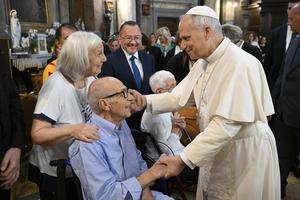
My father was blessed with a profound empathy toward people whose immigrant experience was not as happy and rewarding as his was. Dad never forgot Moshe. He often mentioned him in the years that followed. Dad firmly believed that friendship was a gift of God that should be constantly nurtured. He would have wholeheartedly agreed with Pope Francis, who said in a 2024 Regina Caeli address that friendships can lead to spiritual growth and holiness.
- Keywords:
- human dignity
- charity
- friendship
- holiness
- immigrants