The Three V’s of Church Architecture: Vision, Verticality and Volume
COMMENTARY: Vision, verticality and volume are the silent language of churches that lift the soul to God.

Happily, across America (especially in the South) an increasing number of new Catholic churches, cathedrals and chapels are being built to more traditional designs that aim to inspire through beauty.
Whenever I happen to meet our seminarians, I always make it a point to stress the importance of sacred art and architecture, because these are the men who will go into parishes and be charged with building new churches and chapels and renovating and restoring old ones. The subjects of sacred art, sacred architecture and sacred music — and their role in worship and Catholic culture — are complex and fascinating, too much so for the scope of this article.
Instead, I’d like to consider the essence of sacred architecture.
What is it that makes a church building “sacred?” Why do we enter great churches and cathedrals and gasp with wonder while others fail to inspire or even discourage us? Are some historical styles intrinsically better than others? Why do we like some churches more than others and feel like they are more holy? Does a particular church inspire just because it is old?
Vision
I like to boil the essence of sacred architecture down to three words that begin with the letter “V.” The first word is Vision.
We should start with basic considerations. What is a Catholic church for? We know there are certain utilitarian factors that matter: It needs to seat a certain number of people. The acoustics and sound system should be effective. The toilets should be accessible and efficient. The HVAC needs to be adequate, and around the church, we need parking and sidewalks and so forth. All well and good — but that describes what a church does, not what a church is for.
A Catholic church is not primarily a preaching hall. That’s what Protestant churches are for. A Catholic church is for the celebration of the sacrifice of the Mass and for a suitable dwelling place for the Eucharistic presence of the Lord. In other words, it is a temple, not an auditorium.
The dullness of too many of our contemporary Catholic churches is due to the fact that the clergy, people and architects never stopped to examine this first question — the question of vision. As a result, we have been lumbered with efficient but unbeautiful auditoria. Too often, it seems the architect created a preaching hall then, remembering that it was supposed to be Catholic, added a few windows with pointed arches, or a row of faux pillars, or a poor-quality print of Da Vinci’s Last Supper on the wall.
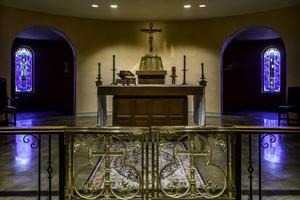
The second takeaway from a consideration of vision is that the interior — and consequently the exterior — should be designed outward from the altar. In other words, the altar of the Lord and the tabernacle to the East behind it, are the focus for the entire building, and the actions that take place within it.
When the altar is the focus of the church, everything else falls into proper perspective. For this to be effective the church, therefore, needs to be designed with a clear orientation from West to East — from the back of the church to the altar and tabernacle. This orientation and focus implies movement and therefore signifies at an unspoken level the fact that Christianity is linear — in other words, it moves from a beginning to an end. There is an alpha and an omega.
There is a first step and a destination. Christianity is not cyclical and circular. This is one of the reasons why so many round- or fan-shaped Catholic churches instinctively feel unsatisfactory.
Verticality
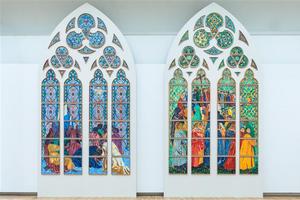
The second word that begins with “V” is Verticality. Whenever someone visits the new Our Lady of the Rosary Church in Greenville, South Carolina, they enter the nave and invariably utter hushed words: “It’s beautiful!” I then ask them why. They will usually say, “I like the stained glass windows” — or pick out some other point of appreciation.
I think, however, that they are struck by something greater — an atmosphere of the sacred — that they are in touch not only with beauty, but also with the source of beauty himself.
How is that communicated? My own opinion is that it is through verticality. The church has height. The high ceiling and the high windows lift the eye and the soul to heaven. We are aware of being in a space that reaches upward.
Furthermore, we sense that this verticality is not utilitarian. There is an extravagance to the verticality — costly, with no obvious economic or practical purpose. Indeed, in many modern churches that are otherwise traditional in form, one can sense that someone, sometime along the building process, convinced the building committee they could save a good bit of money by lowering the ceiling by 30 or 40 feet. Alas, despite their plans for a lofty temple, they ended up with a stumpy preaching hall instead.
Volume
The third word that begins with “V” is Volume. I am referring not to the strength of the sound system, but to the amount of space in the interior of the church.
With proportionate verticality, the volume of space is increased, and we rightly feel that “our feet have been placed in a large room” (Psalm 31:8). With spacious volume we know that we are not in a comfortable auditorium, a living room or the waiting room of a doctor’s office. We are in a palace, a throne room, a temple, a dwelling place of the Son of God.
Adequate volume within a church takes us to a place that is larger than our usual abodes and workplaces, and that encourages our hearts to open in reverence and prepares a proper attitude for worship.
Along with the verticality, the volume of the space adds a sense of grandeur that lifts the spirit. “Ah,” I hear you object, “does not a warehouse, a retail store or an airport have volume?” Yes, but they rarely have volume and verticality — and even when they do, they lack the vision that directs our hearts and minds to God.
Vital Unity
Verticality and volume alone do not inspire. Only when the three (like a little holy trinity) come together do we experience the sweep and strength of sacred space.
What interests me most about these three concepts is that while they are essential to sacred architecture, they operate at an implicit level.
We absorb the vision, the verticality and the volume of a beautiful church, chapel or cathedral, but most of us are not aware of these factors. They operate on us at an instinctive level — below our consciousness — and they are all the more powerful for that.
A proper consideration of these three factors sidesteps the question of architectural styles because any architectural style can be suitably sacred if the vision is correct and is articulated with verticality and volume. Of course, there are other factors to be considered: suitable decoration of the church, practical matters of utilitarian concern, economic realities and the community’s needs.
Too often these practical concerns predominate while the essential questions are never asked. If we are to have a renaissance of Catholic culture that is beautiful, good and true, then our seminarians, the building committee members, architects and benefactors of the next generation will need to do their homework. If they do, I’m confident that we may well see a continued burgeoning of worthy new churches across the land.
- Keywords:
- church architecture
- sacred architecture