There Are Misunderstandings on Both Sides of the Altar Rail Debate
COMMENTARY: The theological, liturgical and historical dimensions of altar rails are no longer widely known.

Trouble has been brewing in various parts of the Catholic Church in the United States over the increasing desire among traditionally minded Catholics to have altar rails in churches.
The issue of altar rails resurfaced recently in the Diocese of Charlotte, North Carolina, as part of Bishop Michael Martin’s proposed crackdown on traditional styles of worship even in the normative form of the Mass, the Novus Ordo.
So what’s all the fuss? I think the problem is a classic misunderstanding, which is a result of ignorance of the issue in question, combined with a lack of understanding of the opposing opinion. The first step in resolving the conflict is clarity. The second step is charity.
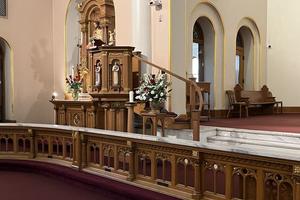
For the sake of clarity — what is the history and purpose of altar rails to start with? From a practical point of view, they help people kneel and rise more easily. They also, in times past, acted as a kind of fence to keep animals out of the sanctuary. But those are merely practical considerations. Like every aspect of church architecture, there are deeper theological and liturgical reasons.
The altar rail is a sign of ancient Church traditions with roots going back to the Old Testament. In the first four centuries, Christian worship took place in private homes, but as churches grew larger, a marker developed separating the priestly action at the altar from the congregation. In these early basilicas, low screens called cancelli (latticed partitions) marked the separation.
Meanwhile, in the East, the iconostasis — the partition with painted icons — developed to separate the congregation from the priestly functions. By the early Middle Ages, in the West, the rood screen — a wooden screen surmounted by a crucifix — was serving the same purpose as the iconostasis in the East.
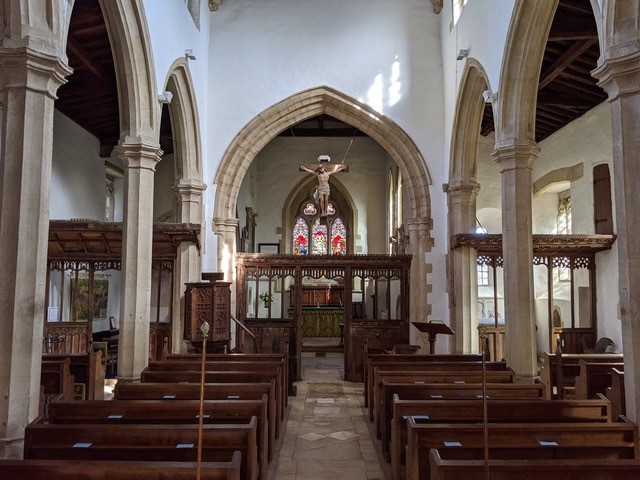
The demarcation of three distinct worship spaces — the nave, the sanctuary and the altar — echoed the more ancient design of the Temple in Jerusalem and before that the Hebrews’ desert tabernacle.
These Old Testament spaces for divine worship were divided into the court of the people, the holy place (where the priests functioned), and beyond that, the Holy of Holies, the focus of the divine presence. In Christian architecture, this developed as the nave, the sanctuary (or chancel) and the tabernacle, where the Blessed Sacrament was reserved.
At the Protestant Revolution, rood screens were demolished and altar rails became the boundary markers between the nave and the sanctuary. Catholic practice followed. That the altar rails also served as kneeling rails was an added practical bonus.
Now here’s where the curious misunderstanding developed: By the 1960s, the “spirit of Vatican II” was sweeping the Church, and one of the hallmarks of this ideology was a kind of shallow egalitarianism.
I doubt if the ecclesiastical revolutionaries understood the ancient symbolism of the trifold division of worship spaces. They just apparently saw kneeling for Communion as beneath the dignity of the people of God.
Altar rails were seen as supporting an overbearing clericalism — upholding an archaic and unfair hierarchy in which the priests were “up there” and the subservient people were “down there.”
So, along with abolishing the altar rail, the new egalitarians moved the altar down among the people and began referring to it as the “Communion table.” The predominant model for the Mass became a communal meal instead of a sacrifice. The disuse or destruction of the altar rail was just one piece of this ideologically motivated agenda.
Likewise, I doubt if many who advocate restoring altar rails wish to restore the ancient trifold division of worship space. Most are unaware of the history, and the younger people are unaware of the reasons why altar rails were abolished 50 or 60 years ago. They are uninterested in shallow (and outdated) arguments of some bishops.
Instead, they simply wish to kneel to receive Communion, and an altar rail makes it easier. They long for reverence in worship, and kneeling and receiving Communion on the tongue seems more traditional and worshipful. If their grandparents were zealous in their enthusiasm for “the spirit of Vatican II,” they are probably just as zealous in their enthusiasm for “the reform of the reform.”
At Our Lady of the Rosary Church in Greenville, South Carolina, we installed an altar rail at the request of the parishioners. After all, they’re the ones who paid for the new church. It seemed fair to listen to their requests for an altar rail. When it was installed, I explained the reason for the altar rail and instructed the people that no one was obliged to kneel. All were free to follow their own custom — to kneel or stand, and to receive Communion on the hand or the tongue. The altar rail was a service to those who wished to kneel.
The result has been a marked increase in people kneeling and an increase in reverence while receiving Communion. The faithful have a few moments more to spend in the Lord’s presence and await the priest or deacon. And practically speaking, with more people receiving on the tongue there is less chance of the Host being profaned, and we have also found that the administration of Communion is faster.
Now that we have some clarity, I suggest we all make room for charity. Surely we are all big enough to lay aside shallow, dated, ideologically based decisions about the styles of worship, strive to understand the history and sound reasons for altar rails, and work with other people in mutual respect to “worship the Lord in the beauty of holiness” — even if that includes kneeling at an altar rail.
Father Dwight Longenecker is a priest of the Diocese of Charleston, South Carolina. He is the author of Letters on Liturgy, published by Angelico Press.
- Keywords:
- altar rails