Pope Leo XIV Highlights Legacy of Fraternity With the Muslim World
COMMENTARY: Reflecting on Pope Francis’ legacy, Pope Leo XIV points to ‘universal fraternity’ and ‘genuine respect for all men and women’ in relations with the Muslim world.
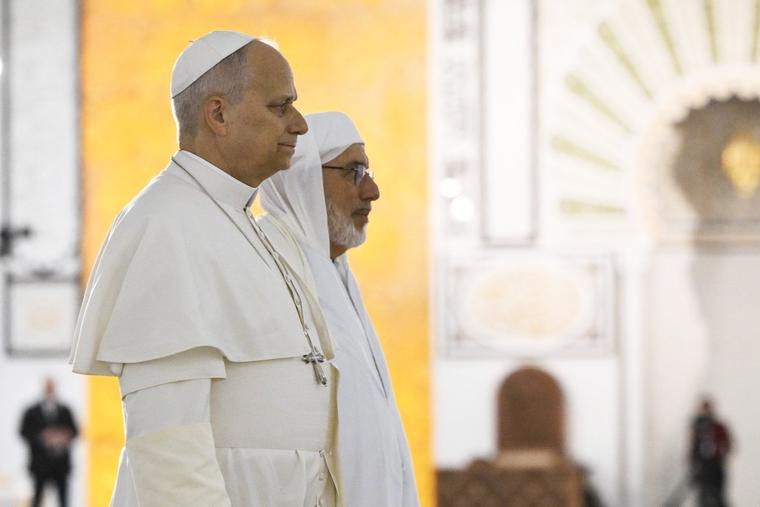
In speaking at the general audience this week about his recent trip to four African nations, Pope Leo XIV began with Algeria, home to sites associated with St. Augustine, which he cited as “the roots of my spiritual identity.” Here he spoke of “crossing and strengthening bridges that are very important for the world and the Church today: the bridge with the very fruitful age of the Fathers of the Church; the bridge with the Islamic world; and the bridge with the African continent.”
That “bridge” to the Islamic world — Algeria is a majority Muslim country — was worth noting. Islamist violence against Christians is a pressing problem in parts of Africa, especially Nigeria, the most populous African state.
A possible “bridge” to the Islamic world was also in the background of the Holy Father’s comments on the first anniversary of the death of Pope Francis, which occurred during the African pilgrimage. Indeed, that part of the Catholic-Islamic story is an important part of Pope Francis’ pontificate that needs to be remembered.
Return to Epic Papal Travel
Pope Leo XIV’s trip to Africa was a return to the papal travel of the 1980s and 1990s, when St. John Paul II routinely completed extended, multi-country trips. His last hurrah in that regard was the 11-day visit to North America in 2002 for World Youth Day in Toronto, Canada, followed by the canonization of Juan Diego of Guadalupe in Mexico City. But the end of the epic voyages was already conceded, with several days of papal rest near Toronto required before WYD.
Since then, under Pope Benedict XVI and Pope Francis, papal trips have been shorter, usually a few days and including fewer stops; Francis in 2014 went to Strasbourg for four hours! But Leo is 70 years old — a pope has not been that young in 36 years — and physically strong.
There was an exception to the rule of shorter papal travel in 2024, the last year of Pope Francis’ life. He took the longest trip of his pontificate, a 12-day marathon to Indonesia, East Timor, Papua New Guinea and Singapore. It had been scheduled for 2020, as a follow-up to the 2019 visit to Abu Dhabi, but was delayed due to the pandemic. Francis was determined to complete it, even as it meant traveling to the other side of the world in a wheelchair.
Islam in the 21st Century
The dominant interreligious file for John Paul II was relations with Jews, which he insisted was not really “inter” religious, but within the same household of faith. Three signature moments marked the Polish pontiff’s relations with Jews: the homily at Auschwitz in 1979, the visit to the synagogue of Rome in 1986 and pilgrimage to Israel in 2000.
As for Islamic relations, in 2001, he became the first pope to enter a mosque, visiting the Great Mosque of Damascus on his visit to Syria, just months before 9/11. However, Islam was not a dominant issue for John Paul.
On the fifth anniversary of 9/11, Pope Benedict XVI spoke on the newly-urgent Islamic question most directly in his Regensburg Address. Here he addressed the unreasonableness of advancing the faith by violence, and spoke about the failures of reason in Catholic, Protestant and Islamic contexts. His comments at Regensburg on the historic role of violence in Islam provoked a firestorm — including violent protests. Some martyrs killed by Islamist extremists following the address, including Sister Leonella Sgorbati, an Italian missionary in Somalia, were later beatified by Francis in 2018.
Benedict’s perspicacity and courage led to a genuine breakthrough in Catholic-Islamic relations. Henry Kissinger considered it the most important statement on Islam after 9/11, and it was sufficiently welcome among Islamic leaders that King Abdullah of Saudi Arabia made a historic visit to Benedict at the Vatican in 2007.
Islamic Shifts in the East
Pope Francis was witness to two historic changes in global Islam. The shift in Saudi Arabia under the reforms of Crown Prince Mohammed bin Salman has received more notice, with the House of Saud having moderated its Islamic fundamentalism at home as well as its support for jihad abroad. This new Saudi Arabia permits women to drive, hosts professional wrestling (with female wrestlers more modestly clad) and has been the first destination of President Donald Trump in both his presidential terms.
The other, more significant change has been the rise of Nahdlatul Ulama (NU) in Indonesia. It is the world’s largest Muslim organization — with some 100 million members — in the most populous Muslim-majority country. Indonesian Islam, led by NU, has developed theological resources from within Islam itself to advance a less aggressive, more fraternal face. It has, notably, advocated that “citizenship” — that is open to all — should be the fundamental civic identity, rather than distinguishing between Muslims and “infidels.”
When Indonesia hosted the G20 summit in 2022, NU — whose leader speaks favorably of finding guidance in the texts of Vatican II — took the opportunity to convene an “R20” summit of global religious leaders. A keynote speaker and keen supporter was Professor Mary Ann Glendon, former U.S. Ambassador to the Holy See, who saw the work of the R20 and NU as advancing the project of providing deeper, religious foundations for the Universal Declaration of Human Rights.
Pope Francis, Fraternity and Islam
It was for this reason that Pope Francis gave such emphasis to fraternity with Muslims during his pontificate. On the papal plane on the first anniversary of his predecessor’s death, Pope Leo XIV chose to remember fraternity as the key legacy of Pope Francis.
“We can recall many things [about Pope Francis],” Leo said. “For example, universal fraternity; seeking to foster genuine respect for all men and women; promoting this spirit of fraternity, of being brothers and sisters to one another, of seeking to live out the message we find in the Gospel whilst recognizing this spirit of brotherhood amongst all.”
The high point of the fraternal outreach was the signing in Abu Dhabi of the Document on Human Fraternity in February 2019 by Pope Francis and the Grand Imam of Al-Azhar in Cairo, Ahmed Al-Tayeb.
Due to some imprecision in theological phrasing, the document created some upset in the Catholic world, requiring clarification that it is God’s “permissive will” that permits religious pluralism in history, not his aboriginal intent.
The point though was not so much that the Pope signed the declaration, but that the Grand Imam did, given that he and Al-Azhar have not, to put it delicately, always regarded Christians and Jews with brotherly affection. The signature of the Grand Imam was a landmark event. It was a worthy attempt by the Holy See to engage with, and lift up, hopeful Muslim developments with the leading scholarly authority in Islam.
Affirmations of fraternity remain a necessary, but not by themselves sufficient, response to brutal episodes of anti-Christian violence. Most dramatically, there was the Easter Sunday massacre in Sri Lanka in 2019, and the slaughter of 21 Coptic Christians on the Libyan beach in 2015.
The latter martyrs, though not Catholic, were added to the Roman Martyrology, the liturgical book of saints, by Pope Francis in 2023 — another theologically imprecise decision, but this time generally welcomed. The relics of the martyrs were venerated in St. Peter’s Basilica just months before Francis went to Indonesia.
While in Algeria, Pope Leo noted that the feast day of the martyrs of Algeria — murdered between 1994 and 1996, and beatified under Pope Francis in 2018 — is May 8, the day of his election as pope in 2025.
The spirit of the Abu Dhabi declaration was concretely expressed in the construction of the Abrahamic Family House in that emirate, a striking complex containing a church, mosque and synagogue.
Pluralism in History
The Islamic fraternal initiatives of Pope Francis — highlighted by Pope Leo — met with some resistance, including from those who did not support John Paul’s Jewish initiatives, fearing that the singularity of the Catholic faith was being undermined. That was too anxious a reading, given that Francis began his pontificate preaching that “when we do not profess Jesus Christ, we profess the worldliness of the devil, a demonic worldliness.”
In the same vein as Professor Glendon in Indonesia, the late Father Richard John Neuhaus was fond of saying that “pluralism is written into the script of history.”
“The Church is not intimidated by pluralism, for pluralism is the inevitable consequence of freedom, and the Church is the world’s premier champion of freedom,” he wrote.
In assessing the legacy of Pope Francis, Leo was right to emphasize fraternity. It was the topic of his final encyclical, and that long final trip to Indonesia where — despite the plague of violence — he sought a face of Islam which offers a fraternal smile.
- Keywords:
- islam
- pope leo xiv