The Difference St. Joseph Makes
Through St. Joseph, God the Father reveals that fatherhood is not incidental, but foundational to human life and history.
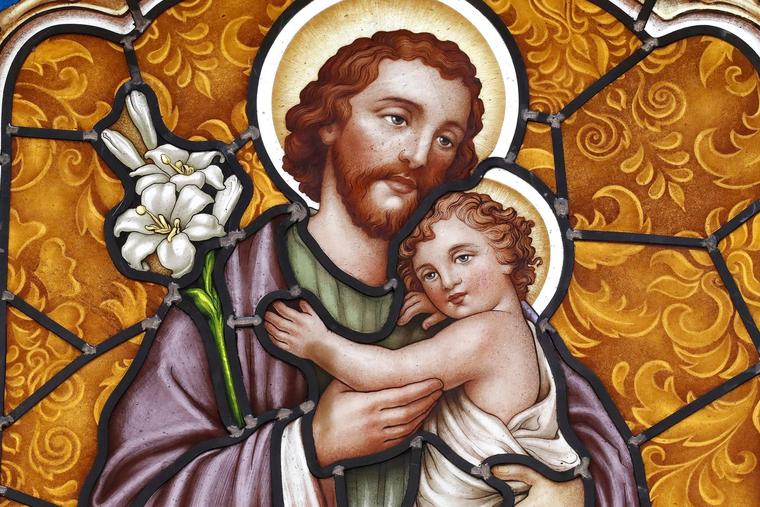
Ramadan began this year on the evening of Ash Wednesday and ended on the evening of the Solemnity of St. Joseph. Those four weeks thus became a shared period of fasting, reflection and almsgiving for Christians and Muslims worldwide. And it’s fitting that the beginning of Eid al-Fitr (the holiday marking the end of Ramadan) should have landed on the evening of St. Joseph’s feast — a convergence that reminds us that although the acts we perform may overlap, the teachings of these respective religions carry very different implications.
We know that Thomas Edison invented the lightbulb, that General Robert E. Lee led the South’s failed campaign at Gettysburg, that Neil Armstrong was the first man to land on the Moon. But what often gets lost are all of those “mundane” moments that formed the minds and characters of such eminent figures. How many of us would care to read a book detailing Shakespeare being taught to read and write and appreciate poetry as a boy, or about Christopher Columbus first being taught as a boy that there exist lands far beyond Italy to explore?
The Gospels detail such events as Our Lord’s Nativity, Baptism, mission, death, Resurrection and Ascension. But they provide us with no details about his life between the ages of 12 and 30.
But ordinary moments matter. A mother reading bedtime stories to her child, a father dropping his children off at school before going to work — these have a profound impact on the child and, sometimes, the entire world. And it is for that reason that we owe St. Joseph, the head of the Holy Family, our eternal gratitude, just as we do Our Lady.
Jesus Christ, though fully divine, was also fully man. Though he never sinned, he agreed to take on the vulnerabilities familiar to all of us when he became flesh. He needed protection, and even a father’s guidance, to grow up and become prepared for his mission to save us all. And so, he providentially agreed to need St. Joseph.
In how many cases would the feats of any of our great historical figures have been jeopardized had they not been raised by a caring father? What would the world look like without the example of St. Joseph and the model of the Holy Family?
There’s no mention of St. Joseph at all in the Quran. Muslim scholars widely presume that the Virgin Mary (Maryam) must have raised Jesus Christ (Isa) largely on her own after the miraculous conception and birth of her Son. This lack of St. Joseph’s presence, and with it the stability of the Holy Family, causes Islam’s teachings about Jesus’ upbringing to resemble those about the upbringing of Muhammad himself.
It’s taught in Islam that Muhammad’s father, a pagan, had died while his mother, likewise a pagan, was still pregnant with him in the closing years of the “age of ignorance” prior to Islam’s introduction in Arabia. His infancy and early childhood had been spent in the desert outside of Mecca, where he was raised by a wet nurse. His mother died when he was 6 and he was given over to the custody of his grandfather. His grandfather likewise died when he was 9 and he was given to the care of his uncle Abu Talib, a merchant who raised him to adulthood and continued to protect his nephew throughout the earlier years of his “prophethood,” despite never having become a Muslim himself.
An orphan rising from obscurity to a pinnacle of power and fame is most certainly an impressive life, but not necessarily an ideal and holy life that we are to universally follow.
Unlike Our Lord, Muhammad got married.
Muhammad’s first marriage to an elder widow named Khadija, remained monogamous until her death in 619. She bore all but one of his children. After her death he got married again, and then again, and then yet again. Perhaps nine women were simultaneously left widowed when he died in 632. The only child he’d had, apart from those who’d been born to Khadija, was a son (who’d died in infancy) by one of his slaves.
Islam allows polygamy (though most don’t practice it), and permits divorce (though divorce rates tend to be significantly lower in the Muslim world than in the West), and the absence in Islam’s teachings of a model such as the Holy Family plays no small role in this.
It was the instability of Muhammad’s family that ultimately led to the split between Sunni and Shia Muslims. There were those in what would become the Shia camp, who believed that the rightful successor of Muhammad (who’d had no sons to survive childhood) was Ali, his cousin and son-in-law by marriage to his daughter Fatima.
The leadership of the Ummah (Muslim community) instead elected Abu Bakr, Muhammad’s lifelong friend and the father of his much younger wife Aisha. Aisha herself opposed Ali’s claim.
Ali eventually became the caliph, but the dispute over proper succession continued after his death, and several of Muhammad’s own descendants and kin were slain in the Battle of Karbala in modern-day Iraq in 680, thus leading the divide between Sunnis and Shias to become permanent, all within 50 years after Muhammad’s death. Shia Muslims across the world still mourn this disaster, during the month of Muharram in the Islamic lunar calendar, to this very day.
The stability, or instability, of a family has long-reaching effects.
We can very much agree with Muslims that God rightfully ought to be worshipped and obeyed. But it is by Islam’s denial of Christ’s divinity, and denial of his death on the Cross, that God’s love ceases to be revealed in its full splendor. We, like Muslims, obey God because he is indeed our all-powerful Creator. We love him because he first loved us, that he even went so far as choosing death on a cross so that we sinners would be gifted the hope of redemption. We love him because he chose to become flesh, and to dwell among us, entering our world as an Infant vulnerable enough to need St. Joseph’s protection.
It is proper to commend those countless Muslims who fast during the month of Ramadan. And as we continue on with our own fasting this Holy Week, drawing near to Easter Sunday, it’s likewise fitting to remember why we, as followers of Christ, are doing so.
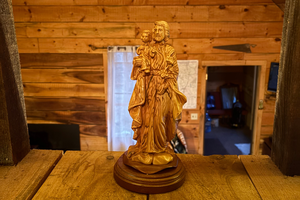
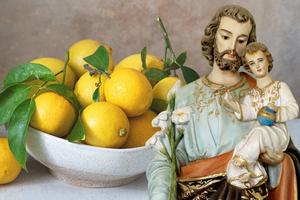
St. Joseph, husband of Our Lady, guardian of the Child Jesus, patron of the universal Church, pray for us always!
- Keywords:
- st. joseph
- islam

Zubair Simonson Zubair Simonson, O.F.S., is a convert who was raised Muslim. He grew up in Raleigh, North Carolina, and has also lived in New York. He received his B.A. at the University of Michigan, majoring in Political Science. He is a professed member of the Secular Franciscan Order. He is a contributing author for the website the Catholic Gentleman. The story of his conversion was included in the book My Name is Lazarus, published by the American Chesterton Society. He has several books available on Kindle, including The Rose: A Meditation, a narrative guide through the mysteries of the Rosary, and Stars and Stooges: A Christmas Tale, a humorous take on the three wise men. His website is zubairsimonson.com. Follow on Twitter at @ZubairSimonson.