Christianity Begins With a Word
Modern philosophy begins with a thought: the isolated thought of Descartes’ “I think therefore I am.” Aristotelian philosophy ends in a thought: a god who is estranged from everything other than himself, eternally content being a “thought thinking a thought.”
Descartes’ “thought” could not affirm the material world; Aristotle’s “thought” was not solicitous to the needs of men. The great danger of “thought” is that its thinker can fail to combine it with something other than itself and, as a result, omits a significant dimension of reality. Its glory, on the other hand, as the proper activity of the philosopher, is that it distinguishes man from beast and touches upon his grandeur. In his Pensées (Thoughts), Blaise Pascal noted, “By space the universe embraces me and swallows me up like an atom, by thought I embrace the universe.”
Christianity begins not with a thought but with a word. As John the Evangelist tells us, “In the Beginning was the Word” (John 1:1). In Goethe’s Faust, we find Dr. Faustus having trouble accepting this Joannine proclamation. The learned doctor rejects the orthodox version of this passage because, as he thinks, every word is an expression of a thought. Therefore, Faustus translates the opening line as, “In the Beginning was the Thought.”
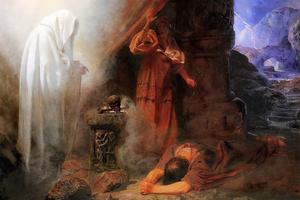
Scholars of Goethe’s great drama have pointed out that the confused mental state of Dr. Faustus, combined with his rejection of the true meaning of the Joannine Prologue, brought his mind into a fit state for listening to the suggestions of the tempter. It is precisely at this moment in the play that the evil spirit, who has a special antipathy for the words of John, is able to exercise his sinister influence over Dr. Faustus. There is indeed something sinister about thought that remains forever locked in on itself.
In the Christian understanding of the Word (Logos), it is an utterance coming from the Father that so perfectly mirrors and manifests God that it is God, but in the presence of Jesus Christ.
Christian theology, which begins with the Word, is far richer and incomparably more realistic than a philosophy that begins and ends with a thought. Yet, a word is incomprehensible if it does not express a coherent thought. We note the mindless chatter on radio and TV talk shows, how politicians can spin words so that they misrepresent their underlying thought, how “buzz words” and “weasel words” divest them of meaningful thought. Deconstruction is the attempt to rid words of thought so that nothing makes sense. It is the great enemy of Logos, of something its advocates commonly disparage as “Logocentrism.”
In addition, let us recall the bitter frustration experienced by King Claudius in Hamlet when he realized that his prayers were mere empty words: “My words fly up, my thoughts remain below: Words without thought never to heaven go” (III,3). A prayer must be a synthesis of word and thought.
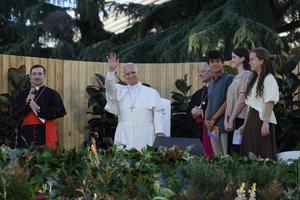
The Catholic world has been greatly blessed with two recent Popes who have had, respectively, a heightened sensitivity to the role of thought and to that of the word. John Paul II, his many gifts notwithstanding, was primarily a philosopher, a student of thought. His book, The Acting Person, is clearly the product of a highly gifted philosophical mind. He was a thinker par excellence. But he knew that thought itself, though it reflects reality, cannot emulate it. He knew that theology crowns philosophy.
Benedict XVI, despite his great knowledge of philosophy, is primarily a theologian, a student of the word. He understands with great clarity and conviction that the word is an object of faith. As he has written: “In philosophy the thought precedes the word; it is after all a product of the reflection which one then tries to put into words. … Faith, on the other hand, comes to man from outside, and this very fact is fundamental to it. It is ... not something thought up by myself; it is something said to me, which hits me as something which has not been thought out and would not be thought out, and lays an obligation on me.”
Philosophy originates in a private search for truth and secondarily seeks traveling companions. Faith is fundamentally a call to community, to a unity of minds through the unity of the word.
Pope Benedict XVI will continue to emphasize the primacy of faith and the basis for unity. His contribution will be all the more intelligible owing to the contribution of his predecessor. The social dimension of faith that he stresses will be easier for us to understand if we have already grasped its underlying components that John Paul has so carefully delineated.
Christian theology avoids the trap of intellectual solitude. Yet we need the work of the intellect — philosophy — to give theology its credibility and to distinguish it from superstition. The contributions of Benedict XVI and John Paul II will flow together the way dancing incarnates music.
Donald DeMarco is adjunct professor at
in
- Keywords:
- April 16-22, 2006