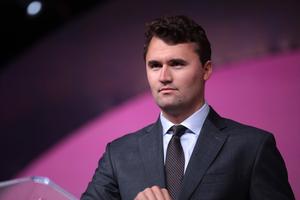
Charlie Kirk Saw Britain’s Decline — and Signs of Change Ahead
COMMENTARY: At Oxford and Cambridge, Kirk confronted secular dogmas and protests, yet beyond the elite halls he sensed a people impatient for change.
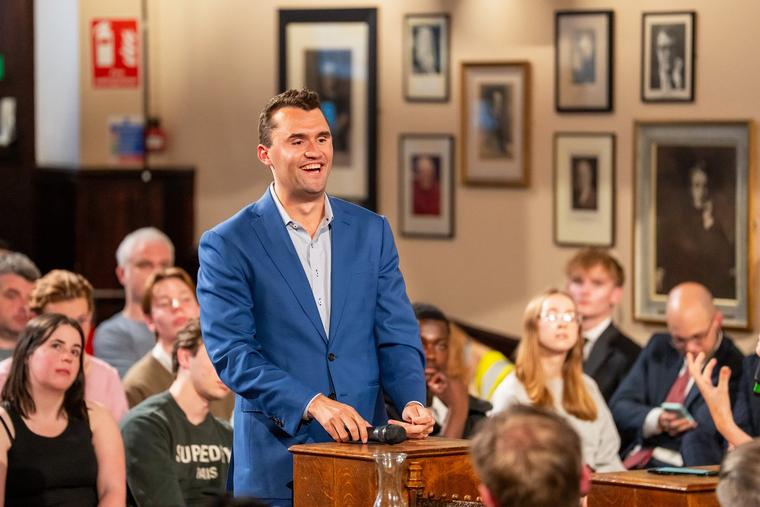
Admiration for Charlie Kirk’s defense of traditional and conservative values extended to Britain, where he was becoming an increasingly celebrated figure among the populace while at the same time derided by the country’s largely secular progressive elite.
Such open hostility became most apparent in May this year when he addressed both the Oxford and Cambridge Unions, prestigious debating societies with a long pedigree of renowned or accomplished speakers invited to address the universities’ students and field their questions.
The majority of those who came to debate Kirk were students who, like most of their peers, had spent much of their student life immersed in the progressivist ideology that has long dominated British academia. The influencer’s bold conservative views therefore inevitably clashed with their own unchallenged dogmas, leading some to boycott the events and stage protests outside.
Soon after Kirk’s assassination, George Abaraonye, the student Kirk debated at the Oxford Union, appeared to celebrate his death in messages reported Thursday by the Daily Telegraph — comments that were denounced by the university. The union’s student members had elected Abaraonye to become its president in the coming weeks.
Kirk spoke at the Oxbridge debating societies at a time when the British government was coming under fire for what many in the U.K. view as draconian restrictions on citizens’ free speech, linked to the state’s inability to bring migrant numbers under control, specifically those entering the country illegally.
Recalling his visit on his television show, and in an article he penned for The Spectator, Kirk sorely lamented what he had witnessed in the U.K. and regretted it had not experienced the freedom of expression that President Trump had brought to the U.S. For this reason, he felt his experience at Oxford and Cambridge was like going back in time.
“For all their learning and talent, the students were unprepared and appalled to hear takes that, by now, are mainstream and even boring in America,” he wrote. “When I described lockdowns as pointless and forced submission to mRNA shots as tyranny, they seethed and muttered. When I said George Floyd died from a drug overdose rather than under a police officer’s knee, they went into an uproar.”
A committed Christian who regularly attended Mass with his Catholic wife and children, Kirk observed that the students had “long abandoned the faith” that had led their colleges to be named after Jesus and the Holy Trinity. He was surprised at how much interest they all took in domestic American politics and noted a “distressing number” of students had to read their questions from their phones.
The students were “certainly bright,” he said, “impressively well-informed,” and “better at insults than the average American,” but added that “if Oxbridge students were long on wit, they were short on wisdom.”
Most notably, Kirk observed that American students had advanced in their worldview in comparison to their Oxbridge contemporaries. In the U.S., the decline of religiosity among young people “has halted and may be in reverse,” he wrote, adding he had met many on campuses over the past year who refuse to passively accept the decline of their civilization.
“In contrast, at Oxbridge I found the dominant outlook to be a depressed and depressing near-nihilism. They were students who hardly cared their country has less free speech than 50 or 100 years ago. They were appalled that a person might think life begins at conception, but not that their own country is being steadily Islamicized.”
During his Oxford and Cambridge Union debates, students expressed disagreement. Some found his comments unsettling and felt that Kirk’s method of reducing complex moral issues to “yes or no” questions was overly simplistic and confrontational, but many attendees remarked on Kirk’s strong rhetorical skill and noted that the atmosphere, while tense, remained respectful.
In his Spectator article, entitled A Revolution is Coming to the UK, Kirk said he noticed that a “very different attitude prevails” in Britain at large, where many recognized him and were more receptive to his opinions.
“I spoke to everybody I could while there, from drivers and blue-collar workers to journalists,” he said, and he noticed how angry they were at present and recent government policies, especially on the economy and immigration. He said they wished to “smash the British party system to bits” by voting for the Reform Party, the closest equivalent of the MAGA movement.
“The great turn in Britain is coming,” Kirk predicted. “And when it arrives, the students of Oxbridge will be the most surprised of all.”
The Oxford and Cambridge debates can be watched here and here.
- Keywords:
- charlie kirk
- united kingdom
- great britain

Edward Pentin Edward Pentin is the Register’s Senior Contributor and EWTN News Vatican Analyst. He began reporting on the Pope and the Vatican with Vatican Radio before moving on to become the Rome correspondent for EWTN's National Catholic Register. He has also reported on the Holy See and the Catholic Church for a number of other publications including Newsweek, Newsmax, Zenit, The Catholic Herald, and The Holy Land Review, a Franciscan publication specializing in the Church and the Middle East. Edward is the author of The Next Pope: The Leading Cardinal Candidates (Sophia Institute Press, 2020) and The Rigging of a Vatican Synod? An Investigation into Alleged Manipulation at the Extraordinary Synod on the Family (Ignatius Press, 2015). Follow him on Twitter at @edwardpentin.