Why the Ascension Should Astonish Us
COMMENTARY: In the Incarnation, heaven descends to earth; in the Ascension, earth ascends to heaven.
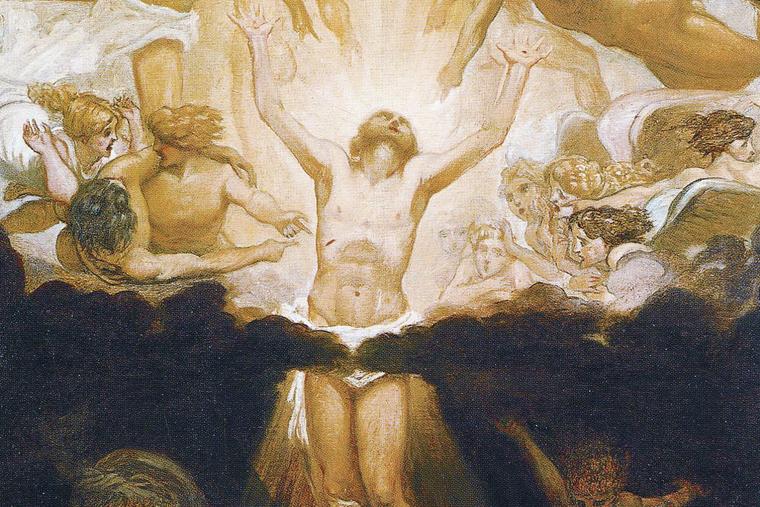
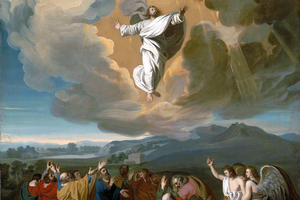
The most astonishing Christian mystery is also the one least considered and least discussed: the ascension of Jesus.
Of course, all the mysteries of Christianity are astonishing. Christ crucified? A stumbling block to Jews and foolishness to Gentiles (1 Corinthians 1:23). The Word become flesh? Madness to Gnostic and Docetic visionaries (2 John 7). The Risen Jesus? Babble to Epicurean and Stoic philosophers alike (Acts 17:18).
But there’s something especially astonishing about the Ascension — and by and large, we don’t see it at all. We affirm our belief in it whenever we recite the Nicene Creed — but do we really know what we’re saying?
Typically, the furthest we get is seeing Jesus’ return to the Father — described in Luke, Acts and Mark — as a mild denouement to the climactic moment of the Resurrection. We might even see it as a somewhat embarrassing, mythologically tinged image of Jesus soaring into the clouds like Superman. In any event, we tend to see this “farewell,” naturally enough, from the perspective of the apostles “left behind.”
We ask: What does Christ’s ascension mean for us on earth?
That’s an important question — but it’s not the real riddle of the Ascension. The real riddle is this: What does Christ’s ascension mean for God in heaven?
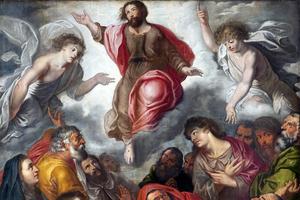
After all, it’s the Ascension — not the Embarkation. The whole point isn’t Christ’s going away from us physically (though that’s part of it) but his going up to the Father metaphysically: “I am ascending to my Father and your Father, to my God and your God” (John 20:17). Jesus enters into the heights of heaven and is even seated at the “right hand” of God, reigning with him in divine glory.
To appreciate just how astonishing a claim this is, we have to see the whole picture of Christian revelation. What’s it all about?
It is the story of all heavenly and earthly reality becoming one in Christ (Ephesians 1:10; Colossians 1:20). The groundwork is laid throughout the whole Old Testament, but the turning point is the Incarnation: God sends his only Son into the world to take on a human nature.
The Crucifixion is the culmination of this descent: Christ “emptied himself ... and became obedient to the point of death — even death on a cross” (Philippians 2:7-8). And the Resurrection is the vindication of Christ Crucified.
But notice that this whole incarnational journey — God becoming man, suffering and dying on the cross, and then rising again on the third day — is effected here on earth. It’s a radical, life-altering revelation indeed — but the story still remains, in a way, earthbound. The union of heaven and earth has unfolded in time but not in eternity, in concrete history but not in ultimate reality. “God is with us” in the Son (Matthew 1:23), but God the Father — the One who created the world and sent his only begotten Son into it — remains as far beyond us as the heavens are beyond the earth. He’s become a part of our story, but we haven’t really become a part of his. How could we?
Enter the Ascension.
The Ascension is, as the name suggests, the inverse movement of the Son’s descent — the other “leg” of his journey. In the Incarnation, the Son “comes down” and is born the Messiah; in the Ascension, the Messiah “goes up” and returns to the Father. The correlation of descent and ascent is pointed out by Christ himself in John 3:13.
St. Paul later strengthens the connection: “‘He ascended,’ what does it mean but that he had also descended into the lower parts of the earth? He who descended is the same one who ascended far above all the heavens, so that he might fill all things” (Ephesians 4:9-10). In the Ascension, the Son comes full circle.
But whereas the Son first “comes down” solely as God, he now “goes up” as the God-man Jesus — still one divine Person, but with both a divine and human nature. Thus, the turning point of the Incarnation has led to a new turning point, one even more outlandish than the first: The human body has entered heaven above. In fact, this human nature has become one with the Godhead. In the Incarnation, heaven descends to earth; in the Ascension, earth ascends to heaven. In the first, God enters the flesh; in the second, the flesh enters God. This new turning point is divinization — “God became man so that man might become God.”
For the two great rival worldviews to Christianity at the time — Gnosticism in religion, Platonism in philosophy — this was utterly scandalous talk. These “heavenward” thinkers took for granted the abyss separating God, heaven and the spiritual on the one hand and man, earth and the physical on the other. Any ascent to the divine realm had to be a purely spiritual ascent that required shucking off the body like a corn husk. An incarnational bridge between the two must have sounded as impossible as a bridge from New York to Galway. But the Ascension? This was not merely heaven descending to earth, but earth itself entering heaven.
The Church Fathers knew full well how shocking the Ascension was. St. Leo the Great declares with awe:
The nature of our human race ascended over the dignity of all heavenly creatures. It passed the angelic orders and was raised beyond the heights of archangels. In its Ascension, our human race did not stop at any other height until this same nature was received at the seat of the eternal Father. Our human nature, united with the divinity of the Son, was on the throne of his glory.
In a homily on the Ascension, St. Augustine exhorts Christians, when tripped up by “the arguments of the philosophers,” to hold fast to what God has revealed: “Let them chatter, but let us believe.”
But as shocking as this entrance of human nature into the Godhead is, there’s a deeper realization more dizzying still: It’s all permanent.
Yes, Christ will “come again” to judge the living and the dead, returning in the same way he ascended — but Scripture is clear that this isn’t a temporary state of affairs. The Son won’t, after the new creation, “drop” his human nature. The hypostatic union is forever — an eternal covenant of heaven and earth, an unending marriage of Bridegroom and Bride.
None of this is to say that the Ascension has nothing to do with us here below. On the contrary: It has everything to do with us. It allows us to live in the hope of entering that same glory. As St. Leo goes on to say:
The ascension of Christ is our elevation. Hope for the body is also invited where the glory of the Head preceded us. ... We not only are established as possessors of paradise, but we have even penetrated the heights of the heavens in Christ.
But this isn’t just a hope for the future, for the “there and then,” but also for the here and now. In another homily, St. Augustine asks:
Why do we on earth not strive to find rest with him in heaven even now, through the faith, hope, and love that unites us to him? While in heaven he is also with us; and we while on earth are with him. He is here with us by his divinity, his power, and his love. We cannot be in heaven, as he is on earth, by divinity, but in him, we can be there by love.
The Ascension also invites us to get to work until Christ comes again. This is, in essence, the message of the angels to the apostles staring at the sky: “Men of Galilee, why do you stand looking up toward heaven? This Jesus, who has been taken up from you into heaven, will come in the same way as you saw him go into heaven” (Acts 1:11).
And as the Church gets to work, it carries with it the greatest humanism possible: If our lowly nature reigns, through Christ, in heaven, we have to love and serve one another on earth, especially the lowly.
Most profoundly, the Ascension reveals how truly and completely his heart loves us. God not only became human in Christ; he took that humanity to himself, inexorably, forever. God didn’t change — he can’t change (Malachi 3:6) — but he made “all things new” (Revelation 21:5), opening his own heart to reveal his innermost self, and then inviting us to enter into it. This was what he wanted from all eternity: to take us to himself. We’re not just part of his story; we are his story. And in descending to us, and ascending with us, he had nothing to gain — but us.
He “ascended into heaven and is seated at the right hand of the Father” — this is not just wishful thinking on humanity’s part but the truth; this is who God is and who we are — what could possibly be more astonishing?
- Keywords:
- ascension