St. Charles Lwanga Protected His Friends — and Faced the Flames
The Ugandan Martyrs challenge today’s culture to rediscover the meaning of purity, courage and spiritual fatherhood.

It had been in the midst of a worldwide cholera outbreak that the Society of the Missionaries of Africa, whose members came to be known as the White Fathers, was founded in French-controlled Algeria in 1868. The White Fathers’ initial focus was to educate and instruct children who’d been orphaned during the pandemic. But founder Charles-Martial Allemand-Lavigerie, the French-born Archbishop of Algiers, saw to it that the society’s mission expanded.
Archbishop Lavigerie wished to see knowledge of the Gospel spread, sending missionaries forth throughout the continent. He’d instructed the White Fathers to integrate with the local cultures by speaking in the native languages, by wearing similar clothes as those whom they preached to, by eating the same indigenous dishes.
King Muteesa had allowed the White Fathers peaceful entry into Buganda (modern-day Uganda) in the late 1870s. He, though a pagan, considered any potential threats from Christian and Muslim proselytizers to be nominal enough. It had been shortly after the White Fathers’ entry that many of the young pages in his own royal court had agreed to receive religious instruction as catechumens.
Charles Lwanga had been born in the kingdom of Buganda, raised to embrace the traditional folk religion of his tribe. He was a young man when the White Fathers had arrived in Buganda.
Perhaps it was the case that young Charles Lwanga once intended to be a priest for the deity Mukasa, a mythological god of prosperity and health, and had thus embraced chastity even prior to his initial exposure to Christ’s teachings. His first exposure to the Gospel may have come from having met two retainers in a local chief’s court. But, regardless of any such specifics, Lwanga was among those who became a catechumen.
The White Fathers temporarily abandoned their mission in Buganda in 1882 for security purposes, though they would return again in 1885. Joseph Mukasa Balikuddembe, a convert, and a trusted adviser in the royal court, was selected to lead the royal court’s new Catholic community in their absence.
King Muteesa died in 1884, leaving many wives and many children behind. Mwanga II, one of the late king’s sons, ascended to the throne at the age of 16.
Charles Lwanga joined the new king’s royal court as a page. He proved himself capable, and was immediately well-liked, thus even impressing Joseph Mukasa, the majordomo. Lwanga swiftly rose the ranks to become one of the court’s chief pages.
The new king viewed Christianity as a threat to his own political power. The European powers were, at the time, on the verge of colonizing the bulk of the African continent. It could potentially itself a difficult task for a pagan king to retain his throne while ruling over Christian subjects. Notions that slaves ought to be redeemed, popular as they were among the Christian missionaries, seemed rather disruptive to the familiar order.
But King Mwanga’s animosity toward Christianity was more than simply political — it was personal.
The young king was accustomed to getting whatever he wanted from his royal court’s young pages, including satisfaction of his own carnal desires. Some of those pages in his court were boys as young as 13. A man controlled by his lust is incapable of understanding the meaning of the word “enough” — that eventually going on to have 17 wives still couldn’t be “enough” for him — and many of the boys and young men surrounding him were prey to his unquenchable desires.
The king’s pride was wounded when several of the newly-converted Christians, among his pages, had been bold enough to resist his advances. He was incensed that they, mere subjects, had the audacity to insist it to him, the authority, that to engage in any such unnatural acts would be immoral. During the nights it oftentimes even seemed that some of the younger pages were nowhere to be found, as if they’d been hidden away. Joseph Mukasa had been going to great lengths to protect the younger boys, unbeknownst to the king.
It was in 1885 that the persecution of Buganda’s Christians, Catholics and Anglicans alike, began. In October of that year several Anglican missionaries, including Bishop James Hannington, were arrested in Busoga. They were accused of plotting against the kingdom and killed. Hannington himself had been speared on both of his sides.
Joseph Mukasa, loyal as he’d been to the king, considered himself God’s servant above all. He courageously approached the king, rebuking him for the murders of these Anglicans, urging him to change his ways. For this, the king ordered that he be seized. “A Christian who gives his life for God is not afraid to die,” said Joseph Mukasa, while being taken hold of. St. Joseph Mukasa Balikuddembe was beheaded on Nov. 15, 1885.
The king appointed Charles Lwanga as the new chief page in place of St. Joseph Mukasa. Lwanga, though still a catechumen, had likewise found himself assuming leadership among the court’s Christians. It was on that night of St. Joseph Mukasa’s day of martyrdom that Lwanga, and several of the pages now under his care, had rapped at the door of the White Fathers’ house. They explained to the White Fathers that they wished to be baptized, knowing that they too could soon enough be martyred. The White Fathers agreed to grant them their wish. Lwanga himself was baptized by Père Giraud. Scores more catechumens were baptized by the White Fathers that following week.
The persecution of Christians in Buganda had died down after St. Joseph Mukasa’s death, for some months. Lwanga quietly went about with his many duties, going to similar lengths to protect the younger boys from the king’s sexual advances as his holy predecessor had.
It was in May 1886, while the court was settled in Monyonyo, that the king’s temper flared yet again. The eruption began when he’d called for a young page, Mwafu, and learned soon after that the boy had been receiving religious instruction from another page, Denis Sebuggwawo. For this, the king had personally thrust a spear through the throat of St. Denis Sebuggwawo while in his fury. He then ordered that there be an assembly of his court, the very next day, demanding that guards be posted around the royal residence to prevent anyone’s escape.
It was during the night that Charles Lwanga secretly baptized four of his charges who were still catechumens. Among those baptized was Kizito, aged 13, whom Lwanga had been protecting from the king’s depravity.
The assembly was called. The pages were all drawn before the king and questioned. The Christians, whether Catholic or Anglican, no fewer than 15, were separated and joined by other Christians who’d already been arrested. The king asked them whether they intended to remain Christians.
“Till death!” came the response, led by Lwanga.
“Then put them to death!” the king ordered.
The Christians were immediately bound, and forced to march 37 miles to Namugongo, the traditional place of execution. The convoy passed by the White Fathers’ house along the way, where the missionaries didn’t see dread in the faces of the condemned, but joy instead. A few of the young men were killed by their captors during the two-day walk. They reached Namugongo, remaining confined there for a week, bound and starved and beaten, while preparations for their execution were made. None of them reneged.
The Feast of the Ascension was on June 3, 1886. It was on that day that the Christians were stripped of their clothing and led to the pyres prepared for them. St. Mbaga was immediately killed by a blow to the neck. His father happened to be the chief executioner, and wished his son to be spared from the agony of fire.
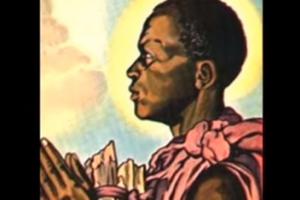
For the leader, a separate pyre had been prepared. The executioners led Charles Lwanga there, lighting only a small fire under his feet, so that he would be made to suffer longer. “You’re burning me,” he told them, “but it’s like water you’re pouring to wash me. Please repent and become a Christian like me.”
“My God! My God!” St. Charles Lwanga said, as the flames consumed him.
The rest of the boys and young men were put to the fire afterward. They died praying the Lord’s prayer.
22 Catholics, and 23 Anglicans, were killed in Uganda between 1885 and 1887. The Ugandan Martyrs were canonized in 1964, by Pope Paul VI.
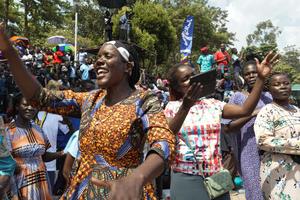
Uganda’s population today is roughly 36% Catholic, 29% Anglican, and 82% Christian in total. The Uganda Martyrs’ Shrine, in Namugongo, Uganda, is among the most popular pilgrimage sites in Africa today.
It’s especially fitting in June, which so many of our neighbors celebrate as “Pride” month, to seek the intercession of those saints who’d gone to great lengths to shield the youth from exposure to sins of the flesh, or who had themselves been victims of those who indulged in such sins.
Ugandan Martyrs, pray for us!
- Keywords:
- st. charles lwanga
- ugandan martyrs

Zubair Simonson Zubair Simonson, O.F.S., is a convert who was raised Muslim. He grew up in Raleigh, North Carolina, and has also lived in New York. He received his B.A. at the University of Michigan, majoring in Political Science. He is a professed member of the Secular Franciscan Order. He is a contributing author for the website the Catholic Gentleman. The story of his conversion was included in the book My Name is Lazarus, published by the American Chesterton Society. He has several books available on Kindle, including The Rose: A Meditation, a narrative guide through the mysteries of the Rosary, and Stars and Stooges: A Christmas Tale, a humorous take on the three wise men. His website is zubairsimonson.com. Follow on Twitter at @ZubairSimonson.