‘People, Look East’: Thoughtful and Spiritually Impactful Reads
Two recent books draw on Eastern Christian spirituality to address healing and the transformation of the human heart.

At this time in the year when we hear the hymn People, Look East, I suggest that we look to the East for thoughtful and spiritually impactful reads for now and into the new year.
First, I have to recommend The Light of His Eyes by Mother Iliana of Christ the Bridegroom Monastery. I have written about this book before; however, it is worth mentioning this spiritually enlightening book. At a time in our history and culture when we are suffering a crisis of human fatherhood, Mother Iliana discusses her spiritually emerging understanding and relationship with God the Father. If you have someone in your life who is struggling with their relationship with God because of the brokenness of human relationships, this book may be the divine spark that brings about the grace of healing.
Another fantastic book is The Kingdom of the Heart: Meditations from the Christian East by Alexander Harb. Harb offers a rich look at the center of our spiritual struggle, namely, the human heart. This battlefield of the Christian life is central to our struggle for growth in holiness and deification in Christ. Through the traditional spirituality of the Christian East, Harb gives us a roadmap for spiritual growth and healing.
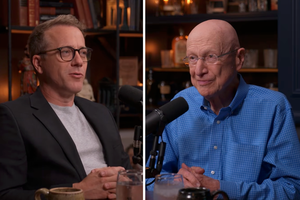
I sat down with Harb to ask him about his journey of faith and how this book came about.
Please tell us a little bit about yourself. Where are you from? Where did you go to school? And what in your faith journey led you to consider writing this book?
I was born and raised in Birmingham, Alabama; my dad is a Palestinian immigrant whose family came over in the ’50s, and my mom grew up in Tennessee in a Lebanese family. I grew up as a Melkite Catholic. So, naturally, when I became interested in theology, I wanted to study my roots. So I attended the Pontifical Oriental Institute for Eastern Christian Studies. This book came from my experiences teaching theology to high-school students who desperately needed the Gospel. I originally wrote the chapters as meditations for them to do in class. Eventually, those class meditations became this book.
As you know, the majority of our readership is Latin-rite Catholic, so what specific lessons from the East do you think will benefit our reader’s walk of faith?
My hope is that anyone who reads my book will grow in wisdom from what the Church Fathers have to tell us.
Most of our readership is familiar with devotion to the Sacred Heart of Jesus. What insights from the East might help us to accentuate this Western devotion?
It’s important to know that attention to the Heart of Jesus far preceded St. Margaret Mary Alacoque. In every culture, there has always been a fascination with the heart, and the Bible is not an exception. Both the Old and New Testaments use the word “heart” more than any other part of the body to speak anthropologically. Luke 11:28, John 7:38, Philippians 1:8 speak about the Heart of Jesus. Having matured spiritually by continuously reading Scripture, the Church Fathers as early as the fourth century (Chrysostom, for example) described Jesus’ Heart as a symbol of the light and mercy which God desires to place in us. It is as if God knows that he created us with our own hearts that are only at rest when we learn how to live with Jesus and ask him to teach us to make our hearts like his: calm, restful, beating in rhythm and in peace.
You spend considerable time in the book talking about how the spirituality of the East can help us to overcome our own woundedness. Why is woundedness such an important topic for contemporary Christians, and what do you think is missing from the Church’s catechesis on this topic?
The way that so many of the Church Fathers talk about the Church as a hospital for the sick — I think this has always been an attractive way to describe it because Jesus himself said he came for the sick and not for those who are well. Therefore, without surprise, the chapter of my book that most people comment on when they talk to me is the one about suffering brokenheartedness. As Christ said, “Not as the world gives do I give peace,” so also is it the case that only he can heal us from our lives’ greatest wounds. Knowing that God suffers with us on his cross is not a solution to suffering, but it is a comfort to know that we are never alone, and that when we unite our suffering to his, it leads to the joy of paradise.
Anything else you would like our readers to know about the book and its mission?
Learn more about the entirety of our Catholic faith. Visit the Byzantine, Maronite and other Eastern Catholic Churches near you for Divine Liturgy. Learn about the history of Christianity in the Middle East. There is so much that these Churches have to offer the Catholic world, and the Christian community is in want if their presence were to dissipate. The ancientness of the prayers and liturgies remind us that we are a priestly people resting on the shoulders of the apostles.
In this season of Advent, as we await the Lord’s second coming, we turn our hearts toward the East — the direction of hope and rising light. If you or someone you know needs a spark of metanoia — a turning of the heart — these two books are excellent companions for the journey.
These books can be ordered here.
- Keywords:
- eastern catholics