Moscow Trip Still Uncertain
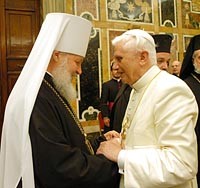
The recent election of Patriarch Kirill as the new leader of the Russian Orthodox Church has led some analysts to predict that Pope Benedict XVI may soon be invited to visit Moscow.
That’s because of Patriarch Kirill’s two decades of experience as the Orthodox Church’s senior official in charge of relations with other churches.
But it’s premature to expect a papal visit to Russia right away, according to a senior Russian Orthodox bishop.
“The possibility of such a meeting [between the Pope and the Patriarch] was never ruled out under Patriarch Alexei II, but there are still obstacles to it, specifically, cases of proselytism,” Bishop Hilarion of Vienna and Austria, who represents the Russian Orthodox Church in European international organizations, said on a televised linkup between Moscow and Paris on Friday, Interfax reported. “We believe that there is a need to work out a common position and, after that has been done, organize such a meeting.”
The charge that the Catholic Church is improperly “proselytizing” by seeking converts within the canonical territory of the Russian Orthodox Church was one of the major reasons why Patriarch Alexei II, Kirill’s predecessor, declined to meet in Moscow with Benedict or with Pope John Paul II.
The Catholic Church has rejected the Russian Orthodox claims of proselytizing.
In the TV linkup, Bishop Hilarion also noted another point of contention with the Catholic Church, citing “the difficult situation” with the opening of new Greek-Catholic parishes and dioceses in Western and Eastern Ukraine.
Overall, though, Bishop Hilarion indicated there is solid reason for optimism that a solution can be found in time that would allow the long-hoped-for papal visit to Moscow. He said Patriarch Kirill “will do everything possible to remove all obstacles hindering this meeting.”
Said Bishop Hilarion, “We cannot specify its dates because we are not talking about dates, but about the purposes of this meeting. If it is well-prepared, it will mean a real breakthrough in our bilateral relations.”