Louisiana’s Catholic Rising Star
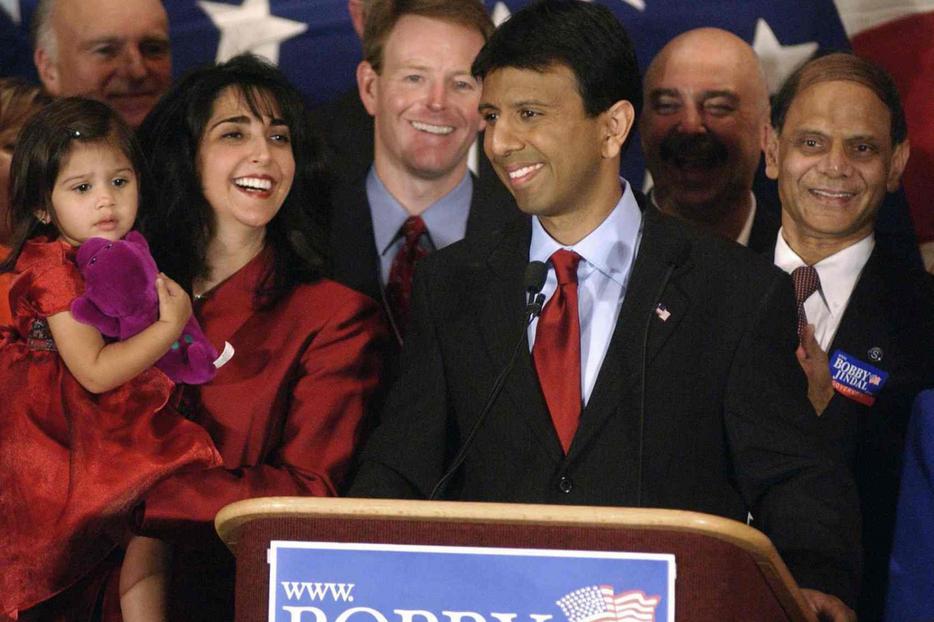
Tonight, Louisiana Gov. Bobby Jindal will deliver the Republican Party’s official response to President Barack Obama’s first address to Congress.
Here is the profile of Jindal that the Register has commissioned to coincide with the young Catholic governor’s prime-time appearance on national TV:
Louisiana’s Catholic Rising Star
By PETER FINNEY JR.
REGISTER CORRESPONDENT
BATON ROUGE — In a sense, the coincidental timing is the ultimate symbol of Louisiana Gov. Bobby Jindal’s studious, calculated, thoroughly deliberated young life.
On Mardi Gras night, Feb. 24, while most south Louisiana citizens will be enjoying a final, exhausting pre-Lenten fling, the 37-year-old Indian American — perhaps the Great Republican Hope to retake the White House in 2012 — will deliver a nationally televised response from the governor’s mansion in Baton Rouge to President Barack Obama’s first address to Congress.
Those who know the former Rhodes Scholar, who breezed through Brown University in three years with a double major in biology and public policy before going on to Oxford University for a master’s degree in political science, were hardly surprised by his meteoric rise, which shows no signs of flaming out.
The Baton Rouge native, born of Hindu parents, was appointed in 1996 at age 25 by Louisiana Gov. Mike Foster to run the Louisiana Department of Health and Hospitals, which at the time represented 40% of the state budget. Eleven years later, he became the first non-white elected governor in Louisiana history, offering himself to post-Katrina voters as a man of deep Christian faith – he converted to Catholicism at Brown in the late 1980s – stunning intellect and ethical tunnel vision.
In other words, he was the anti-Edwin Edwards, the four-term Louisiana governor who is now serving the eighth year of a 10-year federal prison sentence for extorting cash from a potential riverboat casino operator.
“I would certainly say he’s a man of Catholic conviction,” said New Orleans Archbishop Alfred Hughes, who was bishop of Baton Rouge in the 1990s and baptized two of the three children of the governor and his wife, Supriya. “He was very much impacted by the Dominicans, who were the chaplains at Brown, and the way in which they expounded the consistency of Catholic teaching. He is a convinced Catholic, and he loves to solve problems. His service to the poor is through problem-solving.”
Louisiana Sen. Mike Michot of Lafayette was a freshman in the House of Representatives in 1996 when Jindal was the fresh-faced secretary of the Department of Health and Hospitals. He saw Jindal and his then-fiancée, Supriya, at Mass one Sunday at St. Jude Church in Baton Rouge.
“I was really impressed with his commitment to his faith and also with his love and devotion to Supriya,” Michot said. “Two years before he was elected governor I had a very in-depth, private discussion with him about his faith, and I could see how well-grounded he was in his faith. Being a convert to Catholicism, Bobby probably knows more about the history of the Catholic faith than many of us who have been lifelong Catholics.”
Pro-Life in College
On a public policy level, Jindal received a 100% pro-life voting record from the National Right to Life Committee while serving in the U.S. House of Representatives from Louisiana’s 1st Congressional District from 2005-08. But Jindal did not come late to the pro-life party. At Brown, he was heavily involved in the university’s pro-life club, to the extent that he issued a public debate challenge to any student from the pro-abortion side.
“Those groups never took us up on the offer and it never happened,” said Sabrina Arena, who attended Brown with Jindal. “Bobby loved debating and he was good at it. He was extremely smart, but he also was extremely normal. Brown was a very pro-choice campus, and I was a little worried about being part of a pro-life group. But I went to a meeting one day, and as soon as I saw Bobby, I immediately said, ‘Yes, I’m in.’ I became very involved.”
Jindal used significant political capital during the last legislative session to back a groundbreaking voucher bill — he calls it a “scholarship” program — that provided state money to families with children in failing Orleans Parish public schools so they could choose to attend Catholic or other faith-based private schools. Michot said the governor would support another bill in the upcoming legislative session to permit faith-based entities to receive state funds to operate charter schools.
“He’s obviously committed to competition in education as a way of breaking through the challenges that nationwide we have experienced with public education today,” Archbishop Hughes said.
“I had supported choice in education and introduced voucher bills in the past, but we really never had the support of the governor that we’ve had with this governor,” Michot added.
Jindal’s public policy decisions do not always square with Church teaching. He signed a law in 2008 that allows for the chemical castration of those convicted of sexually assaulting children. He also supports the death penalty, which is not forbidden by Church teaching but in recent years has been looked upon less favorably.
“I think he is struggling with the issue of capital punishment,” Archbishop Hughes said. “But I think he’s open to coming to understand and apply Church teaching appropriately.”
Jindal received high marks from voters in 2008 for successfully pushing forward an ethics reform package. Citizens were less enamored of his initial decision not to interfere with legislators’ efforts to double their pay. Jindal vetoed the pay raise only after a public outcry, and in the end, some lawmakers felt they had been betrayed.
Jindal said his very visible speaking engagements in states such as Iowa — the opening battleground for the 2012 presidential nomination — have provided him with an opportunity to promote Louisiana’s recovery, not raise money and awareness for a national campaign.
“I just think the speculation about that is not helpful,” Archbishop Hughes said. “I would like to keep him focused on Louisiana. We have a wonderful opportunity right now with him as governor to make a difference in this state. I hope he remains for awhile.”
Michot said Jindal’s selection to respond to President Obama’s address to the joint session of Congress is a clear signal: Watch out for the man from Louisiana.
“The Republican Party is looking to him to represent the future of the party, with not only his youth and enthusiasm but also because he represents racial diversity which the party needs to embrace,” Michot said. “I think the party is going to continue to put him in a very high-profile position when it comes to the national spotlight. Every time he speaks in public, he represents Louisiana, and it speaks volumes that we have embraced change and racial diversity.”
Peter Finney writes from New Orleans.