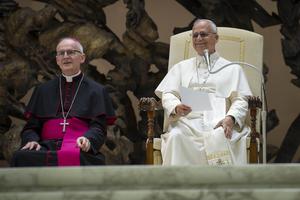
John Paul the Personalist

Yesterday marked the 30th anniversary of publication of Pope John Paul II’s first encyclical, Redemptor Hominis (The Redeemer of Man).
Given the encyclical’s title, it seems only fitting that a Redemptorist priest should offer this reflection on the first installment of the great magisterial legacy bequeathed to the Church by John Paul II.
“As we see now, looking back after these three decades, this first encyclical was to a large degree a first run at many of the themes that John Paul II would constantly visit during his long pontificate,” writes Redemptorist Father Anthony Kelly. ”As with so many of his encyclicals, there was something here for everyone: a piercing criticism of contemporary culture, an emphasis on human rights, a recognition of ecological responsibility, the imperatives of ecumenism, evangelization, and much else.”
Amidst this wealth of possibilities for reflection, Father Kelly chooses to highlight the personalistic perspective that the late Pope brought to his consideration of the redemptive reality of Christ.
“He was not presenting new doctrines, since he structured his message, here and elsewhere, within a strongly Trinitarian and sacramental framework,” Father Kelly comments. ”But, by continuing a line of development that first appeared in Vatican II’s “The Church in the Modern World” (1965), he added a new emphasis, at least as far as papal communications go.
“You could put it this way: the traditional way of presenting the truths of faith was very objective, and usually couched in austerely theological language to make sure that there was no room for ambiguity—and therefore, not directly concerned with the experience of believers themselves. It was more ‘from the outside in’ form of communication. In contrast, we see in RM more of a ‘from the inside out’ style. There is a constant appeal to personal experience, human consciousness, and the ‘heart.’”
And, in a manner that was to be characteristic of so much of John Paul’s papal writings, Redemptor Hominis focuses on the human response to Christ’s act of redemptive love.
Writes Father Kelly, “John Paul II, as would be suggested by the encyclical’s title, ‘The Redeemer of Man,’ is especially eloquent on what he calls the ‘human dimension’ of redemption. He concentrates his message at this point by expressing his conviction of the necessity and influence of love in our lives. Without love, life is absurd and pointless. With love, there is meaning and direction. Faith’s awareness of Christ means a deep experience of being claimed and penetrated by love at its most intense. It means having heart and mind renewed so as to disclose our ultimate identity. In this mystery of redemption, the true self is every ‘newly expressed’ and even ‘newly created.’ The more we draw near to Christ, the more we are in touch with our true selves.”
Father Kelly concludes his reflection, “When Redemptorists preach according to their biblical motto, ‘With him there is plentiful redemption’ (Psalm 130), they find an enduringly fresh resource in this first of John Paul’s encyclical letters. It has not staled over these thirty years, and its central message is ever to be rediscovered.”