When the Stakes Are High, Pray: What the First Apostolic Election Reveals
Before casting lots, Peter led with prayer. His example shows us how to discern wisely and surrender fully in moments of uncertainty.

In the first chapter of the Acts of the Apostles, we are given the account of the choosing of Matthias as the successor of Judas. Peter takes the lead in explaining what Judas has done and how it is necessary to choose a replacement for him. In the details of how Matthias is chosen, we can see not merely an election of a random man but a process that can teach us how to go about making important decisions.
First, Peter reminds those listening of the tragedy of Judas’ sin. Then he implies how the choice of a replacement is required based on the decision of Jesus to choose the Twelve. Regarding whom should be chosen, Peter notes that “it is necessary that one of the men who accompanied us the whole time the Lord Jesus came and went among us” (Acts 1:21).
With this as a requirement, there were two possibilities brought forth: Matthias, and a man named Joseph (also called Barsabbas). Following these two options, the pick for Matthias comes about within two sentences.
“You, Lord, who know the hearts of all, show which one of these two you have chosen to take the place in this apostolic ministry from which Judas turned away to go to his own place. Then they gave lots to them, and the lot fell upon Matthias, and he was counted with the eleven apostles” (Acts 1:24-26).
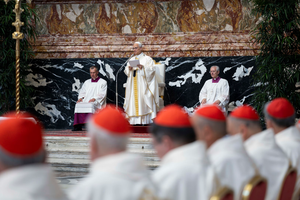
There are two important steps in the selection process of Matthias. First, Peter brings the group together for prayer. He implores Christ to “show” them which man they ought to choose as the replacement of Judas. Each time we are moved to make an important decision about life, Peter reminds us (as the College of Cardinals just did when voting for Leo), that we must bring it to a deep place of prayer.
Too often, if you are like me, we turn to prayer when we need to make up our minds on a certain decision for the family or at work. We ask God for guidance to make the right decision. While the turn to prayer is virtuous, it can often be robotic and empty of substance. Peter’s words are not so.
He begins his prayer by referencing the fact that Jesus, “knows the hearts of all.” Prayer is about union with the heart of God. It can bring clarity and insight, but its main mission is to praise God for who he is and become so close to him that we know our identity can only be found in him. It is from this location that Peter moves forward in the decision process.
After praying for guidance, they cast lots to see who would replace Judas. This was no random and obtuse process. It was not an election through gambling. Casting lots was a tradition that has its roots in Sacred Scripture, including the life of King Saul (1 Samuel 14:40-42). Casting lots was seen as an impartial way of making a difficult decision. It personified the will of God coming to fruition. When coupled with prayer, it ensured that the decision had divine origins and certitude.
Ultimately, the casting of lots is a biblical method of surrender to the hands of God. While we do not use this process anymore, the principle is absolutely necessary for us to make decisions with God in mind. After we have moved to pray and be united with God, we must trust that the decision that we move forward with is the one that God will bless — even if the situation does not turn out exactly as we desired it to.
This would have been the role of Matthias and Barsabbas (the man who was not chosen). They must live with the choice and depend on the providence of God in moving forward. And so must we.
Let us ask St. Matthias for his intercession when we are faced with a tough decision to make. Let us follow in the footsteps of Peter in the process. Let us be grounded in a deep prayerfulness and rooted in a radical trust that God will never abandon his children — no matter what decision lay before us.
- Keywords:
- st. matthias
- discernment
- apostles
- prayer