Hercules at the Seminary: Dana Gioia Brings Seneca to the Catholic Imagination
America’s leading Catholic poet offers a stunning new verse translation of a play once read by Dante and forgotten by most — until now.

Dana Gioia is a one-man Catholic renaissance.
When I first learned about Dana Gioia’s new translation of Seneca’s verse play, The Madness of Hercules, I was astonished and intrigued: Seneca, the stoic philosopher and Roman statesman, wrote plays? I knew that Seneca and the other Roman stoics were much admired by the early Church Fathers, whose work demonstrates that much of the moral law could be discerned by reason alone.
As St. Justin Martyr explained in the second century, “In moral philosophy, the Stoics have established right principles, and the poets too have expounded such, because the seed of the Word was implanted in the whole human race” (Second Apology, VIII, 1).
But in his own time, as Gioia points out in his introduction to the play, Seneca was at least as famous as a playwright as a philosopher — which makes sense, since plays (the movies of their time) were far more popular than philosophical tracts. Dante would have read The Madness of Hercules in the original Latin, including Seneca’s terrifying description of hell. Seneca influenced playwrights during the English Renaissance in particular, when John Donne’s uncle, the Jesuit Father Jasper Heywood — who was imprisoned and exiled during England’s persecution of Catholics — published the first English translation. One might call Seneca’s plays “Shakesperean” in their intense depiction of the evil the human heart is capable of — but of course, it is more chronologically correct to call Shakespeare “Senecan.”
Gioia says that throughout his college years and graduate study at Stanford, Seneca was rarely taught — and when mentioned, often looked down upon. “Not as good as the Greeks,” the academics lectured — too violent, too perverse, too “vulgar,” as Gioia puts it. Much like a Quentin Tarantino film today, he explains: “I’m going to kill these people, but first I’m going to make a great speech. Tarantino is doing something nobody else does — bringing violence, rhetoric and poetry together. That’s what Seneca is like.”
Gioia, who has written four operatic librettos and whose recent book Weep, Shudder, and Die: On Opera and Poetry recounts his childhood devotion to opera, recalls saying to himself upon reading his first Seneca play: “This is a really good play.” He’s like that, he says — a contrarian. Defective, even, in some of the ways that Seneca is defective.
His love for Seneca’s plays gestated for another quarter century. About 20 years ago, he staged an earlier version of The Madness of Hercules in lower Manhattan. He gave the director clear instructions: “I don’t want any of the actors to try to make it like a modern play. I want it to feel ancient. And I want it to feel foreign. Give these speeches to terrify people: Just belt it out. Make it like opera.” The audience was shocked, horrified — and fell in love.
The actress who played Jupiter’s wife, Juno, sometimes joins Gioia at poetry readings to bring to life Juno’s monologue of vengeance — a horrifying and electrifying monomaniacal descent, bordering on madness, in her relentless desire to kill Hercules. It is somewhat scary, he points out, when middle-aged women in the audience come up afterward and say of “this crazy vengeance-ridden goddess who has been trying to destroy Hercules since his cradle” that “I really loved the thing you did about Juno, she’s so right about men.” Juno is not a moral exemplar, Gioia points out.
He wrote and rewrote the introduction some 20 times, seeking nothing less than to put Seneca back in the canon of what we used to call Western civilization. Gioia points out this introduction is the first serious literary essay on Seneca since T.S. Eliot — a full 100 years ago. His new verse translation is, he says, the first English poetic translation of The Madness of Hercules since before Shakespeare.
In my mind, this is an artistic event of the first order: a great playwright forgotten and revived in great poetry written by America’s finest and most famous Catholic poet.
I begged him to let me invite poets to do a Zoom reading with him. But like all great artists, Gioia aimed higher. He wanted it to be performed by great actors who could light up and terrify an audience with his words. Still, I couldn’t quite give up on the idea.
“What about at this year’s Retreat for Artists and Art Lovers?” I asked again, after repeatedly getting turned down.
“Maggie,” he said to me quite sternly — and Dana’s voice is the epitome of stentorian — “Get me three classically trained Shakespearean actors. I will read the Greek chorus myself, and you can do this.”
Done, I said. So on June 14, in the medieval architecture of holy and beautiful St. Patrick’s Seminary, excerpts from a work of a lost, great playwright will be brought to life again — a meditation on the evil to which the human heart can be driven without the succor of Christ.
Standard registration for the June 13-15 Retreat for Artists and Art Lovers is $750, which includes beautiful liturgies, fine food and fellowship — but we also offer a “starving artists” fare of $275, no questions asked.
At our first retreat bringing together artists of all kinds — painters, poets, playwrights, composers, sculptors and architects — wonderful new works of art were born, some of which we will experience at this year’s gathering. Duncan Stroik will share how his grief over the untimely death of his daughter Raffaella, a ballerina, has been transformed into a beautiful ballet, with the help of choreographer Claire Kretzschmar, who will also be joining us.
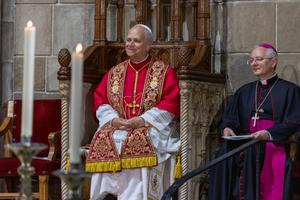
I’m especially looking forward to our “Christmas in June” panel, where composers and poets will share new Advent and Christmas carols the Benedict XVI Institute has commissioned. Jennifer Donelson-Nowicka of the Catholic Institute of Sacred Music will provide the sacred music for the liturgy, a heavenly experience. And Archbishop Salvatore Cordileone will welcome us and share his vision of the high calling of both the Catholic artist and the Catholic patron of the arts.
We are still searching for the right Hercules. In fact, I’m waiting to hear back from Kelsey Grammer, who is working with Wall Street wizard Pierre Ferragu to bring Bernadette of Lourdes to the United States. (Pierre will be there to talk about his patronage of the arts.) Yes, it’s what one calls a Hail Mary pass — but the chance to share a great work of art and discuss its moral weight with one of America’s great poets? That alone is worth the price of admission.
For more information or to register for the Retreat for Artists and Art Lovers, go here.