Don’t Overthink Your Mary Garden: 3 Tips for Making It a Reality This Year
We’ve been growing flowers to honor Mary while our family has grown, and our faith has grown too...
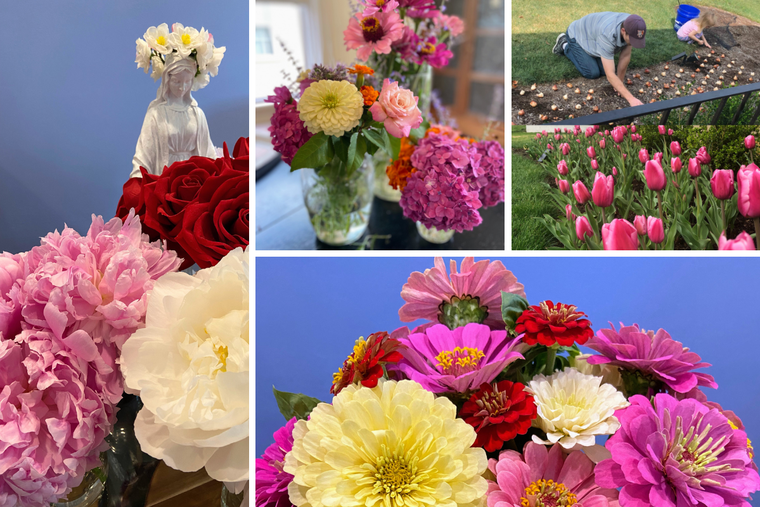
If you’ve been putting off creating a Mary garden for your home, I hope my family’s experience will inspire you to make it a reality this year.
When my husband and I were in our first year of marriage, we lived in a very small apartment in Birmingham, Alabama, and, as newlyweds expecting our first daughter, we had little extra money and few possessions to our name. I told Dave about my desire for a Mary garden, but we both knew it couldn’t be anything elaborate because of our limited space and budget. At the time, we lived on one income while my husband completed his doctorate, and our apartment balcony had less square footage than most people’s bathrooms.
Still, Dave supported me, and we headed to the store to buy flowers and pots. We got one rose, one lily, one daisy, one marigold, one blue hydrangea, one verbena and one hibiscus (the meanings of each I’ll explain below), and we arranged them around a hand-me-down Mary statue that belonged to a friend’s grandma. Together, we had very little gardening experience, but, also together, we gave the best we had to the Blessed Mother.
Flash forward to today, almost a decade later, and our little Mary garden has grown to more than I ever could have dreamed: We currently have nine rose bushes (one for each year of our marriage), plus peonies, tulips, daffodils, clematis, hydrangea, daisy, hosta, grapes and many other fruit bushes and trees, plus the most prolific marigold you’ve ever seen (they grow into bushes, several feet high!). We cut many of these flowers to place in a vase to honor our Blessed Mother throughout the growing season, and our children love taking care of the many plants around our home. As you can see, it wasn’t built in a day. We’ve been growing flowers to honor Mary while our family has grown, and our faith has grown too, as we do our best (we aren’t experts, and we’ve had plenty of setbacks!).
Here’s how you can ensure the success of your garden: 1. Identify your favorite flowers and discover how they tie back to the Blessed Mother. Throughout the centuries, legends and traditions have associated flowers with the Virgin Mary. Here are some of them:
- Roses: They are the quintessential “Mary flower,” in honor of her title as “Mystical Rose,” symbolizing her beauty and grace, as well as the Holy Rosary.
- Lilies: Symbolize purity, Mary’s virginity, St. Joseph, and the Immaculate Conception.
- Hydrangea: The Meaning is abundance of grace.
- Peonies: known as the “Pentecost rose,” probably because they bloom around Pentecost, but I also think it’s a nod to the way they burst open from a tight bud to an enormous flower, as the Church burst forth from the Upper Room on Pentecost Sunday. They also represent the happy home of the Holy Family.
- Hosta: Their flowers are known as “Assumption lilies.”
- Iris: It is known as the “Sword lily,” alluding to Our Lady’s Seven Sorrows.
- Daisy: Symbolizes purity and innocence.
- Verbena: Symbolizes prayer and joy.
- Hibiscus: Symbolizes the passion of Jesus.
- Tulips: They are known as “Our Lady’s Prayer.”
- Marigold: “Our Lady’s Gold”
- Daffodils: “Mary’s Star”
- Petunia: “Our Lady’s Praises”
- Morning Glory: “Our Lady’s Mantle”
- Violet: “Our Lady’s Modesty”
- Foxglove: “Our Lady’s Gloves”
- Pansy: “Our Lady’s Delight”
- Clematis: “Our Lady’s Bower” (Legend has it that a canopy of clematis shaded the Holy Family when they fled to Egypt.)

2. Find a few options that fit your space, budget and skill level. As you can see from the Cowdens’ story, we were not ready for nine rose bushes when we got married (in fact, we weren’t even ready for one rose, as fellow novice gardeners will understand!). Source pots and planters from thrift stores or ask for them as gifts; start with a few easy-to-grow options like marigolds and daisies, purchase annuals like petunias, or choose reliable perennials like hosta and daffodils; and don’t be intimidated by the idea of propagating flowers from cuttings (it’s a fascinating process, and we’ve successfully propagated roses, hostas, hydrangea, clematis, and various herbs).
3. Remember, what counts most is your intention. The first spring after we moved to our house, I was excited to offer the “first rose of the season” to the Blessed Mother and eagerly monitored our rosebuds, waiting for the first to bloom. To my disappointment, a thunderstorm blew through and knocked the first rose off the bush, and I found it wilted in the mulch. I picked up the damaged bloom and placed it on our mantel under our portrait of Mary and thought, “What mother would refuse a flower from her child, no matter how imperfect it might be?” Just as I’d never refuse dandelions from my children, the Blessed Mother will never reject an act of love we make from our hearts.
I’m thankful Dave and I didn’t start our Mary garden during the heyday of social-media influencers, or I would have been embarrassed about our humble start and lack of “aesthetic.” Don’t let the perfection you see on social media scare you away from doing something beautiful for the Blessed Mother.
Which flowers do you have in your Mary garden? Mention them in the comments, and include your flower gardening tips for beginners.
Mother Mary, pray for us!