Benedict Nudges Muslims Again
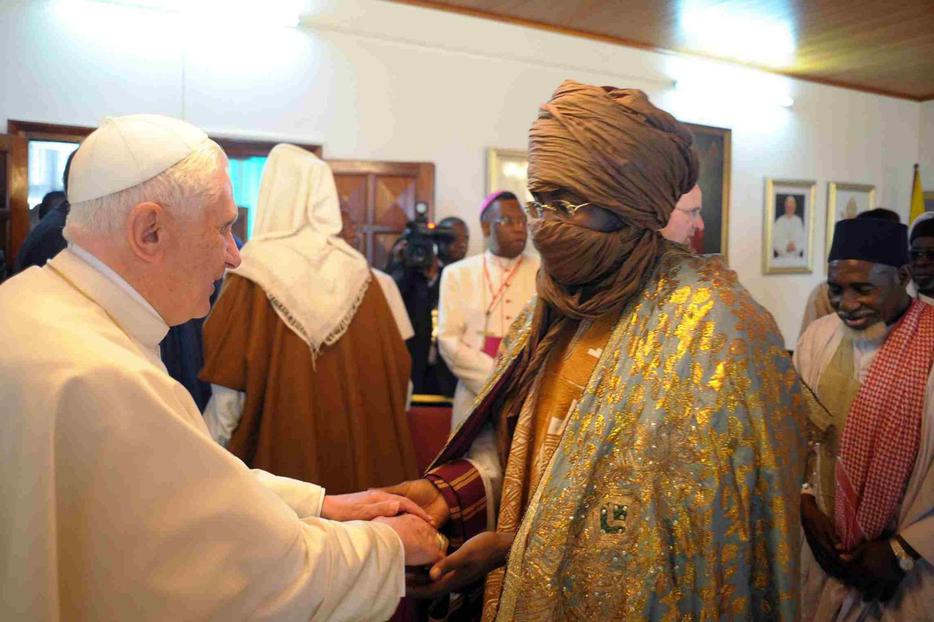
Here’s an aspect of Pope Benedict XVI’s just-concluded trip to Africa that deserves to be much more than a forgotten footnote.
Speaking March 19 to Muslim leaders at the apostolic nunciature in Yaoundé, Cameroon, the Pope reminded them that true religion rejects violence because it violates both faith and reason.
Said the Holy Father, “I believe a particularly urgent task of religion today is to unveil the vast potential of human reason, which is itself God’s gift and which is elevated by revelation and faith. Belief in the one God, far from stunting our capacity to understand ourselves and the world, broadens it.”
Added Benedict, “This insight prompts us to seek all that is right and just, to step outside the restricted sphere of our own self-interest and act for the good of others. Genuine religion thus widens the horizon of human understanding and stands at the base of any authentically human culture. It rejects all forms of violence and totalitarianism: not only on principles of faith, but also of right reason. Indeed, religion and reason mutually reinforce one another since religion is purified and structured by reason, and reason’s full potential is unleashed by revelation and faith.”
The Pope concluded his remarks by encouraging Muslims “to imbue society with the values that emerge from this perspective and elevate human culture, as we work together to build a civilization of love.”
These remarks demonstrate the Holy Father’s intellectual fearlessness: Remember how his comments in 2005 in Regensburg, Bavaria — noting that Islam may be prone to committing violence in the name of religion because Islam appears to conceive of God as being beyond reason — incited waves of violent protest in Islamic countries? And how those comments incited waves of unfounded criticism from Western commentators that Benedict had unjustly criticized the Islamic religion?
Many Vatican-watching pundits declared in the wake of Regensburg that the Pope had blundered in making his comments. But as Register correspondent Father Raymond J. de Souza noted in this commentary in the National Post, the Holy Father’s Regensburg remarks actually have facilitated interreligious dialogue with Muslims.
And the prudence of Benedict’s decision to raise the matter in passing in his Regensburg speech was vindicated by the absence of a hostile reaction when he raised the same themes again last week in Yaoundé.
Having braved the angry reaction the first time around, Benedict now has made the integration of faith and reason and the renunciation of violence in the name of religion into issues that Muslims accept they will be required to address in any meaningful dialogue they conduct with Catholics.
And, by displaying his characteristic charity and gentleness in meeting with the Cameroonian Muslim representatives, the Pope has shown that this important interreligious message can be sent and received in a spirit of mutual goodwill.