At St. Matthew's, Francis Sounds Like Benedict XVI, Looks Like John Paul II
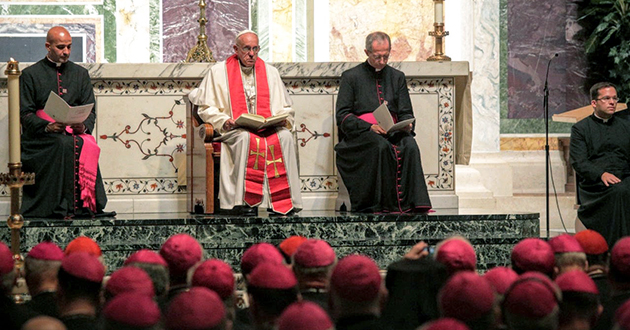
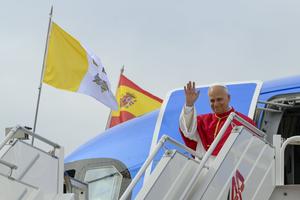
Setting off from the White House where he met with President Obama and the First Lady, Pope Francis continued on his first visit to the United States, meeting with US bishops at the Archdiocese of Washington’s cathedral.
As he entered St. Matthew’s cathedral, many braced for a stormy confrontation between a pope and an episcopate that the secular news media has sought to pit against each other. But the first moments of the visit forecasted a storm of a different kind.
Alongside Washington’s Cardinal Donald Wuerl, Pope Francis prayed reverently before the Blessed Sacrament, the great foundation of the Church’s unity. Then, and only then, did he continue in his procession toward the altar where he gathered his brethren in midday prayer.
At that moment, something became tangibly visible to those gathered. Before them stood the aged, but vigorous, Bishop of Rome called from the ends of the earth on the night of March 13, 2013 to preside over the Church in Christian charity. This was not the media’s progressive potentate who seemingly departs from traditional Church teaching.
Here was someone seeking to speak with the voice of his predecessors in obedience to the Fisher of Men from Galilee. As he said, “I do not speak to you with my voice alone, but in continuity with the words of my predecessors” and “I trust completely in the voice of the One who ‘teaches all things’ (Jn 14:26).”
Continuing, Pope Francis addressed his brother bishops in Italian, the language of the ancient See of Rome, reminding them that “the Church of Rome has always been close to you; you have never lacked its constant assistance and encouragement.”
In this connection, he told them that he did not come in order to judge or lecture them, but to recommit with them to the journey the Church must travel at this hour. He said that “I have not come to judge you or to lecture you.” Rather, “Allow me only, in the freedom of love, to speak to you as a brother among brothers.”
As a brother, he said that he speaks to them “as the Bishop of Rome, called by God in old age, and from a land which is also American, to watch over the unity of the universal Church and to encourage in charity the journey of all the particular churches toward ever greater knowledge, faith and love of Christ.”
But he did not intend his message for the bishops alone. Rather, he appealed through them to all of us that wherever their people are gathered at the Eucharistic liturgy, they may regard him as more than a name, but as a felt presence. Imploring them with words from his heart, he said he wanted to be one who uplifts and sustains the whole People of God.
In poetic terms, he said that “Whenever a hand reaches out to do good or to show the love of Christ, to dry a tear or bring comfort to the lonely, to show the way to one who is lost or to console a broken heart, to help the fallen or to teach those thirsting for truth, to forgive or to offer a new start in God… know that the Pope is at your side and supports you.” He added: “He puts his hand on your own, a hand wrinkled with age, but by God’s grace still able to support and encourage.”
With the ecclesial bonds of unity renewed, the pope applauded the courageous and faithful work of Catholic educators and all those who put their lives at the service of the Church’s charitable work.
For Americans familiar with the current political landscape, the subtext could not have been clearer. The pope was referencing the attack on the culture of life and the civilization of love, rooted in traditional marriage and the family, which certain executive and legislative efforts have imposed. And so, he told his hearers that he is “conscious of the courage with which you have faced difficult moments in the recent history of the Church in this country without fear of self-criticism and at the cost of mortification and great sacrifice.”
Indeed, the pope asserted again that “I appreciate the unfailing commitment of the Church in America to the cause of life and that of the family, which is the primary reason for my present visit.” (All this, recall, just a short time after he gave a firm affirmation to religious liberty within earshot of President Obama.)
As he spoke in these terms, he left no questions unanswered. This week, Pope Francis is in the United States in order to renew fraternal love between himself and the bishops and between the See of Rome and the local churches of this continent; to recommit his pastoral ministry to the unity of the Church; to defend marriage and the family; and, to advocate religious liberty. He said that “These essential aspects of the Church’s mission belong to the core of what we have received from the Lord. It is our duty to preserve and communicate them, even when the tenor of the times becomes resistant and even hostile to that message.”
He comes to the United States with a message of defense for life, marriage, family, and religious liberty that has regard for “the innocent victim of abortion, children who die of hunger or from bombings, immigrants who drown in the search for a better tomorrow, the elderly or the sick who are considered a burden, the victims of terrorism, wars, violence and drug trafficking, the environment devastated by man’s predatory relationship with nature.”
Giving a preview of the remainder of his pilgrimage here, Pope Francis said that at the World Meeting of Families in Philadelphia he will “emphatically proclaim [the Gospel of the Family] together with you and the entire Church.”
As Pope Francis departed the same cathedral that hosts the annual celebration of the US Supreme Court’s Red Mass, one thing was clear.
We have entered a new phase of this pontificate. This week Americans are being visited not by the media’s pope, but by the successor of St. John Paul II and Benedict XVI who desires to enflame “a beacon whose light can reassure men and women sailing through the dark clouds of life that a sure haven awaits them, that they will not crash on the reefs or be overwhelmed by the waves.”