Archbishop Dolan to New York
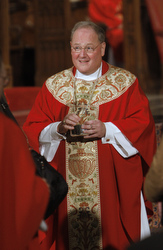
Pope Benedict XVI has named Archbishop Timothy Dolan as the new archbishop of New York.
Go here to read a Catholic News Service article about the appointment of Archbishop Dolan, who served as archbishop of Milwaukee from 2002 until today’s appointment. From 1994-2001, he served as rector of the Pontifical North American College in Rome.
The Register will be reporting in depth about Archbishop Dolan’s appointment, on both the Daily Blog and in the pages of our print edition.
In the meantime, to help readers get better acquainted with New York’s new shepherd, we’re posting this interview Archbishop Dolan gave last spring to Register associate editor Tom Wehner:
What was it like growing up in the Midwest?
Archbishop Timothy Dolan: If you are looking for a textbook case of a meat-and-potatoes Catholic upbringing, all you’d have to do is look at Timothy Dolan.
I was raised in a beautiful, loving, warm family. With a mom and dad who were great believers. They weren’t the kind of people who wore their religion on their sleeve, but they obviously took their faith seriously.
They never missed a Sunday Mass. It was real important to them that their five kids went to Catholic school. Prayer was important to them. It was just a beautiful Catholic upbringing.
The older I get the more I think that the greatest natural blessing the Lord gives us is a happy upbringing. And I had it.
I also had the added blessing of living in a neighborhood that was very heavily Catholic, with tons of kids, and the parish — Holy Infant Parish in Baldwin, Mo. – was not only a center of worship and prayer. We’d go there for sports, for fun. It was just the center of our lives socially, culturally, spiritually, in every way.
There was also a culture of vocations, where, when people would say to me … “What are you going to be when you grow up?” and I’d say, “I think I want to become a priest,” they’d say, “Wow! That’s tremendous. I hope that works out and we’ll pray for you.”
And I can’t overemphasize the importance of my Catholic grade-schooling ... wonderful women religious from Ireland. They were Sisters of Mercy from Ireland. They were joyful women. They were women of learning and faith. The school was the closest thing that I could explain as a “Catholic culture.” Feast days, the songs the prayers — religion was fun, religion was healthy. It was just a great place to grow up.
The older I get the more I realize that those normative years are still what sustain me. The prayers I say in the morning when I get out of bed are the same ones I learned in second grade. And that means a lot to me.
Besides your family, who are some of the greatest influences on your faith?
The sisters and priests in my parish had a great effect on me.
I was fortunate, three years after ordination, to go to The Catholic University of America in Washington, D.C., and get my doctorate in Church history. There, I came under the influence of Msgr. John Tracy Ellis, who was a great Catholic American historian; a man who loved the Church and a man of impeccable scholarship who taught me a deep love of Church history.
I’d always tell the seminarians in Rome, “You study your Church history because you see that the Church has been through it all. And the Church always comes out.”
The Church’s history is the experiment that proves the validity of Our Lord’s promise that “not even the gates of hell will prevail” over the Church, because, Lord knows, they have tried.
When I see the problems today, I’m thinking, “We’ve been through this before.” Sometimes it irritates me when people would give you the impression that “We’ve never been through this. The problems today are unique. And the pastoral challenges are singular today.” And I’m thinking, “Are you crazy? Let’s go back in Church history and see what the Church has been through.”
My first pastor when I was a parish priest for three happy years in St. Louis was Msgr. Cornelius Flavin, who was just a veritable Cure of Ars. He was just a loving, wise, joyful, shrewd, effective pastor. To come under his tutelage was a great blessing.
Then there was the towering influence of John Paul II, which became very, very dramatic once I returned to Rome in 1994 to become rector of the North American College. For those seven years, from ’94 to 2001, I had a box seat into the pontificate of John Paul II. And he had a tremendous influence on me, not only with what he said but what he did.
There was always one more person to see, one more place to go, one more lesson to give, the radar that he seemed to have for the sick.
And, of course those seminarians at the North American College were a great influence on me. I had the privilege of seeing 50 new men each year, and that’s a total of around 400 young men who went on to the priesthood in the United States.
There seems to be a lot of doom and gloom over the state of the priesthood today, but what you witnessed at the North American College would belie those sentiments.
I really believe that we are on the brink of a springtime in the priesthood. And I believe that all of the turmoil — the trials, the suffering, the scandal that we’ve been through, the shortages, the questioning, the dissent, the anger — is part of the cleansing of the Church. The priesthood is at a real turning point. … I often think that the paradigm of where the priesthood is today, and in a more extended way the Church, is in the third chapter of the Acts of the Apostles. Remember when Peter and James were in the Temple square and a blind beggar asked them for alms, and Peter said, “Silver and gold I don’t have, but what I do have I give you. I have Jesus Christ.”
Today, for the priest, what does he have, earthly clout, prestige, prominence? Forget it. More often than not, he sees the priesthood mocked. From a natural point of view, things have been taken away.
And that’s not too bad, when you think about it.
When I saw the seminarians in Rome or the 38 seminarians we have here in the Archdiocese of Milwaukee, they don’t go in for clout. They can’t go in for prestige. They can’t go in for prominence. So what are they going in for?
If they’re not going in driven by faith with a passionate love for Christ and his Church, well, heck they don’t have anything else. Now that’s not a bad place to be.
Sometimes the Church is on the cross, and, well, that’s when Our Lord was most effective.