A Father Found in Ireland: How a Young Archbishop Coakley Discovered His Vocation
A harrowing and tragic ordeal on the Emerald Isle moved a young Coakley to consider the priesthood.
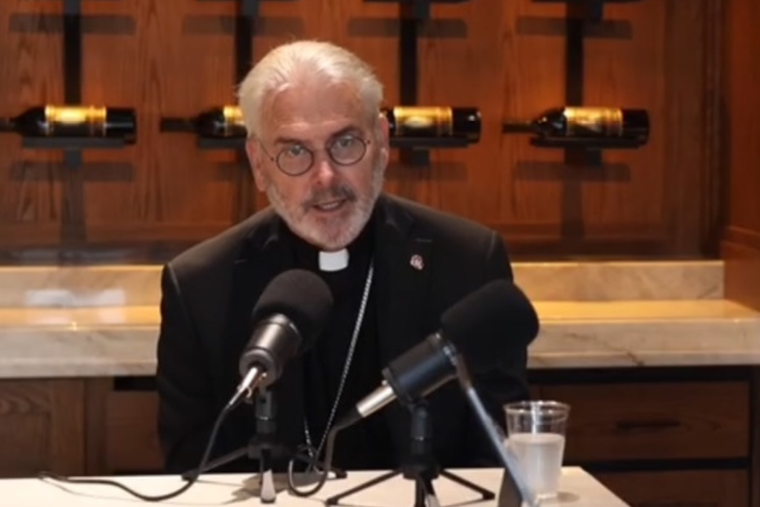
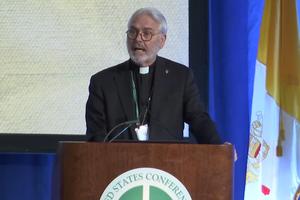
Every Catholic priest who dons a collar has a story of what compelled him to become a spiritual father. Some know from an early age; others find out during high school or college when discerning a career, and amid every other story under the sun. Archbishop Paul Coakley, who is now at the helm of the U.S. Conference of Catholic Bishops, serving as president, recently shared his own vocation story with the Napa Institute’s Shepherd Circle Priest Podcast.
Speaking to Father Michael Duffy during an interview that was published in December, but conducted on the sidelines of the Napa Institute’s summer 2025 conference, the shepherd of Oklahoma City talks extensively about his own upbringing, and although he and his family never missed Sunday Mass — “never missed, never, ever” — becoming a priest was never a thought.
“I remember every now and then my parents would bring up the question when I was in middle school, probably, and certainly in high school, ‘Paul, did you ever think about being a priest?’ And I would suddenly remember that I had some homework waiting that needed attending to. So I would change the subject immediately, because it was just not on my radar screen,” Archbishop Coakley said. “I was not in the least bit interested.”
But things changed when he went off to college at the University of Kansas and became involved in the Integrated Studies Program there. At first, he didn’t attend Mass regularly, as his faith “just didn’t seem to have much relevance in my life other than the obligations that came with being a Catholic. I always knew I was Catholic. I never rejected it.”
So out on his own, he began to be a “bit lax in my practice.” But then the Integrated Studies Program spurred some good Catholic camaraderie.
“I didn’t know it at the time when I enrolled in it with my best friend from high school, Jim Conley, who is now Bishop [James] Conley — we were roommates in college — but we both experienced the remarkable educational opportunity that the Integrated Humanities Program was for us.”
Similar to the Great Books program, he recalled:
“We read the Great Books. We memorized poetry; we did stargazing. We did all kinds of wonderful, seemingly unconventional educational things.”
And during his junior year, the group spent an entire semester abroad in Ireland, and he and his fellow students experienced something that changed his heart and mind forever.
“I was 20 years old and a junior, and I was thinking, ‘This is going to be great. It’s like a four-month pub crawl through the 26 counties of Ireland’ — and it didn’t turn out that way. The first week that we were there on this little island called Inishbofin, two of our classmates and friends went for a walk along the rocky coast and didn’t come back and didn’t know the danger that that entailed.”
Archbishop Coakley recalled waking up the next morning “and went to the local church on the island for Mass, and after Mass, mentioned to the local parish priest, young [Father] Martin O’Connor, that our friends had been out exploring the island and didn’t come back, and he basically raised an alarm on the island.”
Alongside Father O’Connor, young Coakley and his friends spent the entire day walking along the rocky crags, searching for a sign of their two friends.
“But by the end of the day, we realized that we wouldn’t, would not find them — found a little scrap of a nylon windbreaker that one of them had been wearing jammed in the rocks; and by the end of the day, we realized that they had drowned and had they fallen in.”
And, sadly, news of their fate was confirmed.
“The next day, their bodies were recovered by the Coast Guard. Actually, a local fisherman saw something flashing in the clear waters just a few 100 yards off of the coast. But it seems that one of them had fallen in, and the other one went in to try to rescue him, but they were both kids from Kansas — didn’t know anything about tides, didn’t know anything about the North Atlantic and the cold, and it was in February. So at any rate, it was a tragedy. They both drowned.”
Both of the students were Catholic, Archbishop Coakley remembered. “One of them was a lifelong Catholic. The other had converted to the faith 30 days before. And it was there, with 150 of us in Ireland for this trip, and it moved us profoundly. All of us, other students actually ended up converting to the faith while we were abroad that semester.”
But it was in these moments that the college-age Coakley embraced his childhood faith, marked by this Irish man who had consoled all of them in moments of grief and uncertainty.
“But for me, it was the beginning of an understanding why we call priests ‘Father.’ Because I spent all of this time with Father O’Connor. He was a young priest. I think it was his first assignment, maybe a second assignment, but I went to the rectory — I walk up to a rectory and knock on the door, not being forced there by my parents to fess up to something. But I had some great conversations with Father O’Connor, which concluded, ultimately, with making a general confession of my life. And I just recognized, you know, being a priest wouldn’t be such a bad thing after all. And so that was a significant experience.”
Archbishop Coakley continues sharing more details about his days in seminary, his ordination day, touching on the importance of camaraderie, learning about Blessed Stanley Rother, and so much more. Please find the full interview below:
- Keywords:
- archbishop paul coakley
- priestly vocations

Alyssa Murphy Alyssa Murphy is the Register's Managing Editor of Digital Assets. Starting her career on the airwaves in San Francisco, she has worked in all facets of media. Alyssa enjoys writing and covering stories that inspire and uplift. Register readers may be familiar with her voice from EWTN radio's Morning Glory. Alyssa currently lives in New Jersey just outside Manhattan with her husband Andrew and young daughter, Annabelle.