My esteemed colleague Pat Archbold’s lively and engaging post on big-screen Jesuses has obliged me to add a few notes of my own (with apologies for the post title joke—I don’t really think Pat “forgot” anything, since his list wasn’t meant to be exhaustive in the first place, and certainly mine isn’t either).
Judging from Pat’s combox, the best big-screen Jesus for a lot of people is either Robert Powell of Jesus of Nazareth or Jim Caviezel of The Passion of the Christ. I think there’s a lot to be said for both, although obviously no actor could truly do Jesus justice, and both performances have weak spots in my opinion.
Powell aptly conveys authority, fire and tenderness, but there are moments, particularly during miracle sequences, when, to quote Mike Hertenstein of Flickerings.com, Powell’s “Jedi-like histrionics” are a bit much. As for Caviezel, he embodies the Suffering Servant of the Passion narratives as well as any actor could, I think—yet he’s less convincing, at least to me, in the crucial flashback sequences as the New Moses of the Sermon on the Mount and the High Priest of the Last Supper. (On the other hand, both films have utterly flawless Blessed Virgins, in my opinion: I can find no fault in either Olivia Hussey or Maia Morgenstern.)
What other big-screen Jesuses deserve mention? I won’t go through all the Jesuses that Pat considers—or even all the Jesuses he doesn’t. (For example, I have nothing to say about the Musical Jesuses of Godspell and Jesus Christ Superstar, except to say that, for me, they are, simply, Not Jesus. I’m also aware that I’m skipping a number of others.) But there are some that I want to highlight ... including my own favorite screen Jesus of all time, which so far has gone unmentioned.
Let’s begin with a couple of Jesuses from the Vatican film list. First, there’s Enrique Irazoqui, a half-Jewish, half-Basque economics student who had never acted before played Jesus in Pier Paolo Pasolini’s The Gospel According to St. Matthew.

I think Irazoqui was about 21 when he played the role, making him possibly the youngest big-screen Jesus. If I were going to hang a facetious, Archbold-style handle on him, though, I might go with Marxist Jesus. Pasolini was a Marxist, and a lot of people have felt that Irazoqui’s firebrand prophet is a Marxist rabblerouser in Galilean guise—though I don’t feel that way myself, and very much like the film’s portrayal.
Second, there’s one of the earliest screen Jesuses in any extant film: the 1905 Life and Passion of Jesus Christ. This is an extraordinary document from the very beginning of the cinema era, more like a set of filmed vignettes from a stage play than a film drama per se. The actor playing Jesus is fine in that context—not very convincing, but he gets the job done. Sort of like a second-rate department-store Santa Claus that even kids know isn’t the real Kris Kringle, but he’ll do. We might call this one Fat Stage Jesus (again, let me emphasize that I do love this film):

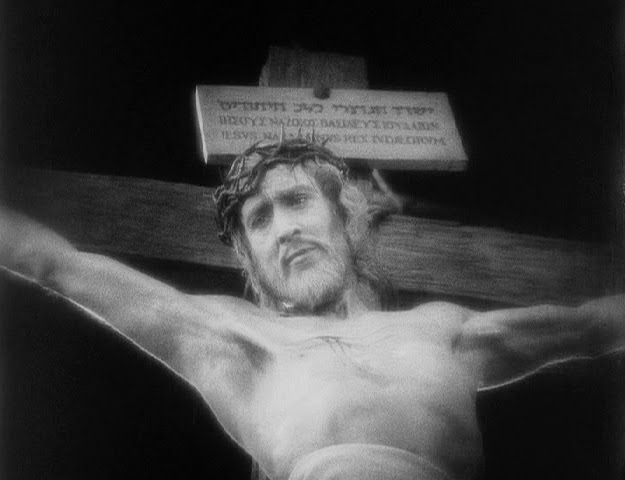
Another silent-era Jesus also warrants mention: H. B. Werner of Cecil B. DeMille’s silent masterpiece The King of Kings. For most readers the name DeMille conjures images of Charlton Heston as Moses in The Ten Commandments, but The King of Kings is a better and more genuinely spiritual film, and very much worth seeing.
Werner is an excellent Jesus, compassionate, dignified, authoritative, but too sedate in some sequences, like the cleansing of the temple. Already in his early 50s in the role, Werner was 20 years older than the actress playing His Blessed Mother, and so of course we must dub him Old Jesus. (Incidentally, Werner has a cameo in The Ten Commandments as the elderly Hebrew slave who dies in Moses’ arms after being struck by an Egyptian in the mud pits. (His most familiar role might be as Mr. Gower the pharmacist in It’s a Wonderful Life.)
Finally, if I had to pick my favorite big-screen Jesus ...
... well, I’m not sure I wouldn’t pick this one:
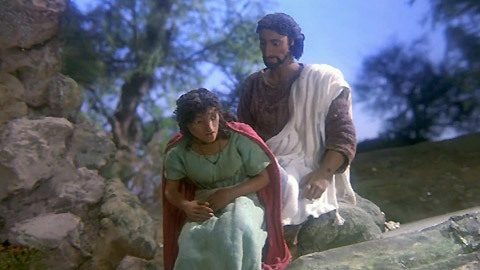
That’s right: A stop-motion figure made by Russian puppeteers and voiced by Ralph Fiennes in the 2000 BBC production The Miracle Maker may be my favorite big-screen Jesus. (And yes, The Miracle Maker did play on the big screen, in the UK.)
Like an icon, a statue or a crucifix, this figure is Jesus to me in a way that no actor could ever be—even an actor who brings no baggage, who has no prior screen history, like Irazoqui. Fiennes’s line readings are wonderful, capturing everything from the peasant humor of some of Jesus’ sayings (e.g., the log in the eye) to the compassion of Jesus’ healing miracles to the desperation of the agony in the garden.
The Miracle Maker is arguably the best critically informed life-of-Christ ever made—the most historically credible depiction of Jesus’ work, death and resurrection ever filmed. (The Passion of the Christ is not a life-of-Christ film, and is more informed by Catholic devotional tradition than historical studies. Jesus of Nazareth is critically informed, but not as good as The Miracle Maker—and it departs far more substantially from the Gospel accounts, annoyingly so at times.)
The Miracle Maker also has the distinction of being the only Jesus film I can think of that does any kind of justice to the resurrection accounts. (The two silent Jesus movies mentioned above manage transcendent resurrection appearances, but the actual resurrection accounts in the Gospels are really honored only by The Miracle Maker.) Compare the graceful handling of Jesus’ post-resurrection appearance to Mary Magdalene in The Miracle Maker (shown above) to the awkward staging of the same scene in The Gospel of John, which has Jesus deliberately crouching with his face hidden behind a plant, as if he’s trying to look like a gardener.)
The Miracle Maker is indispensable Easter viewing for the whole family at Casa Greydanus. If you aren’t familiar with it yet, buy it now and watch it this year. I practically guarantee you won’t be disappointed.



Comments
Post a Comment
Your link on “buy it now” apparently has two hh’s in it, as firefox says it cannot open it.
Thanks for the catch, fixed.
I can’t agree about Caviezel… I think his Sermon on the Mount performance is great! It actually helped me to see Jesus in a new way - a good new way.
In reading the gospels, Jesus always came across to me as at best very authoritative and at worst very strict. Now neither of these things are bad, in and of themselves - in fact they are good. It’s good to be firm about right and wrong, and the fact that Jesus spoke with authority was something which drew people to Him.
However, Jesus also had compassion, mercy, empathy, and other such qualities. I never really saw these in Him in reading the Gospels - not because they aren’t present there, but because black and white text so very often strips a speaker of his more human qualities (especially when his words involve laying down directives).
Caviezel’s Jesus preaches the Sermon on the Mount in a way that blew me away the first time I saw it. I still sometimes turn to when I want to remind myself that Jesus was not going around preaching rules “at” people all of the time. Caviezel’s Jesus offers hard teachings, but in an inviting way. It’s precisely they way I think Jesus would have been.
In meditating on the Luminous mysteries of the Rosary, I was once struck with a subtle difference between Jesus’ calls to conversion and that of the prophets before Him. So often, they cried out for repentance, promising the negative consequences which would result from failing to do so. Jesus does not shy away from this (and neither were the former prophets completely devoid of any hope), but His ministry was marked by an emphasis on invitation: “Repent,” not simply because of the evils that may befall you, but “for the Kingdom of God is at hand.”
I see Caviezel’s Jesus coming across this way. He gives the difficult teachings of Christ, but sounds as though rather than *condemning* his listeners in doing so He is *calling* them to that conversion.
As an aside, my current favorite Jesus is the one from the Jesus Film, which I recently saw for the first time. He’s not the best in any particular way, but there’s something about the way his portrayal complements the portrayals of the others around Him which in some deeper way echoes the love Christ has for every person. Put simply, when I watched it I felt like I was seeing people drawn to a God who knows and loves them through and through.
“On the other hand, both films have utterly flawless Blessed Virgins, in my opinion: I can find no fault in either Olivia Hussey or Maia Morgenstern.”
Two puns for the Immaculata?
What about Charlton Heston in The Omega Man?
Fair enough, though the Jesus of Jesus Christ Superstar is not Jesus in a crucial way that the Jesus of Godspell isn’t not.
Any thoughts on the Jesus of Intolerance? He’s a very slow and stately figure, but, in my opinion, effective as far as he goes. However, this is the portion of the film that suffered most from the heavy editing for length.
What about Bela Lugosi?
Mark, stop it. You’re kidding. Oh… you’re… not.
Oh yes, Miracle Maker is THE JESUS FILM in our household. Love the way He holds up the bread, too. Just like our priest now (we’re converts and are especially moved by this).
Speaking of resurrection accounts, one of my favorite Jesuses is the one played by Michael Wilding Jr. (son of Elizabeth Taylor and her second husband, Michael Wilding Sr.) in the mini-series A.D. Anno Domini (1985). That particular production is based on Acts, not the gospels, so Wilding’s Jesus gets little more than a cameo; but the mini-series *does* begin with Jesus meeting the two men on the road to Emmaus, followed shortly by the resurrection appearance to Thomas and the other apostles behind closed doors. The show’s treatment of Thomas’s doubt and renewed faith has always been one of its selling points, for me, and the interaction between Jesus and Thomas is a big part of that, so, there you go.
Wow! I’ve always maintained that the Miracle Maker Jesus was the best, and am pleased to see a genuine film critic agree with me. I think the key is that with Miracle Maker there is no Hollywood personality/ego getting in the way. I also think Powell in J. of Nazareth was the worst thing about the film, but it couldn’t be helped: it was made in the 70s so we got a 70s Jesus.
You are welcome, Steve!
Yes, “The Miracle Worker” is both inspirational and historical. I also like the way it is partly viewed through a child’s eyes.
How Catholic is “The Miracle Worker?”
Hi Steven,
Upon your recommendation, I rented The Miracle Worker, and while I enjoyed it overall, there was one aspect that troubled me a little. The post resurrection scenes seemed (to me) to subtly imply that the resurrection of Jesus was a metaphorical resurrection rather than a literal one, and I felt the Ascension is something that couldn’t have been easily overlooked, and must have been omitted intentionally. Being released by Mel Gibson’s Icon productions, I was a little surprised that he would have been willing to release it, but perhaps he didn’t see what I did in those final scenes, and perhaps he’s not so particular these days. I felt that aside from leaving a lot out in terms of the burial/resurrection accounts (the Roman guard posted at the tomb) and inaccuracy of the discovery of the resurrection to Gospel accounts, as well as the brevity of his entombment (I think a nice slow dissolve, if not a scene of the apostles grieving and gathering in fear would have sold it as being a little more than a few hours in the tomb, but that’s a directorial pacing issue, not a moral one) the post-ressurection scenes seemed to focus more on Jesus appearing and disappearing amongst the disciples than on the fact that he was there with them, which made me feel it was a subtle implication on the part of the filmmakers that Jesus didn’t “actually” rise, but “rose in spirit among believers,” which is what bothered me. Of course, this may not have been intended, and perhaps I misinterpreted it.
ALL THAT ASIDE, I thought it was a well directed film, and the thing I loved most was how flashbacks, parables, demonic temptation, etc. (story elements that were not physically present in real time) were portrayed with hand-drawn animation as opposed to stop-motion. I even joked to my siblings who watched it with me, that doubting Thomas might have said that he wished to see Jesus in claymation before his doubt would be satisfied! But I thought that was a brilliant artistic move to portray the imagined and corporeal in the other medium. Jesus’s temptation in the desert was a particularly powerful example of this technique.
Also of note is the excellent stop-motion which was skillfully excecuted, with dramatic lighting and great voice acting, which made this a unique and engaging telling of the teachings of Christ which I enjoyed not only as a Catholic, but as an aspiring animator who has a discriminating appreciation of the craft. It was nice to see a well animated movie with artistic merit that relied on traditional methods rather than the ubiquitous computer graphics, infusing the human touch into the artwork.
All in all, I’d say that it’s an excellent film that should definietly be seen, and the ending, while it’s not necessarily problematic, is in my mind, incomplete without the Ascension and as with any film of the life of Christ, should not be viewed casually, but with reference to the Gospels, etc.
Besides Jim caviezel, when it comes to Jesus film the first person who comes to my mind is always Brian Deacon. When I was a little boy I thought it was not the movie.To me he became Jesus!!!
This may be surprising, but honestly I think I prefer performances of Jesus that are NOT speaking in English (even though that’s my first language). Which means, of the ones I’ve seen, Enrique Irazoqui and Jim Caviezel (although I liked Ralph Fiennes too, maybe it’s because that’s a stop-motion animated puppet and the voices were all done to match up and I didn’t recognize a lot of big-name stars in The Miracle Maker, I don’t know).
But honestly, I was always confused at CCD when I learned that Jesus said “Take, eat: this is My Body.” Who talks like that, I thought? Now I realize it’s what someone whose first language was not English would say. What about a Jesus Who, while speaking in English, spoke with an accent like that and said something like “Take eat; this is My Body, the being broken on behalf of you; this do in remembrance of Me.”? In other words, sounding like your uncle from the old country?
Post a Comment
By submitting this form, you give The National Catholic Register permission to publish this comment. Comments will be published at our discretion, and may be edited for clarity and length. For best formatting, please limit your response to one paragraph and don't hit "enter" to force line breaks.