WEEKLY CATECHESIS
Register Summary
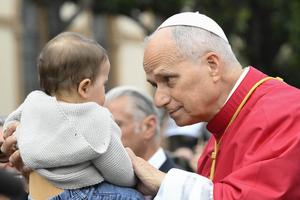
Pope Benedict XVI met with 30,000 pilgrims in St. Peter’s Square during his Oct. 4 general audience. Continuing his series of portraits of the Twelve Apostles, he spoke about the Apostle Bartholomew.
Pope Benedict XVI pointed out that
Bartholomew’s name is mentioned solely in the four lists of the apostles that
appear in the New Testament. However, Bartholomew is traditionally identified
with Nathanael, a close friend of the Apostle Philip,
with whom Bartholomew is also identified. When Philip enthusiastically told Nathanael about his encounter with Jesus, the Holy Father
pointed out, “Nathanael raised an objection that
revealed a rather deep-rooted prejudice: ‘Can anything good come from
“Nathanael’s experience prompts yet another reflection,” the Holy Father continued. “In our relationship with Jesus, we must not be satisfied only with words. In his reply, Philip extends an important invitation to Nathanael: ‘Come and see.’ Our knowledge of Jesus is in need, first of all, of a living experience.”
Like the Apostle Thomas, Pope
Benedict XVI explained, Nathanael also makes a
significant profession of faith: “Rabbi, you are the Son of God; you are the
King of Israel!” His profession of faith highlighted Jesus’ special
relationship with God the Father and with the people of
The Holy Father concluded his
reflections by pointing out that Bartholomew has traditionally been considered
to be an apostle to
Dear Brothers and Sisters,
Today we will focus our attention on the Apostle Bartholomew in our series of teachings on the apostles whom Jesus called during his life here on earth. In the earliest lists of the Twelve Apostles, he always appears before Matthew, while the name of the apostle who precedes him varies: it is either Philip (see Matthew 10:3; Mark 3:18; Luke 6:14) or Thomas (see Acts 1:13). His name is clearly derived from his father’s name, since it explicitly refers to it. In fact, his name is probably of Aramaic origin, “bar Talmay,” which means “son of Talmay.”
Nathanael and Philip
We do not have any significant
information on Bartholomew. In fact, his name always appears and only appears
within the lists of the Twelve Apostles that I mentioned earlier; thus, he is
never the focus of any narrative. Traditionally, however, he has been
identified with Nathanael, a name that means
“God-given.” Nathanael came from
The reason why these two figures
are identified with each other is probably due to the fact that Nathanael, in the scene where he finds his vocation
recounted in the Gospel of John, is placed there along with Philip — that is,
in the same place that Bartholomew occupies in the lists of the apostles
recorded in the other Gospels. It was to Nathanael
that Philip had said that he had “found the one about whom Moses wrote in the
law, and also the prophets, Jesus, son of Joseph, from
His objection is, in its own way,
important to us. It allows us to see that, according to Jewish expectations,
the Messiah could not come from such an obscure village like
‘Come and See’
Nathanael’s experience prompts yet another reflection: In our relationship with Jesus, we must not be satisfied only with words. In his reply, Philip extends an important invitation to Nathanael: “Come and see” (John 1:46b). Our knowledge of Jesus is in need, first of all, of a living experience. The testimony of other people is certainly important, since our whole life as Christians normally begins with the proclamation that comes to us through one or more witnesses. But we ourselves must be personally involved in a deep and intimate relationship with Jesus. In a similar way, the Samaritans, after having heard the testimony of one of their fellow townswomen whom Jesus had met at Jacob’s Well, wanted to speak directly with him and, after that conversation, said to the woman: “We no longer believe because of your word; for we have heard for ourselves, and we know that this is truly the savior of the world” (John 4:42).
Returning to the scene of Nathanael’s vocation, the evangelist tells us that, when Jesus saw Nathanael approaching, he exclaimed: “Here is a true Israelite. There is no duplicity in him” (John 1:47). Jesus’ words of praise recall the text of a psalm: “Happy those … in whose spirit is no deceit” (Psalm 32:2). At the same time, they piqued Nathanael’s curiosity. Astonished, he replied: “How do you know me?” (John 1:48a). Jesus’ answer is not immediately comprehensible. He said to him: “Before Philip called you, I saw you under the fig tree” (John 1:48b). Even today it is difficult to understand precisely the meaning of these words. According to some experts, it is possible that, since the fig tree is mentioned at times as the tree under which the doctors of the law sat to read and teach from the Bible, Jesus was referring here to this occupation as the type of occupation in which Nathanael was engaged at the time of his calling.
A Profession of Faith
In any case, what matters most in
John’s account is Nathanael’s clear profession of
faith in the end: “Rabbi, you are the Son of God; you are the King of Israel!”
(John 1:49). Nathanael’s profession of faith does not
have the same intensity as Thomas’ at the close of John’s Gospel, “My Lord and
my God!” (John 20:28), but it serves to pave the way for the fourth Gospel.
Through his profession of faith, he takes his first important step on the path
of following Christ. Nathanael’s words highlight a
dual and complementary aspect of Jesus’ identity. He is recognized both by his
special relationship with God the Father, of whom he is the only-begotten Son,
as well as by his relationship with the people of
We must never lose sight of either of these two dimensions: If we only proclaim the heavenly dimension of Jesus, we run the risk of making him an ethereal and fleeting being; if, on the contrary, we only recognize his physical presence in history, we end up forgetting his divine dimension, which fittingly describes him.
Apostle to
We do not have any precise
information on the subsequent apostolic activity of Bartholomew-Nathanael. According to some information to which the
fourth-century historian Eusebius refers, a man named Panteno
found signs of Bartholomew’s presence in
In conclusion, we can say that the figure of St. Bartholomew, despite the lack of information regarding him, remains nevertheless before us in order to tell us that we can live out and give witness to following Jesus without achieving any sensational works. Jesus himself is, and will always be, the one who is extraordinary, and each one of us is called to consecrate our own life and our own death to him.
(Register translation)
- Keywords:
- October 15-21, 2006