The Vatican’s Long Game With Iran
ANALYSIS: Behind a recent controversial honor for Tehran’s envoy lies a history of back‑channel diplomacy, shared U.N. battles and carefully tended lines to the ayatollahs.
In late March 2007, as the Ahmadinejad government paraded captured British Royal Navy personnel on Iranian television, the crisis appeared to be hardening into one more grim standoff between Tehran and the West.
Behind the scenes, however, quiet efforts were underway to secure their release. Among the most effective involved the British Embassy to the Holy See, Vatican diplomats and Iranian officials. At the center of these efforts was Msgr. Pietro Parolin, then the Vatican’s undersecretary for relations with states.
Working with long-established U.K. and Iranian diplomatic contacts, Msgr. Parolin arranged for Pope Benedict XVI to send a confidential appeal to Iran’s spiritual leader, Ayatollah Ali Khamenei, requesting the sailors’ release as a goodwill gesture before Easter. The appeal succeeded, and the sailors were freed on April 4, the Wednesday of Holy Week, in what President Mahmoud Ahmadinejad described as an “Easter gift” to the British people.
The episode was a reminder that the Vatican’s relationship with Iran — one that officially dates back to 1966 — has long been more substantial, and more useful, than is often assumed.
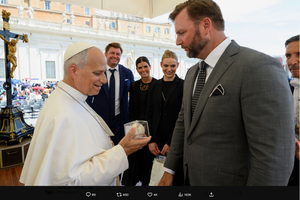
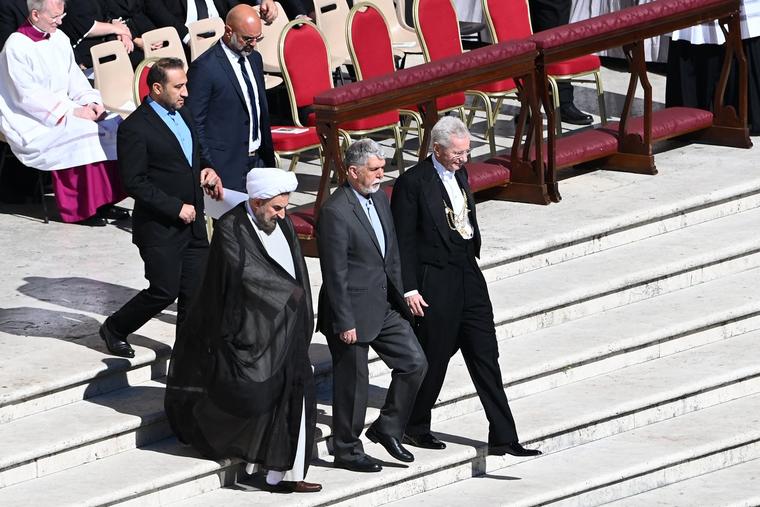
That history helps to explain, though not necessarily justify, a recent controversy surrounding the Vatican’s decision to confer a routine but prestigious diplomatic honor on Iran’s ambassador, Mohammad Hossein Mokhtari.
Iranian state media portrayed the award as a gesture of papal support for Tehran’s foreign policy and efforts to promote peace. Responding to critics who said the honor legitimized the Iranian regime, the Vatican and the U.S. Embassy to the Holy See stressed that the Grand Cross of the Pontifical Order of Pius IX is routinely conferred on all ambassadors after more than two years of service, adding that 13 diplomats received the recognition at the same May 12 ceremony.
A routine diplomatic nicety, though it may have been, bilateral ties between Iran and the Holy See have been consistently strong for decades. Iran’s Embassy to the Holy See is among the most active in Rome. I vividly recall visiting the compound several times some years ago for media interviews and being impressed by the amount of activity taking place there — possibly, I thought, because it’s a useful listening post, but more likely because both the Holy See and the Islamic republic consider each other useful.
Tehran has occasionally sought the Vatican’s help as a mediator, as happened last July when Mokhtari wrote to Leo XIV, urging him to publicly denounce what Iran described as U.S. and Israeli threats and insults directed at Khamenei.
For its part, the Holy See has at times found in Iran an unexpected partner in multilateral settings, especially at the United Nations. Iranian diplomats have, on several occasions, aligned with the Vatican in defending positions on the sanctity of life, the protection of the family, and resisting expansive interpretations of reproductive rights to include abortion.
The Vatican has occasionally leveraged its positive relations with Iran to offer criticism when it is due, as in January, when Cardinal Parolin — albeit mildly — criticized Tehran for the slaughter of its own citizens.
The relationship has also developed through sustained intellectual and religious exchange. Delegations of Shiite clerics have regularly traveled to Rome for meetings with their Catholic counterparts, often under the auspices of the Dicastery for Interreligious Dialogue. These encounters have gone beyond symbolism, fostering familiarity and, at times, genuine warmth, as well as providing an opportunity to push for religious freedom for Christians in Iran.
In 2010, Iranian Ayatollah Mostafa Mohaghegh Damad took part in that year’s Synod for the Middle East. In an interview with the Register at the time, he said he clearly held Benedict XVI in very high regard, noting that they had “known each other for years,” and he recalled their participation in a Vatican conference on human rights.
Recent developments further underline that this diplomatic channel remains active. In a message on Saturday to Leo XIV, Iranian President Masoud Pezeshkian expressed appreciation for the Pope’s “moral and logical stance” on the U.S.-Iran conflict. The message, reported by Iranian state media, reflected Tehran’s continued interest in maintaining a line of communication with the Holy See, even, or perhaps especially, amid heightened regional tensions.
All of this helps explain why the Vatican is reluctant to jeopardize its ties with Iran, particularly at a moment of renewed strain in the region. The Holy See has, on occasion, positioned itself as a potential intermediary where trust is scarce. Preserving that possibility, even if it is remote, requires keeping relationships intact.
None of this, however, fully resolves the question of prudence surrounding the timing of the honor bestowed on the Iranian ambassador. Routine or not, diplomatic gestures carry symbolic weight, and symbols can easily be misread. A short deferral might have avoided unnecessary controversy without materially damaging the underlying relationship.
Yet the decision perhaps reflects a broader calculation: that the long-term value of diplomatic relations matters more than the bad optics of any controversial award. The Vatican is playing a long game, shaped by decades of mostly positive diplomatic relations with Iran.
Viewed in this light, the honor conferred on the ambassador appears less an aberration than a continuation of a quietly consistent policy, one that wishes to keep positive diplomatic channels open with a regime and in a region upon which so much of world peace currently depends.

Edward Pentin Edward Pentin is the Register’s Senior Contributor and EWTN News Vatican Analyst. He began reporting on the Pope and the Vatican with Vatican Radio before moving on to become the Rome correspondent for EWTN's National Catholic Register. He has also reported on the Holy See and the Catholic Church for a number of other publications including Newsweek, Newsmax, Zenit, The Catholic Herald, and The Holy Land Review, a Franciscan publication specializing in the Church and the Middle East. Edward is the author of The Next Pope: The Leading Cardinal Candidates (Sophia Institute Press, 2020) and The Rigging of a Vatican Synod? An Investigation into Alleged Manipulation at the Extraordinary Synod on the Family (Ignatius Press, 2015). Follow him on Twitter at @edwardpentin.