Choosing to Love, Even When It Breaks Your Heart
Kate Stapleton was 21 when she became pregnant. She never considered abortion, but at the same time, she realized she didn’t have the kind of life she wanted her child to have.
The pro-life movement has an enormous range of support and services for young women in unplanned pregnancies, as well as for those suffering after an abortion.
One area that needs more attention is birth mothers who choose adoption.
While the Catholic Church has always been at the forefront of pro-life issues, this is one area that needs to be addressed, says Kate Stapleton, birth mom to a daughter who is now 24 years old.
Their story is told in the new film The Inner Sea Film.
“Stories have the ability to shift our perspectives,” Stapleton told the Register. “The gap between pro-life and pro-abortion perspectives is wider than ever. Finding a new path and approach to the conversation about choice is crucial.”
In directing the film about her own journey, Stapleton’s aim is to reach people outside the pro-life community. “Although this is a deeply pro-life film, our goal has been to reach out to those whose hearts have been hardened by the lies that our culture tells about love. Beauty is a language that transcends barriers and reaches vulnerable souls. The lack of this perspective is something greatly needed in the pro-life community,”
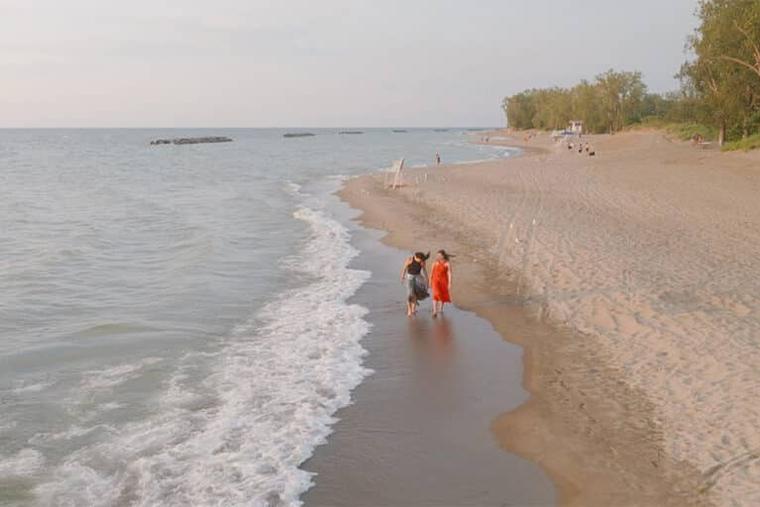
The title refers to the Great Lakes shores of Michigan, where Stapleton often walked and prayed while pregnant.
Filmed over the course of a year by cinematographer Martin Jernberg, the movie highlights the sacrificial choice of adoption and “the inevitable connections between love and suffering, the ways beauty can surprise us when least expected,” Stapleton said.
Stapleton was 21 when she became pregnant. She never considered abortion, but at the same time, she realized she didn’t have the kind of life she wanted her child to have.
“I went to a crisis-pregnancy center, and I remember how well-meaning the women there were,” she told the Register. “I remember vividly the plastic figures of the baby in the womb, but I also remember a feeling of a huge lack of information there about adoption. Mostly women were just handed a brochure about adoption being love, which is true, but I think not informative.”
“The information offered in pregnancy centers often focuses around the number of waiting couples, how much they want a child and are prepared to raise one, and how adoption is better than abortion in so many ways,” she added. “Yet there’s usually no information from the perspective of the birth mom who makes an adoption decision.”
Ultimately, Stapleton chose an open adoption for her daughter, and that decision began a journey that has been a central part of her life ever since.
Many people assume that once the baby is placed with adoptive parents, the birth mother resumes her life with no emotional impact. What Stapleton and other birth moms want people to know is that the difficulty of that decision stays with them, often permanently. Birthdays, Christmas, graduation, seeing a child in a stroller, even feeling lonely, can all trigger the feelings of loss.
“The enormity of our grief was beyond believing and yet, we shared a strong conviction that we had done the right thing,” explained Stapleton in a heartfelt essay called, “Blossoms of Love.”
“We simply could not offer our child the life we wanted, so badly, for her to have, and those hopeful, faithful, and incredibly generous people holding our daughter at that moment? They could. They did.”
“The first year after the adoption was a blur of grief and darkness. Light returned slowly to my life. At first it was like the visible beams of light you see streaming down from dark clouds, sun piercing through shadow,” she also wrote.
“My daughter Brigid was a constant presence in my mind and in my life. There were pictures, letters, and eventually visits. I saw their home, their family growing. They returned to my parent’s farm, braving a blizzard to do so. We gathered with our whole extended family around the table. I watched my daughter — our daughter — singing in the choir.”
Later, Stapleton met and, as her poignant essay recounted, “fell in love with a man with an extraordinary soul. He lived just an hour from where my daughter was being raised.” They married a year later, and her daughter and her adoptive family were there.
“I believe in grace,” her essay continued. “The story of my adoption is beautiful. It’s also a huge part of who I am, intertwined with my life and being. The presence of this part of my life has become much more natural over the years. The parents who adopted my daughter have seven children. They are a continual inspiration to me.”
She added with raw honesty, “Each May when the world is in bloom, the world celebrates Mother’s Day, and I celebrate the birth day of the daughter that I gave away. Each year, I struggle.”
Kate and her husband Casey now have six children who attend a hybrid education of part Catholic school and part home school in Pittsburgh. At various points they’re on the road in a converted bus as a musical duo known as The Stapletons. Kate plays harp, Casey plays guitar, and the kids sing along.
The musical talent extends to Brigid — Brigid Burt, who is a recent graduate of Franciscan University of Steubenville — and her own band, Acaciawood, joined the Stapleton family for a recent concert, as seen in the movie.
Asked by the Register if the new movie has encouraged adoption in any way so far, Kate Stapleton shared a story about working with Emmy Award-winning editor Ben Kruis, who edited the film.
“We got to the end of Act One, where Brigid was placed for adoption. He sent me the final draft of that, and in the morning, he texted me that he’d gotten a call from the hospital and he and his wife needed to go pick up a baby. Through their work with Springs of Love, a Catholic foster and adoption support ministry, they were inspired to sign up for foster care. Ben had to take a break from editing for a few months as he was the full-time caretaker for their baby, who they are now adopting. He shared with me that my story gave them so much courage in becoming foster, and then adoptive, parents.”
Having premiered at the Julien Dubuque International Film Festival in Iowa in April, the film has also seen showings at the Door County Film Fest in Wisconsin, the Buffalo Roots Film Festival in Rome, and the Houston International Film Festival, and the Stapletons are working to bring the film to colleges and parishes. A Christmas show is planned. (View the upcoming schedule and request a showing at The InnerSea Film.com).
Stapleton is committed to telling her story to underscore the beauty of adoption.
“To be ethical in encouraging adoption we need to have a more holistic view of the whole experience,” she said, including the ongoing feeling of loss for the birth mom.
Springs of Love is also committed to promoting the reality of choosing adoption.
Kimberly Henkel, founder and executive director, holds a Ph.D. in moral theology and ethics from The Catholic University of America and along with her husband Greg has adopted four children, including identical 11-year-old twins.
They recently completed a video-based curriculum for foster and adoptive parents that incorporates the voices of birth mothers, including Kate’s, allowing them to share their experiences and perspectives.
“When we were first exploring adoption ourselves, especially in the midst of our struggle with infertility, our focus was on our desire to become parents. We didn’t give much thought to the experience of the birth mother. We oversimplified things, imagining that if a woman couldn’t care for her child, we could adopt — and it would be a win-win. We hadn’t yet grasped the depth of grief involved in that decision,” explained Henkel to the Register.
“That changed when we met a birth mother who had recently placed her baby with another family. She stood before a room of hopeful adoptive parents and bravely shared her story — how gut-wrenching the decision had been, how deeply she missed her baby, and how, even though she believed she made the right choice, she was left grieving in silence. Her words profoundly changed how we saw adoption — and how we began to pray for the birth families of the children placed in our care.”
Henkel produced the “Springs of Love Foster & Adoption Video Stories,” available on EWTN, which includes Kate and Brigid’s story: “God Plays a Long Game” — which won “Best Pro-Life Video” at the 2024 Catholic Media Awards.
“When we launched Springs of Love, we knew that educating Catholics about the birth mother's perspective had to be part of our mission,” Henkel said. “It’s a voice too often left out of the conversation, even within the Church.”
Inspired by stories like Kate Stapleton’s, Springs of Love is raising funds for programming specifically for birth mothers, including a healing retreat and the video-based curriculum. (To learn more about supporting birth moms or to sign up for updates, visit SpringsofLove.org/birthmomsupport.)
“That’s why we were so grateful to meet Kate and include her in our video series. And it’s why her film, The Inner Seas, is so powerful and so needed,” Henkel observed. “Kate offers a rare and honest window into the heart of a mother who chooses life — and chooses to place her child with another family — not out of indifference, but out of a deep, sacrificial love.”