Saudi Plan a Glimmer of Holy Land Hope
JERUSALEM — The deadly spiral of Holy Land violence has escalated again this month, with 39 people killed in Israeli-Palestinian clashes in the first weekend of March. Against this backdrop of war, a peace initiative recently unveiled by the Saudi Arabian government is offering a glimmer of hope to some Christians in the Holy Land — but is alarming others.
Though details of the proposal remain sketchy, broadly speaking it calls on Israel to relinquish all of the land (the West Bank, Gaza Strip, East Jerusalem and the Golan Heights) it captured from Jordan and Syria during the 1967 Middle East War. The Palestinians would then establish an independent state in the first three territories, while Syria would regain control of the Golan.
In return, all Arab countries would recognize Israel's right to exist and fully normalize cultural and other ties with the Jewish state.
This formula isn't new. In fact, it was the basis of the failed July 2000 Camp David II negotiations between then Israeli Prime Minister Ehud Barak and Palestinian leader Yasser Arafat.
What is new: For the first time, the push for a regionwide peace deal comes from an Arab country, not the United States or Israel. If successful, the deal would ensure Israel something it has never achieved during nearly 54 years of statehood — full recognition and peace with its Arab neighbors.
Upon hearing of the plan, which has yet to be formally presented to either the Israelis or Arab countries, the Vatican missionary news agency Fides said Feb. 26 that it was “a ray of hope.”
“The Saudi peace initiative could mark a turning point in Middle East history,” Fides said, adding that it “serves to lighten the very heavy atmosphere at present in the Middle East. Many hope world political leaders and diplomats will welcome and pilot the plan.”
Cautious Optimism
Local Church officials in the Holy Land also expressed cautious optimism.
“We can't give any official position because the plan is not very clear,” said Father Raed Abusahlia, chancellor of the Latin Patriarchate in Jerusalem.
Speaking for himself, Father Abusahlia added, “we think it is a golden occasion for both sides, but especially for the Israelis. Here is a plan which will enable Israel to be integrated into the Arab world, to normalize relations with all Arab countries.”
Even where Israel already has diplomatic ties with Arab countries, namely Jordan and Egypt, “there is not real normalization,” Father Abusahlia said. “These agreements are only pieces of paper between states and governments, not in the hearts of the people.”
Although the two Arab countries have diplomatic relations with Israel, professional organizations in both countries forbid their members to travel to Israel or even to meet with their Israeli counterparts in a third country.
And the state-regulated Egyptian press is chock-full of anti-Israel and anti-Semitic articles and cartoons.
Asked whether all Arab countries, including Iraq, Syria and Libya, which have repeatedly called for Israel's destruction and which are known to sponsor terror groups, would agree to full normalization even after an Israeli withdrawal, Father Abusahlia conceded, ”It won't be easy, that's for sure.” But, he added, “There are psychological barriers that will eventually come down.”
Father Abusahlia, a Palestinian, said he could only speak for his own people.
“If we are really able to realize our own national aspirations, independence, the Palestinian people are ready to be good neighbors to the Israelis,” he said. “We see our fate and our destiny linked with theirs.”
But before that happens, Father Abusahlia said, Israel must withdraw from all disputed territory.
“We are afraid that the Israelis will play with this initiative in the sense that they will accept normalization and then try to negotiate modifications. We can accept nothing less than the full withdrawal from all Arab land occupied in 1967.”
Riah Abu El-Assal, the Anglican bishop of Jerusalem, said that the proposal could be “a new opportunity … if it guarantees the national rights of the Palestinians and an independent state on their soil side by side with Israel in accordance with U.S. resolutions. If so, we're heading for a new chapter.”
For the initiative to be acceptable, the Anglican bishop said, it must “address the right of return for the Palestinian refugees in a manner that will respect the dignity of those who wish to return to their homes and compensate those who may not wish to return.”
According to news reports, the Saudi plan does not deal with the issue of Palestinian refugees, a fact that has angered many Arabs, including Christians.
Israel refuses to accept the return of Palestinian refugees who once lived within its borders, on the grounds that a newly created state of Palestine will ultimately be established for exactly this purpose. If 3 million to 4 million Arab refugees were to move to Israel, Israelis say, the 5 million Jews in Israel would become a minority within their own country within a few decades. The country already has more than 1 million Arab citizens.
Holy Places Oversight
Regarding the contentious question of who should administer the holy places once a Palestinian state is established in East Jerusalem and the West Bank, where many such sites are located, Anglican Bishop Abu El-Assal said there should be no rush to judgment.
“In my opinion, this talk should take place in a time of peace,” he said. “I look to the day when the two parties will sit down and work out a formula in which the municipal services of Jerusalem will become a shared responsibility which will involved Christians, Muslims and Jews.”
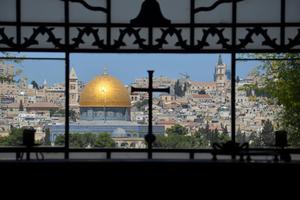
While the Vatican earlier floated the suggestion that Jerusalem should be an international city, with no one nation ruling it, that hope has proved untenable. Israel considers all of Jerusalem its capital, and the Palestinians are demanding sovereignty over the eastern half of the city.
The Vatican now favors a negotiated settlement between Israelis and Palestinians that would provide international guarantees from both governments that the holy places will be protected and accessible to all worshippers.
Father Abusahlia said that the local Catholic Church welcomes Palestinian rule over holy sites in the West Bank, Gaza and East Jerusalem.
“As Christians we are part of the Palestinian people, and so we have no problems with Palestinian sovereignty over all the holy places,” he said.
Not all Holy Land Christians agree, however. Dave Parsons, information officer of the International Christian Embassy, an organization that represents evangelical Christians from around the world, said he was appalled by the notion of Palestinian control of sacred sites.
“If it were up to us, there would be a recognition that Israel is the proper custodian of the holy sites. Israel has an excellent record regarding protection and providing access. I don't want to see any Palestinian rule over any part of Jerusalem,” Parsons said.
Parsons cited several “incidents of harassment” of Christian pilgrims by Palestinian policemen in the West Bank town of Bethlehem, which is under Palestinian control.
“It's scary,” he said. “We don't want to have to pass Palestinian police to get to the Temple Mount or Gethsemane.”
Added Parsons, “Some of these police have trained in terror camps in Iraq and Libya and there's a lot of apprehension among Christian tourists going into Palestinian-ruled areas. The problem isn't getting through Israeli checkpoints, it's being in the midst of a hostile Muslim population.”
Pope's Plea
At the end of his March 3 Angelus address to pilgrims, delivered at the height of the weekend wave of violence in the Holy Land, Pope John Paul II called for an “immediate” cease-fire between Israelis and Palestinians.
The Pope said he was “profoundly saddened” by the latest news from Jerusalem, and asked the faithful to join him in prayer for this intention.
“Violence, death and reprisals cannot but push the civilian populations, whether Israeli or Palestinian, toward despair and hatred,” the Holy Father said. “May an immediate cease-fire, together with a renewed sense of humanity, in respect of international laws, silence the arms and make the voice of reason be heard!”
Michele Chabin writes from Jerusalem.
- Keywords:
- March 10-16, 2002