New Cardinal, New Responsibilities
Donald Wuerl of Washington hopes his new role will 'provide me a bigger pulpit ... to proclaim the Gospel, to teach, to pass on the faith and apply the Gospel message to the issues of the day.'
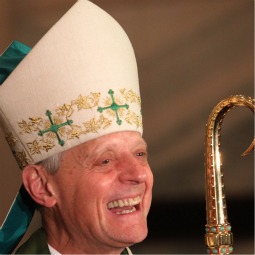
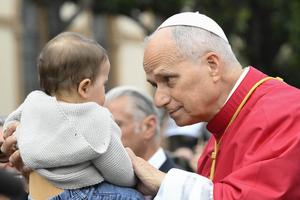
VATICAN CITY (CNS) — Just after the final fitting of his new red robes, Cardinal-designate Donald Wuerl of Washington said his new clothes are a sign of new responsibilities.
“When a married couple exchange rings, it’s to say things are different now. When a priest puts on a Roman collar, it’s to say things are different now. And when a cardinal receives that red hat, it says things are different,” he said Nov. 17.
“All of those examples speak to joy and responsibility,” he told Catholic News Service just three days before Pope Benedict XVI was to induct him into the College of Cardinals.
As a cardinal, he will become a member of the clergy of Rome and be assigned a titular church in the city. He also likely will be named a member of several Vatican councils or congregations.
His responsibilities as archbishop of Washington will not change, but he said he hoped being a cardinal would “provide me a bigger pulpit, a larger platform on which to stand” when fulfilling his role as a bishop, which is “to proclaim the Gospel, to teach, to pass on the faith and apply the Gospel message to the issues of the day.”
“I think now, with the red hat, there may be those who would be persuaded to listen more carefully,” he said.
Cardinal-designate Wuerl said he is concerned about the tensions among Catholics, including serious disagreements related to political issues and the challenge of encouraging Catholic politicians and voters to allow their decisions to be informed by Gospel values.
“One of the things we simply have to keep reminding ourselves is that Jesus established his Church, I believe, to follow his style of teaching, which was to convince, persuade, teach and then repeat again the teaching in the hope that you would persuade. I’ve always found in doing that, you get a wider hearing,” he said.
“If you are prepared to reason with people and explain your position, you have a far better chance of winning them over to that position,” he added.
He said Pope Benedict demonstrated how effective reason and persuasion can be during his 2008 visit to the United States.
The Pope pointed out the barriers to the Gospel in U.S. society and called Catholics to step up their witness and coherency, “but he never did it by scolding. He did it by encouraging.”
Cardinal-designate Wuerl added, “I do wish we didn’t have as much polarization” within the U.S. Catholic community.
But he also said, “I think right now we are on the verge of something very exciting” with “a whole generation coming along who are looking for spiritual values. They are looking for some connectedness to the transcendent, to God. We have an opportunity now to invite them into the experience of the Church.”
When a society is struggling to define the values it considers important, he said, “the more united we are in our witness to Christ and his Gospel, the more effective our witness is. And when we’re fretting among ourselves over things that are not essential to the faith, we weaken our witness.”
Although he would not officially become a cardinal until Nov. 20, he was invited to participate in Pope Benedict’s meeting Nov. 19 with the College of Cardinals. Some commentators have expressed surprise that the Church’s response to clerical sex-abuse is only one of six topics on the agenda.
“The list touches a whole range of issues the Church is dealing with and confronting today,” the cardinal-designate said.
The Vatican said the topics would include religious freedom; liturgy in the life of the Church; a discussion on the 10th anniversary of Dominus Iesus, a Vatican document emphasizing Church teaching that salvation comes through Christ alone; the Catholic Church’s response to the sex-abuse crisis; and progress in implementing Pope Benedict’s provisions for Anglicans seeking full communion with the Roman Catholic Church.
Cardinal-designate Wuerl said the discussion about religious freedom is particularly important, not only because Christians face violence in places like Iraq, but also because of threats in increasingly secular societies like the United States, “where faith-based organizations are told they can’t carry out their activities according to their own conscience.”
In March, after the District of Columbia began issuing marriage licenses to same-sex couples, Catholic Charities of the Archdiocese of Washington felt forced to hand off its adoption and foster-care services to another agency, and it announced that spousal insurance benefits would no longer be provided to new employees or to current employees who want to add a spouse to their coverage.
When the cardinals discuss the Church’s response to clerical sex abuse, the cardinal-designate said, he hopes one of the things they will hear is an encouragement to duplicate norms like those in the United States, which appear to be effective in preventing new cases and protecting children.