Leo XIV and the Legacy of Europe’s Great Churches
ANALYSIS: Beginning with Spain, the Pope signals his priorities with visits to important sacred sites to European Catholicism.
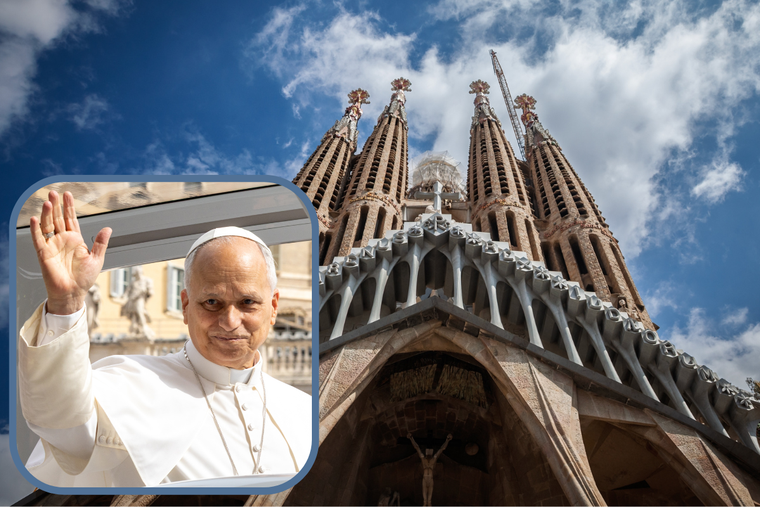
Leo XIV’s upcoming trip to Spain will center on the blessing of the Tower of Jesus Christ of the Sagrada Família, the extraordinary church in Barcelona designed by the brilliant 19th-century architect Andoni Gaudí, whose cause for beatification is underway. And this blessing perhaps most characterizes the first major European journey of Leo’s pontificate.
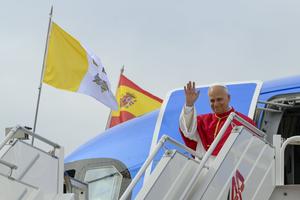
The Pope will be in Spain June 6-12 for a series of highly significant events. For the first time in history, the Pope will address the Spanish Cortes, i.e., the Chamber of Deputies and the Senate, in a joint session. Then, the Pope will visit two refugee centers in the Canary Islands, where the plight of refugees is palpable. But the heart of it all, the main reason for the trip, is the blessing of the great tower of the Sagrada Família on June 10, which also marks the centenary of Gaudí’s death.
With his visit to Sagrada Família, Leo XIV inaugurates a trip to a trio of European churches. The bishops of France have already announced that the Pope is planning a trip to the nation considered the “eldest daughter of the Church,” with stops in Paris and Lourdes. The French bishops did not include on the Pope’s itinerary a visit to Strasbourg to address the European Parliament, to which he has received repeated invitations. Indeed, it was precisely this invitation to Strasbourg that led the Pope to decide to make a more extensive trip to France, according to various parliamentary sources. The Vatican confirmed the Pope will travel to France on May 16.
When Leo XIV made his first European trip to Monaco earlier this year, he traveled by helicopter, thus avoiding passing through French territory and subsequently bypassing an official meeting with authorities in Paris. Likewise, Leo could not have made a trip to Strasbourg to visit the European Parliament at the exclusion of the cathedral, as Pope Francis did in 2014, when he landed in the French territory without visiting the rest of the country, or in 2024, when he went to Corsica and didn’t pass through its capital, as is customary.
This trip to France will likely include two highly significant stops: first, a visit to Paris’ Notre Dame Cathedral, which reopened on Dec. 7-8, 2024, following the 2019 fire in an emotional ceremony that Pope Francis did not attend; he convened his last consistory that Dec. 7.
Leo XIV will almost certainly visit another Notre Dame Cathedral, too — the one in Strasbourg. In 2014, the Gothic-style cathedral — celebrated as a symbol of the crossroads of Europe — celebrated its millennial anniversary, but Pope Francis did not mark the occasion, opting instead to skip the religious site and focus his visit on the European Parliament and the Council of Europe.
Following Barcelona’s Sagrada Familia, Paris and Strasbourg will thus likely round out the trio of apostolic visits to important sites of Catholic Europe.
Built by a ‘Monk in the City’
Barcelona’s Sagrada Família, although not a cathedral, has the weight and solemnity of one. A succession of builders followed the death of its brilliant original architect, as was the case for many medieval cathedrals, whose construction dragged on for generations, often leaving the names of their early builders forgotten.
From the first stone laid in 1882 to today, Gaudí’s design has remained intact. Living as a monk in the city, he developed a liturgical plan.
Sagrada Família is built in the center of a cloister and conceived as a sacred place within a garden (the earthly paradise) where God and man can speak face-to-face. The cloister is not inside, but around it. And outside the cloister is an urban “desert.”
For Gaudí, even Barcelona was deserted. As he grew older, he truly became a monk in the city, living a life of simplicity in a small house near the construction site. But every day, as Sagrada Família grew in its construction, he showed his city that the new creation had already begun, that the “desert” was beginning to bloom.
Just seeing the church from a distance gives a strong sense of the sacred. This was Gaudí's intention. The bell towers are the most striking exterior feature.
There are four such towers on each of the two side facades. The intention is for there to be 18 in total: four more on the main facade and five more above the central crossing, with the highest dedicated to Christ and the others to the evangelists; and, finally, one above the apse, dedicated to the Virgin Mary. Carved on each tower are the words Sanctus and (towards the top) Hosanna in excelsis — “Hosannah in the highest” — the words that introduce the great Eucharistic Prayer, the liturgy of the earthly and heavenly Church that is celebrated in every Mass.
Every detail has meaning in Sagrada Família. The church is oriented on a north-south axis, but there are two lateral facades: the eastern one dedicated to the Nativity and the western one to the Passion, which, interpreted together, present the church as a passageway: While the sun that is Christ passes through Sagrada Família from east to west, from birth to redemptive death, the city of men — starting with Barcelona, located mainly to the west of the basilica — is called to make the reverse journey, from death to new birth.
With the choice to visit these religious sites, is Pope Leo signaling a path forward for Christian Europe? Leo XIV will likely draw on this symbolism to outline his message to Europe. And then, by visiting the Notre Dame Cathedrals of Paris and Strasbourg, he will further define his European vision, which he has already outlined in various meetings with institutional representatives and European parliamentary groups.
The Council of the Bishops’ Conference of Europe (CCEE), comprised of all the episcopal conference presidents of the European Union, noted, “In this first year of his pontificate, Pope Leo XIV did not view Europe as a simple institutional construct; rather, he described it as a historical subject with a global responsibility, a community of peoples called to rediscover the meaning of its vocation to peace, to defend human dignity, and to promote dialogue.”
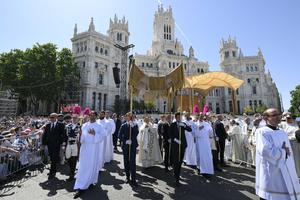
In this sense, the papal trip to Spain is filled with meaning. The itinerary includes a Corpus Christi procession in Madrid, while his speech to the Cortes joint session will be delivered on June 8. The previous day, the Pope will address the “Weaving Networks with the Worlds of Culture, Art, and Sport” event.
The trip to Spain, however, also honors the legacy of Pope Francis. The former pontiff had planned to visit the Canary Islands, characterized by migrant reception centers, perhaps as a stop on a journey to his native country of Argentina that he never made. Leo XIV will visit the migrant reception center in the Port of Arguineguín on June 11 and meet with migrants at the Las Raíces center on June 12.
Ultimately, the trip stands out as an example of how Leo XIV is defining his pontificate. The Pope is integrating hallmarks of his predecessor with his own perspective, introducing nuanced changes in his travels that reflect a different focus.
What matters most for Leo XIV, however, is that the message to Europe passes through his homage to the legacy of these sacred churches, beginning with the blessing of the monumental Tower of Jesus Christ at Sagrada Família.
- Keywords:
- papal travels
- catholic europe