Cardinal Cupich’s Ever-Expanding ‘Coaching Tree’
The cardinal-archbishop of Chicago has profoundly reshaped the American hierarchy over the past 10 years and is poised to exert a lasting influence.
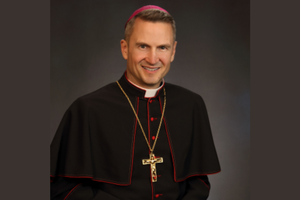
At an upcoming Mass in Manhattan, Bishop Ronald Hicks will become the 11th archbishop of New York. But during the Feb. 6 installation in St. Patrick’s Cathedral, the Chicago native will also be the latest addition to another sort of lineage.
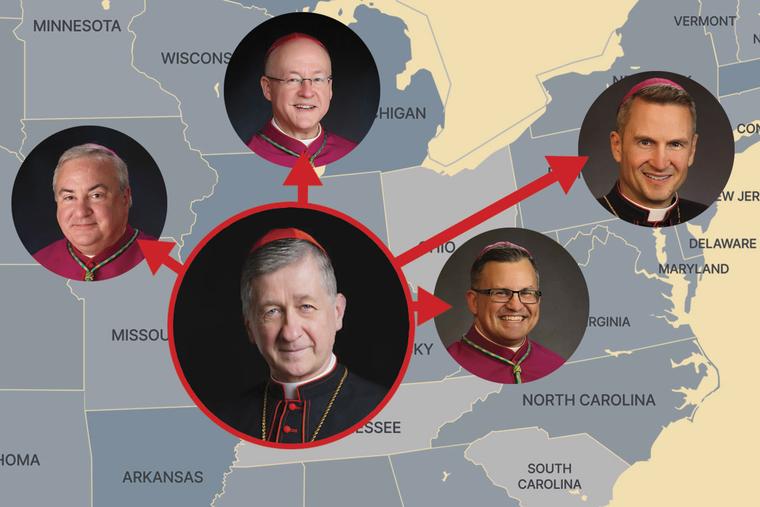
Archbishop-designate Hicks is set to become the fourth former deputy of Chicago’s Cardinal Blase Cupich to be named to a major American see in just the past 13 months.
The three other prelates who fit the bill are Archbishop Jeffrey Grob of Milwaukee, Archbishop Michael McGovern of Omaha, and Archbishop Robert Casey of Cincinnati, each of whom was installed as an archbishop in 2025.
Along with Archbishop-designate Hicks, Cardinal Cupich promoted each to a key archdiocesan-wide position after his 2015 arrival in Chicago, like vicar general and chancellor; all but Archbishop McGovern went on to serve as one of his auxiliary bishops. And once the New York installation is complete, the four will account for more than 12% of all U.S. Latin Rite archbishops, the upper echelon of Church leadership in the country.
The significant number of new archbishops who have worked under and been elevated by Cardinal Cupich, a longtime member of the Vatican’s Dicastery for Bishops and one of the most progressive prelates in the country, underscores the considerable influence the Chicago cardinal has exerted on the U.S. episcopal landscape over the past decade.
“Cardinal Cupich has been very eager to take his role at the dicastery seriously, and we’re seeing the fruits of that,” said Michael Heinlein, a Catholic commentator and biographer of Cardinal Cupich’s predecessor in Chicago, the late Cardinal Francis George.
What’s more, the sizable and significant “coaching tree,” or episcopal network, which has formed around Cardinal Cupich, doesn’t just secure the 76-year-old prelate’s legacy as one of the most important American Churchmen of his generation. It also raises questions about how his influence will endure in the American hierarchy even after his active ministry ends.
In addition to Cardinal Cupich’s decade-long membership in the Dicastery for Bishops, which vets potential bishops and makes recommendations to the pope, his influence has been aided by his reportedly close rapport with the late Pope Francis. The Argentinian Pontiff saw the Chicago prelate as his “eyes and ears” in the United States and elevated him early on in his pontificate.
The relationship allowed Cardinal Cupich to influence appointments beyond those involving his former subordinates, such as Cardinal Robert McElroy’s placement in the Archdiocese of Washington after a Cardinal Cupich-led lobbying effort.
Cardinal Cupich’s influence has also come through in the sizable number of auxiliary bishops appointed to Chicago during his time there.
Since he became a member of the Dicastery for Bishops in 2016, the archdiocese has had bumper crops in 2018, 2020 and 2025, totaling 11 new auxiliary bishop appointments. By comparison, the Archdioceses of Los Angeles and New York combined have had only 10 new auxiliary bishops named during this same stretch.
The phenomenon provided a moment of levity at this past November’s U.S. bishops meeting in Baltimore, when the gathered bishops began to laugh as five Chicago auxiliaries in a row were named during the introduction of new bishops. The Windy City auxiliaries accounted for nearly 50% of the 13 new bishops introduced at the meeting.
The Vatican has drawn heavily from Cardinal Cupich’s auxiliary bishops when looking to fill diocesan vacancies. But some Chicago clerics, such as the Diocese of Peoria’s Bishop Louis Tylka, have also made the jump straight to diocesan leadership. Bishop Tylka was named to the Illinois diocese in 2020, after having served as the Cardinal Cupich-appointed chair of Chicago’s archdiocesan priest council since 2015.
Episcopal Networks
Church watchers told the Register that when it comes to playing “kingmaker” in U.S. episcopal appointments, Cardinal Cupich has no present-day peer. His episcopal network is more expansive and includes more prominent postings than any other currently serving American ordinary.
“There’s really nothing comparable to it right now,” said Jayd Henricks, a former staffer at the U.S. Conference of Catholic Bishops who now leads a Catholic apostolate.
But historically, episcopal networks like Cardinal Cupich’s are par for the course.
In the United States, some of the most significant networks have centered on figures like Cardinal Justin Rigali, a longtime archbishop of both St. Louis and Philadelphia, who had served as secretary of the then Congregation for Bishops in Rome for a decade before becoming a U.S. ordinary.
Cardinal Francis Spellman of New York was also known as a major patron, as George Marlin and Brad Miner detailed in their book on the Big Apple’s archbishops, Sons of Saint Patrick.
“Priests who were loyal and competent, known as ‘Spelly’s Boys,’ were promoted, and many became ordinaries throughout the nation,” they wrote, mentioning 15 such figures, including seven archbishops.
In their 2022 article, “Power, Preferment, and Patronage: An Explanatory Study of Catholic Bishops and Social Networks,” the Catholic social scientists Stephen Bullivant and Giovanni Sadewo explored why “episcopal networks” form and how they function.
The pair explained that, given both the priest-bishop relationship of obedience as well as the relational dynamics of the bishop selection process, certain influential prelates exercise significant, disproportionate clout in advancing preferred candidates to the ranks of the episcopate. Not only do these bishops “employ the hope or even promise of preferment as a means of incentivizing or rewarding loyalty,” but they also tend to advance “certain ‘types’” of priests with whom they share specific qualities, from ethnic background to theological vision, class status to personality.
As a result, the episcopacy is marked by “identifiable ‘factions’ or ‘cliques’ of bishops, bound by mutual bonds of preferment and favor, and who act, formally or informally, in concert, and who each support and promote each other’s protégés.”
Bullivant and Sadewo highlighted possible concerns of this dynamic, from cronyism to cover-ups of crimes to clandestine homosexual activity. The most alarming such case featured former cardinal Theodore McCarrick, who created a network of preferment and mutual complicity that shielded him from being held accountable for grievous acts of sexual abuse until his 2018 fall from grace.
At the same time, Bullivant and Sadewo stressed that belonging to an “episcopal network” doesn’t necessarily say anything about whether a bishop is a good one or not, as the dynamic is ubiquitous among the hierarchy.
“Saintly and heroic bishops are … just as much a ‘product’ of networks as are defrocked former bishops,” wrote the scholars.
Imitators or Independent?
But what can be said about the new archbishops who worked under Cardinal Cupich? Given Cardinal Cupich’s reputation as a progressive prelate, well-known for everything from challenging the USCCB’s prioritization of abortion over other social issues to restricting more traditional devotions, many have naturally questioned whether these men share the same commitments.
Not necessarily, according to one local Catholic leader who has worked with each of them. According to the source, who requested anonymity in order to speak candidly, most of the archbishops elevated by Cardinal Cupich “are more conservative” on various social and ecclesial issues than the cardinal-archbishop.
In particular, the source cited Archbishops Grob and McGovern’s long-standing and passionate support for pregnancy centers as a contrast from Cardinal Cupich. The local Catholic leader also pointed to Bishop Hicks’ enthusiastic embrace of the National Eucharistic Revival as a distinguishing factor and said that New York’s archbishop-designate is looking to “put his own stamp on things.”
Rather than preferring episcopal candidates who see eye to eye with him on every social and ecclesial issue, the source said Cardinal Cupich looks for something else in those he advances.
“He likes guys who keep the trains running on time,” said the local Catholic leader, referring to clerics who are competent administrators.
Henricks suggested that part of the reason Cardinal Cupich’s picks might not all share his theological and pastoral emphases is because the cardinal is “sui generis,” meaning that there aren’t other candidates for major U.S. appointments who are of the same ideological mold.
And, of course, many of these archbishops had already been identified as leadership candidates before Cardinal Cupich arrived in Chicago. Under the more conservative Cardinal George, for instance, Archbishop-designate Hicks was tapped as dean of formation at Mundelein Seminary, Archbishop Grob was sent to get his doctorate in canon law, and Archbishop McGovern served as vice chancellor.
At the same time, this doesn’t mean that theological and pastoral concerns don’t come into play for Cardinal Cupich when he chooses whether to support a cleric or not.
In particular, the source in Chicago said the cardinal vetoes so-called “culture warriors,” a derogatory term used to describe those who take public stands against progressive-backed departures from Christian morality in wider society and generate “negative press” for the Church. For instance, the “minor exorcism” performed by Springfield’s Bishop Thomas Paprocki in 2013 in response to Illinois legalizing so-called “gay marriage” was highlighted as the kind of action that “is not looked upon favorably” by Cardinal Cupich and would get a candidate blocked from advancement.
“He likes men who, by and large, keep their head down,” the source said. “People who are going to lead the Church, administer the sacraments, evangelize, but not who the media is going to rush to for quotes. They’ll respond to things, but they don’t make them a big issue.”
Heinlein made a similar observation about what the four Cardinal Cupich-approved archbishops have in common.
“I don’t think it’s ideological to say they’re not figures who are eager to promote division,” he said.
Influence Going Forward
Undoubtedly, Cardinal Cupich has played an outsized role in shaping the present-day American hierarchy, a reality that will come into even clearer focus when his former vicar general becomes the archbishop of New York.
But his expansive network also suggests that the cardinal, who is set to turn 77 in March, will continue to influence U.S. ecclesial affairs for the near future, even if Pope Leo XIV soon accepts the mandatory letter of resignation Cardinal Cupich submitted when he turned 75.
For starters, Bullivant and Sadewo both noted how ascending clerics tend to rely upon their episcopal patron for an education in “bishopcraft,” given that there are so few men who have actual experience governing a diocese.
The source in Chicago expects that kind of relationship to continue between Cardinal Cupich and Archbishop-designate Hicks, even after the latter arrives in the Big Apple.
“I wouldn’t be surprised if he was on the phone all the time asking Cardinal Cupich, ‘What would you do?’” regarding administrative challenges in New York, the source said, from personnel issues to parish closures.
The ongoing connection Cardinal Cupich is likely to maintain with his former deputies could be significant if he intends to try to influence American ecclesial affairs from retirement.
For instance, the cardinal could continue his long-standing push for the USCCB to no longer describe opposition to abortion as a “preeminent priority” in election-year guidance. Notably, all of the former Cardinal Cupich deputies mentioned in this article signed a 2021 letter co-authored by the cardinal that called for the bishops’ conference to suspend discussion on barring pro-abortion politicians from the Eucharist.
“He’s big on getting consensus, particularly if it’s his initiative,” noted Heinlein.
A proactive second act for an aged-out cardinal wouldn’t be unprecedented. Before his fall from grace, McCarrick played the role of “kingmaker” for years after his 2006 retirement. Rocco Palmo reported that Pope Francis considered the former cardinal-archbishop of Washington to be “a hero” of his, and McCarrick reportedly influenced the appointments of Cardinal Joseph Tobin to Newark and even Cardinal Cupich himself.
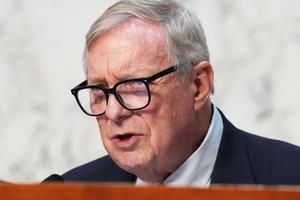
The presence of members of Cardinal Cupich’s network in the hierarchy could also help to protect the cardinal’s name and legacy. One instance of this kind of dynamic may have already been on display, when Archbishop Grob demurred when asked to weigh in on Cardinal Cupich’s controversial decision to give an archdiocesan award to Sen. Dick Durbin, a proponent of abortion rights. Durbin ultimately declined the award following the backlash.
The anonymous Catholic leader in Chicago said that Cardinal Cupich’s active promotion of men he knows and trusts is just “good common sense.”
“You’re helping place a good person for the job, but because you helped them get there, they’re probably going to take your call and be receptive because you have that familiarity.”
“It’s good to have friends in places all over,” the source added.
And no other currently serving American ordinary has helped put more friends in high places than Cardinal Cupich.
- Keywords:
- cardinal cupich
- american catholicism